


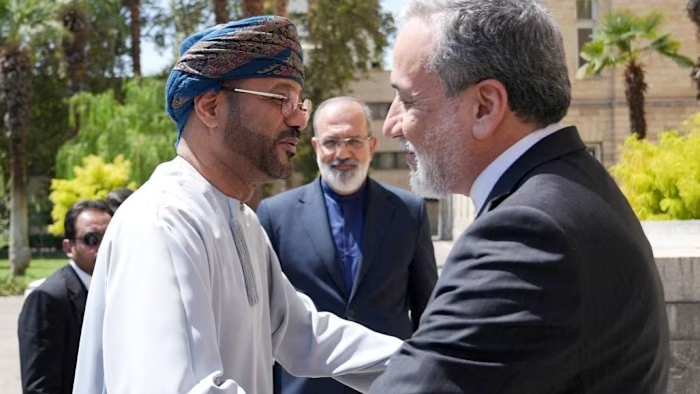
Iran and Oman have edged towards an interim agreement on managing shipping through the Strait of Hormuz, the first hint of diplomatic progress in weeks as mediators seek to defuse the battle over the strategic waterway.
In a joint statement, Tehran and Muscat said they had discussed a “proposed framework” to establish a temporary corridor for ships to move through the strait and to implement a project to demine the waterway.
“Technical negotiations between the two sides would continue with a view to agreeing on a permanent navigational corridor and future administration of the strait, as well as a mechanism for information sharing, traffic management and the provision of relevant navigational and security services,” the statement added.
Omani foreign minister Sayyid Badr Albusaidi, who was in Tehran on Tuesday, said he was “hopeful we will soon announce a temporary corridor for the Strait of Hormuz and practical arrangements to restore safe navigation”.
Iranian officials have repeatedly said that a deal with Oman would not mean Tehran would immediately allow the free flow of traffic through the waterway, insisting that the US would first have to meet its conditions. This includes lifting a naval blockade on Iranian ports and reinstating a waiver to allow Iran to sell oil.
Iran and Oman, whose waters also flow through the strait, have been holding talks on a provisional arrangement to manage shipping through the waterway since a June memorandum of understanding agreed between Washington and Tehran collapsed last month.
Diplomats hope a deal between Tehran and Muscat will create a path for the US and Iran to return to the MoU.
Under that deal, the US and Iran agreed to extend an April ceasefire and gradually allow shipping through the strait to return to its prewar levels without paying fees while they held talks on a final settlement to end the conflict between the two countries. However, the MoU began unravelling about two weeks after it was signed.
Iran had previously said it was in the final stages of a deal with Oman regarding the strait three weeks ago.
The latest signs of diplomatic progress between Iran and Oman come a day after Washington announced that it was initiating a campaign to expand secondary sanctions on Iran as US President Donald Trump attempts to further isolate the Islamic republic and intensify the pressure on its beleaguered economy.
No timeline was set for Iran’s trading partners to comply with Washington’s warning to cut financial and commercial ties with the republic, but it underlined Trump’s increasing frustration with the US’s inability to force Tehran to fully reopen the strait and return to the negotiating table.
Diplomatic efforts to persuade the warring parties to resume talks have continued as Trump has sought to raise the stakes.
A day before Albusaidi was in Tehran for talks with his Iranian counterparts, Pakistan’s military chief Asim Munir, who has also been involved in the mediation efforts, was in the Iranian capital.
Iran’s Tasnim news agency, which is affiliated with the Revolutionary Guards, said Tehran’s conditions regarding the strait were conveyed to the US through Pakistan.
Gregory Brew, a senior analyst at the consulting firm Eurasia Group, said the joint Iranian-Omani statement indicated that despite Trump signalling that he was comfortable with “a long stand-off without any resolution, there’s clearly pressure within the region to clarify the situation in the strait”.
“And that what the US is touting as success at shuttling oil through the strait is a band-aid, not a permanent solution,” he added. “There’s still likely interest on the US side in a negotiated settlement to this crisis and that perpetual stand-off is not a sustainable status quo.”
However, analysts also caution that Trump’s stance may have hardened in recent weeks and that he is no longer willing to return to the June MoU.
“There is this belief that the Iranians are weaker and the US position is stronger,” Brew said. “It may also simply be that Trump has decided the deal he reached in June he doesn’t like any more. He has a long history of going back on prior agreements.”
After the MoU between the US and Iran was agreed in June, Trump ordered the lifting of the naval blockade and issued a waiver that allowed Tehran to export oil.
But it began unravelling when the US encouraged ships to transit the strait through a so-called southern route that traces Oman’s coastline. Iran said the vessels were using an “unauthorised” route and began firing at ships as both sides accused each other of violating the MoU.
That set off a cycle of escalatory tit-for-tat strikes between the US and Iran, and caused Trump to reimpose the naval blockade and revoke the oil waiver. There have, however, been no significant attacks since the US paused strikes in late July.
On August 5, Iran said it had agreed with Oman on the geographical coordinates of a temporary corridor for ships to transit the Strait of Hormuz and was in the final stages of drafting an agreement.
Under that arrangement, ships would have entered the strait through Iranian waters and would exit mostly through Omani waters, according to people briefed on the talks.
That would be in place during a ceasefire extension, with Iran supposed to discuss the future status of the strait with Oman and other Gulf states.
However, the diplomatic process stalled as Oman worried that it was being bullied into ceding its sovereignty in regard to the waters, as Iran has sought to assert its control over the strait and it and the US shifted its position.
Last week, Trump threatened to bomb Oman if “gets in the way” of Washington’s efforts to strike a deal with Iran to reopen the strait, Fox News reported.
