


Unlock the Editor’s Digest for free
Roula Khalaf, Editor of the FT, selects her favourite stories in this weekly newsletter.
The writer is an FT contributing editor and director of economic policy studies at the American Enterprise Institute
Economic liberalism is not in vogue, to put it mildly. In the US, the energy in the Democratic Party lies with self-described democratic socialists who are critical of free markets. On the right, vice-president JD Vance argues that economic growth is overrated, economic science might be “fake,” and the bipartisan liberal consensus on economic policy has “failed” for the last four decades.
Critics argue that liberalism has not delivered broad-based prosperity — an attack that can be convincingly defended against with statistics and quantitative analysis. But their critique goes further, asserting that liberalism is morally corrosive. This, too, is off base.
For one, economic liberty is intrinsically valuable. Also, the free enterprise system pushes against the problematic tendency in American life to see people less as individuals and more as members of a group. The system is premised on the idea that society should accept the preferences, knowledge and decisions of individuals and families.
This system argues that the welfare of society should be measured not by hazy perceptions of national greatness or by progress towards objectives set by elites, but instead by how well off individuals and families are — in their capacity as individuals and families.
Work is itself of great moral value. It offers a sense of identity and purpose, directs our energy and time to productive ends, and allows us to provide for our families. It offers spiritual benefits, as well, because it is inherently creative. Pope John Paul II argued that in carrying out the biblical mandate “to subdue, to dominate, the earth”, every person “reflects the very action of the Creator of the universe”.
In a market economy, worker compensation is largely determined by productivity. Because effort is rewarded, individuals come to exercise personal responsibility for, and agency over, their outcomes.
Free markets facilitate growing economies, which in turn facilitate important virtues. In a growing economy, you can do better without others doing worse. This dynamic fosters tolerance, pluralism and support for political liberty and self-government.
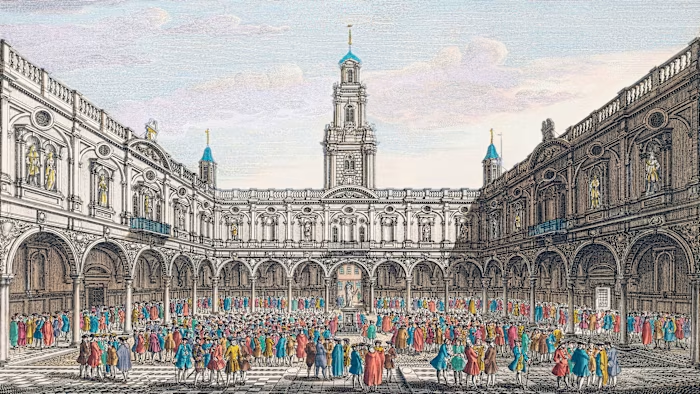
Market exchange requires voluntary co-operation, which in turn leads society as a whole to be more co-operative. As Voltaire marvelled in the 18th century of the Royal Exchange in London, Jews, Muslims and Christians “transact together, as though they all professed the same religion, and give the name of infidel to none but bankrupts”.
Commercial transactions create a sense of mutual dignity among citizens. The millionaire and the shopkeeper may have very different financial net worth, but they look each other eye to eye and shake hands, each needing something from the other.
Still, there is something to the anti-liberal critique. Slapping a price tag on some things can change their character by turning them into commodities. A market society does encourage consumerism and materialism. It can lead to a reductive understanding of the good life by elevating commercial activity above cultivating relationships, caring for family and enjoying leisure.
Its emphasis on individual preferences can make society morally thin by focusing so much attention on what people want and so little on debating what people should want. The focus that economic liberalism places on individual autonomy can lead some to forget the duties we have to each other, can sever connections to home and community and can make people feel isolated.
But none of this argues for curtailing economic liberty in the way suggested by democratic socialists or some Maga Republicans. A major flaw in their critiques is that they too often let individuals off the hook.
People are not puppets responding to the string pulls of market forces. We have agency. The market may value my taking a consulting project over spending time with my family, for example. But that doesn’t mean I have to take the project — the choice is mine to make.
Liberalism gives pride of place to liberty. But liberty is not the same as licence. To let your passions — or market incentives — determine your choices is to be enslaved. Instead, liberty must be ordered to notions of truth, human flourishing and the good life. As John Paul II argued, “freedom itself needs to be set free.” Free markets require a virtuous citizenry to prevent society from decomposing.
The challenge for liberals is to live liberty well. The anti-liberals have it exactly backwards: the problems facing a market society do not come primarily from markets — they come from society.
