


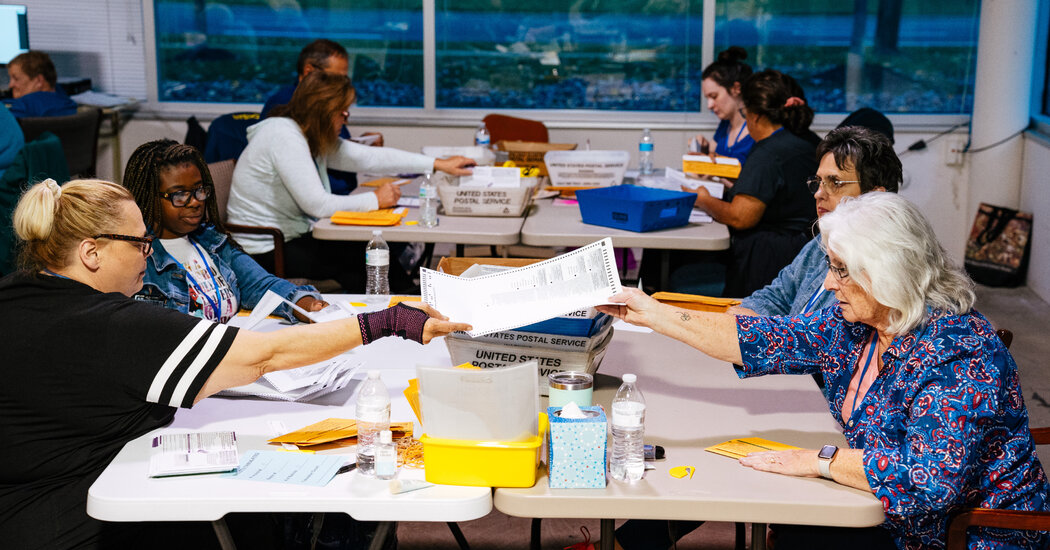
A divided Supreme Court on Monday allowed the Trump administration to move forward with plans to restrict mail-in voting before the midterm elections.
In an emergency opinion, the justices said President Trump could proceed with implementing an executive order he had signed, which directed the U.S. Postal Service to help decide which voters should receive mail-in ballots. Under the executive order, the Department of Homeland Security will also create lists of U.S. citizens that the administration believes could be used to monitor voter rolls for noncitizens.
The decision means the administration can move ahead with planning for restricting the use of mail ballots even as a lower court continues to weigh the legality of Mr. Trump’s executive order. But with a little more than two months until Election Day — and considerably less time before early voting begins in many states — it remains unclear whether the White House’s rules will be in effect for a midterm election in which control of both chambers is at stake. Additional legal action is a near certainty with the plan’s fate not yet final.
A separate injunction by the same lower court complicates matters. That court action prevents the postal service from implementing some parts of the executive order. That case could also soon be headed to the justices.
Monday’s order from the Supreme Court was unsigned, as is typical in such emergency rulings. The majority wrote that it agreed with the government’s argument that it should be able to move forward with its plans, finding that the Trump administration was “likely to suffer irreparable harm” unless the justices lifted a freeze that had been imposed by lower courts.
The three liberal justices dissented, with Justice Ketanji Brown Jackson warning that the majority “needlessly injects chaos and uncertainty into the upcoming midterm elections.”
The majority said the states that challenged the president’s order could not demonstrate that they were sufficiently harmed by voting rules that had not yet taken effect. The justices cautioned that their order was preliminary and not a final decision about whether the administration’s order “will necessarily be lawful” once the plans are complete. “On that score, time will tell,” the majority said in the 10-page, unsigned order.
The Supreme Court’s conservative majority has been receptive to some, but not all, of the administration’s broad claims of executive power. In this case, the majority said that the provision of Mr. Trump’s order that required creating lists of U.S. citizens was “an internal directive from the president to a subordinate” and so far imposed no obligations on the states.
Meanwhile, the high court’s order landed just one business day after the Postal Service published final regulations on Friday clarifying how it would carry out the president’s executive order. The Postal Service said in its rule that it would “not take actions to implement the rule specifically for the 2026 election” unless the Supreme Court ruled in the administration’s favor.
A spokesperson for the Postal Service declined to comment, citing the pending lawsuits.
New York Attorney General Letitia James called the ruling a “painful setback,” but predicted it would not be the final word from the court.
Got a news tip about the courts? If you have information to share about the Supreme Court or other federal courts, please contact us.
“The right to vote is sacred, and no administration should be allowed to put that right in jeopardy by making it harder for eligible voters to cast their ballots,” she said in a statement. “This fight is far from over. We are exploring our legal options.”
In a social media post, Pennsylvania Gov. Josh Shapiro said the court’s decision did not deal with the substance of Mr. Trump’s executive order, asserting that the ruling “does not mean his illegal attempt to restrict mail-in voting will go forward.”
“Donald Trump does not run elections here in Pennsylvania — or in any state,” he added. “We’ll see the Trump Administration in court.”The legal team representing voting rights organizations in the separate challenge to the president’s executive order said in a statement that they were “disappointed by this interim ruling by the Supreme Court,” but would press on with their efforts to block the order.
The team, which includes the American Civil Liberties Union, called the president’s order an “attempt to seize control of election rules from the states and Congress” that was “clearly unconstitutional and unlawful.” They added that they would “continue to vigorously pursue all available avenues to challenge this executive order.”
Mr. Trump signed the executive order in March as part of his broader attempts to curtail voting by mail. It directed federal agencies to create “state citizenship lists” of people who will be 18 or older as of Election Day. Federal officials were then directed to send those names to state election officials, who administer the vote, purportedly so they could use them to purge voter registration lists of anyone who is not a citizen. The order also instructed the Postal Service not to mail ballots on behalf of anyone whose name was not on the approved list.
Several court challenges immediately followed, including a lawsuit in federal court in Massachusetts brought by Democratic state attorneys general. The challengers argued that the president exceeded his authority because the Constitution gives Congress and the states power over elections, not the executive.
In late June, Judge Indira Talwani, a Federal District Court judge in Massachusetts, temporarily blocked the president’s order, finding that it violated the Constitution’s separation of powers. She also determined that Congress had not delegated authority to the Postal Service to determine which voters should receive mail ballots, and that the executive order did not allow enough time before November for the Postal Service to follow the legally required process for agencies when they adopt new rules.
Judge Talwani issued a separate broader ruling in a related case this month, blocking any enforcement of the executive order for the 2026 midterms. She again emphasized that the Constitution does not grant authority over elections to the executive branch. She also noted that, contrary to Mr. Trump’s claims of widespread voter fraud, the government had not provided “evidentiary support of illegal or fraudulent absentee voting.”
A federal appeals court earlier upheld Judge Talwani’s temporary block. At that point, Trump administration lawyers filed an emergency application asking the justices to step in. Several Republican state attorneys general filed a separate, parallel request.
In a brief to the court, the Democratic state attorneys general wrote that the executive order “would allow the federal government to rush out an unprecedented, legally indefensible voter-verification and ballot-interception program that would, among other things, give the U.S. Postal Service far-reaching new powers and responsibilities.”
They also argued that allowing the order to be implemented would mean a chaotic rollout not long before states begin to send out absentee ballots.
And they wrote that voters could be confused and disenfranchised, given that the federal government was likely to make errors in compiling citizen lists and that valid voters would have little time to challenge the government’s determinations.
Chris Cameron and Adam Sella contributed reporting.
