


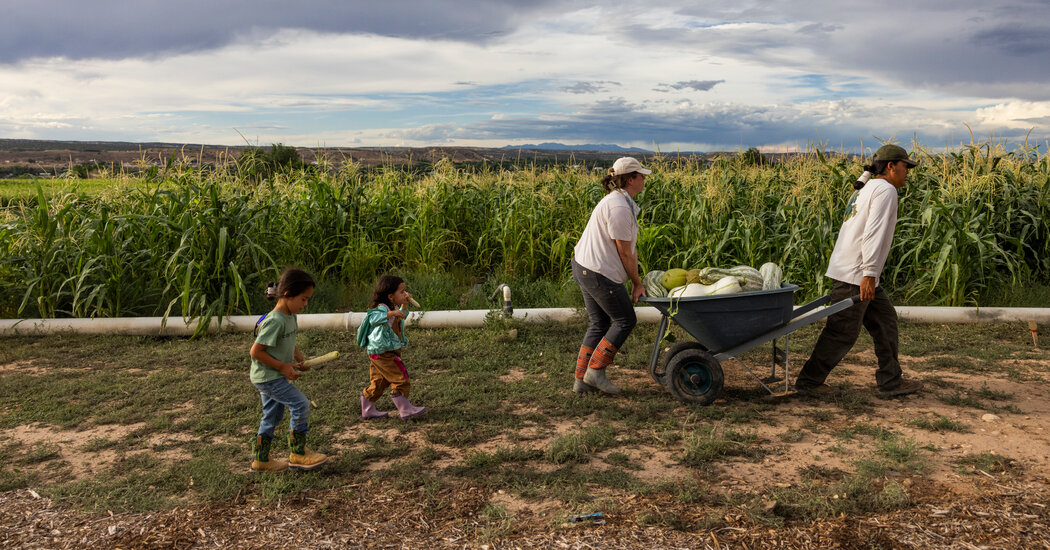
Mary and Zachariah Ben, farmers in New Mexico, believed they were on the verge of buying the property of their dreams last fall: 47 acres, with enough cropland to grow heirloom corn and a processing facility to expand their organic baby food business.
But the low-interest loan they secured from the Agriculture Department to make the purchase in Aztec, N.M., was on hold for months, first during the government shutdown that lasted until mid-November and then as federal workers left the agency in droves. Only half a dozen loan specialists who could help process their claims remained in the entire state, the couple learned, leaving them in limbo indefinitely and the seller impatient to know whether the agreement would ever go through.
Zachariah Ben, who along with his children is a member of the Navajo Nation, ultimately turned to private lenders instead, and the family absorbed more than $200,000 in interest as a result. “At least we got the land because we could have also lost that, and we would have if we had to wait” on the Agriculture Department, Mary Ben said.
The experience of the Bens, whose aim of providing organic and shelf-stable options for young children appears to align with some of the Trump administration’s stated goals, is not unique. Across the country, farmers and rural residents describe struggling to obtain the basic services the Agriculture Department is meant to offer, including loans and grants, technical assistance and financing for housing and utilities. Sharp attrition under the Trump administration, largely through voluntary resignations and dismissals by the Department of Government Efficiency, have left many of the Agriculture Department’s local offices with skeletal staffing — and, in some counties, with no one at all.
The ripple effects of the Agriculture Department’s depleted work force illustrate how the Trump administration’s mission of shrinking the federal bureaucracy has undercut a competing priority: delivering for farmers, a core political constituency. Strained government resources also risk posing additional challenges for a farm economy that administration officials have described as “dire,” increasing barriers to entry for new farmers who need more assistance, impeding assistance to producers already facing tough economic conditions, and hampering basic services and government aid in the most remote and poorest places.
“All these practical things that make the wheels go around in a community were facilitated by U.S.D.A., and it was with staff who knew how to navigate and had the trust of the local community,” Senator Pete Welch of Vermont, the top Democrat on the Senate subcommittee on rural development, said in an interview. “It’s something that was working, was working well, and was very cost-efficient. And now it is being demolished.”
Trump administration officials have defended the staffing cuts as voluntary and necessary to trim a bloated agency.
“We don’t have the money in our budget to pay for all of the employees that were hired in the prior administration,” Stephen Vaden, the deputy secretary of agriculture, said in a congressional hearing in July. He emphasized that the reductions were “voluntary decisions made by individual employees who chose, with the information that the agency provided to them, to seek a new career elsewhere.”
Overall, more than 20,000 workers out of more than 110,000 left the Agriculture Department through the first half of 2025, according to an inspector general report. Recently obtained data showed that the Farm Service Agency, a division whose approval the Bens sought in applying for a low-interest loan, has no staff left in dozens of counties across the country, forcing farmers to travel long distances for assistance or to simply give up. Among divisions that directly work with farmers and aid rural residents, the percentage of departures is even higher.
The Agriculture Department said that it currently had about 93,000 employees after hiring more workers this year, and that it believed staffing levels were adequate as “services and supports have become more targeted and efficient” through planned technological improvements.
Still, its plans to fundamentally overhaul the agency, as well as funding cuts proposed by President Trump’s latest budget, are likely to deepen difficulties for farmers and rural communities.
Already, the agency is moving more than half of its staff in the Washington region out of the nation’s capital, a move that is all but certain to further thin the ranks of the agency. Such losses will affect the department’s ability to finance home loans, carry out agricultural research and service farmers, according to federal workers, farm groups and rural lenders. (Unions and farm organizations have mounted a legal challenge to that plan.)
Likewise, Mr. Trump’s budget for the next fiscal year proposes a nearly $5 billion cut to the Agriculture Department, essentially eliminating programs for beginning farmers, conservation and rural aid.
Some of the steepest cuts have fallen on a part of the Agriculture Department responsible for improving the economy and infrastructure in rural communities, leading to long delays in aid for residents and charities alike.
The subagency, known as Rural Development, has lost about 1,700 workers, or more than a third of its staff, since the Trump administration took office.
In New Mexico, questions directed at the agency often languish for weeks, as do approvals of key documents, with emails and queries bouncing among staff members scattered across the state and in Washington, said Lorenzo Alba Jr., the executive director of Casa de Peregrinos, an anti-hunger charity in the area.
After receiving a grant from the Rural Development section at the end of the Biden administration to build a food pantry in Hatch, N.M., the charity is still waiting for $300,000 in federal funding. For now, Casa de Peregrinos has cobbled together other sources of financing to set up and operate a makeshift pantry with limited hours and food varieties, despite no refrigeration or air conditioning.
“Our pantry should have been up and running, fully renovated by now,” Mr. Alba said. He added that the delays had led costs to balloon to $600,000 from $475,000, money the charity could have used to buy more food and serve more families.
“I quit blaming the U.S.D.A. on this because I didn’t know what they were going through,” he said. “Now I do.”
It is unclear whether staffing cuts have been a factor, but in the last year the subagency has also financed far fewer loans and grants. As of mid-August, with a little over a month left in the 2026 fiscal year, the agency has approved nearly 52,000 investments worth $15.8 billion. In comparison, in the past three fiscal years, the agency made between 63,000 and 74,000 investments totaling $24 billion to $40 billion annually.
Another crucial service the department offers — helping producers carry out sustainable farming practices through its Natural Resources Conservation Service — has lost more than 2,700 workers, or nearly a fourth of its staff, forcing farmers to miss contract deadlines and turn to expensive private consultants for advice.
In central Nebraska, Clay Govier, who farms corn and soybeans on 3,500 acres in Broken Bow, described the cascading effect of 50 percent staffing cuts at his local conservation agency. The technician he had worked with took a buyout at the start of the Trump administration. Now, Mr. Govier and his family coordinate with someone who travels between two counties to survey different farms.
Though the technician is knowledgeable, “he’s stretched very thin because if he needs a signature, he has to drive to our farm and then he drives back or we have to drive to him, and it just burns up an entire morning to get some basic paperwork done,” Mr. Govier said.
As a result, the office is missing more details and overlooking crucial steps to verifying the farmers’ practices these days, leading to delays in the contract cycle and payments.
“Farming is an art and a science,” he said. “It’s so different for every operation, every state, every region, so you need local N.R.C.S. staff that understand their region and how to implement these programs.”
In southwestern Pennsylvania, Amanda Butterfield worked with the conservation service for nearly a decade, first to restore roughly 180 acres of strip-mined land in Meyersdale into pasture for a herd of beef cattle. After her technician shared anecdotes about burnout and long working hours, Ms. Butterfield turned instead to private consultants who work for agribusinesses. But that advice often comes at a steeper cost, like the expectation of buying certain products.
Ms. Butterfield also added that staffing turnover at her local Farm Service Agency had led to errors and inefficiencies: A new worker hired to replace an employee who had left asked her husband to report crop acreage, unaware that the ranch did not grow crops at all.
“We’ve completely lost a whole group of experts within our communities across the United States that can no longer help and support us,” she said.
