


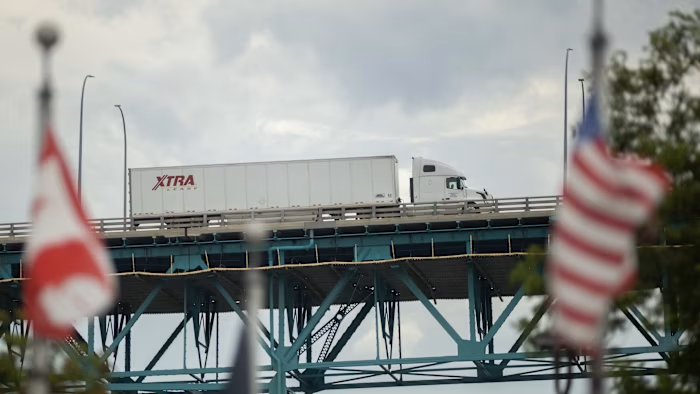
Donald Trump is facing a domestic backlash over the collapse of trade talks between the US and Canada, as the countries’ deteriorating relationship risks more financial pain for Americans ahead of midterm elections.
US lawmakers, governors and business leaders warned that Washington’s new tariffs on Canadian goods would increase costs for American households and companies, while a Federal Reserve official said that protracted sparring between the trading partners could help keep inflation stubbornly high.
Trump’s tariffs targeting $20bn worth of Canadian goods went into effect on Saturday on top of existing levies on steel, aluminium, lumber and vehicles, after talks between Washington and Ottawa broke down on Friday night.
Prime Minister Mark Carney said Canada would soon announce “dollar-for-dollar” retaliatory levies on American goods, while US trade representative Jamieson Greer said Washington would respond to Ottawa’s retaliation.
US senator Susan Collins of Maine, a Republican whose state borders Canada, said that the “on-again/off-again trade talks” between the allies would “lead to higher costs, risk and uncertainty for Maine businesses”.
The new tariffs would “increase costs for Maine families, as most businesses will have no choice but to pass on the tariffs to their customers through higher prices”, she added.
Collins, who is facing a tough re-election battle in November as Republicans and Democrats vie for control of the Senate, said Trump “must consider the negative impact of tariffs” and “work to reach a fair agreement” with Carney’s government.
Trump’s first-term vice-president Mike Pence told CNN on Sunday that “the last thing we need right now, as our economy is getting back on its feet, is a trade war with Canada”.
Washington and Ottawa have accused each other of sabotaging trade talks with last-minute demands.
Democratic governors of states with high imports from and exports to Canada said the hit to their constituents would be swift and could result in lost American jobs amid an already cooling labour market.
Governor Gretchen Whitmer of Michigan, which borders Canada and is the home of the American auto industry, said her state was “uniquely impacted” by “the tariff wars” with Ottawa. Fresh levies amounted to a “tax hike on Michigan families and businesses by raising prices at the grocery store and the gas pump”.
“Companies — especially our auto manufacturers — face the difficult decision of laying off workers or passing costs on to their customers,” she said.
Virginia governor Abigail Spanberger said Canada was her state’s top export destination and that the fresh levies on Canadian goods would “hurt Virginia families, farmers, producers, foresters and businesses” in “a matter of days”.
Neel Kashkari, president of the Federal Reserve Bank of Minneapolis, told CBS News on Sunday that “the longer there’s back and forth on the trade front, just like the longer there’s back and forth in the conflict of Iran, the imprint in inflation ends up being extended and delayed”.
The Minneapolis Fed covers several states bordering Canada, including Minnesota, Montana, North Dakota and the Upper Peninsula of Michigan.
US businesses criticised the collapse of talks, warning of increased costs to American companies if negotiations do not resume.
Neil Herrington, senior vice-president for the Americas department at the US Chamber of Commerce, said: “We urge US and Canadian negotiators to return to the table and finish the job — a trade deal that addresses US tariffs and Canadian retaliation. The alternative is an escalating cycle of tariffs that will raise costs and impede economic growth.”
Business Roundtable chief executive Joshua Bolten said the “new tariffs and retaliation risk raising costs for American businesses and families, disrupting vital supply chains and straining the important economic relationship between the United States and Canada.”
Republican senator John Barrasso defended Trump as protecting American jobs with his tariffs but said it was necessary to keep trading with Canada.
He told Fox News on Sunday that it would be “wise” and in the “best interest” of Canada to return to the negotiating table and “make sure that we move forward, because we need to continue trade with Canada.”
In fiery remarks on Saturday, the Canadian prime minister used the language of armed conflict to describe the state of relations between the North American neighbours, saying his country was “at war” with the US after it was “attacked” by the Trump administration.
Trump remained defiant on Sunday, writing on social media that “Canada wants the benefits of being a State, without being one!!! They have also charged our great farmers, for many years, massive amounts of Tariffs. No more!!!”
Californian governor Gavin Newsom, considered a possible 2028 Democratic presidential contender, described the situation this way on X: “Our closest ally. Our critical trading partner. And Trump is hitting Canada with 50% tariffs. What the actual fuck are we doing?”
Additional reporting by James Politi in Washington
