



A new Federal Reserve Bank of Cleveland working paper offers a provocative explanation for why cryptocurrency behaves so differently from traditional financial assets: Americans who buy crypto don’t simply have different demographics or risk appetites, they have radically different beliefs about digital assets’ future returns.
The finding could help explain both crypto’s persistent volatility and the way rallies can attract new buyers, potentially creating a feedback loop in which rising prices reinforce bullish expectations and pull more investors into the market.
Using repeated surveys of as many as 25,000 US households per wave, researchers Michael Weber, Bernardo Candia, Olivier Coibion and Yuriy Gorodnichenko found that expectations about crypto returns explain more of the variation in who owns cryptocurrency than a broad range of demographic characteristics.
The paper, titled “Do You Even Crypto, Bro? Cryptocurrencies in Household Finance,” also uses a randomized information experiment to show that simply giving people information about Bitcoin’s (BTC) recent performance can increase both their desired crypto allocation and their subsequent purchases.
Perceived risk of crypto by ownership. Source: Federal Reserve Bank of Cleveland
The researchers say the results point to a potential mechanism behind speculative bubbles: past gains can attract new investors, whose purchases push prices higher and potentially attract still more buyers.
“Positive returns attract new participants, which raises the price further,” the authors write
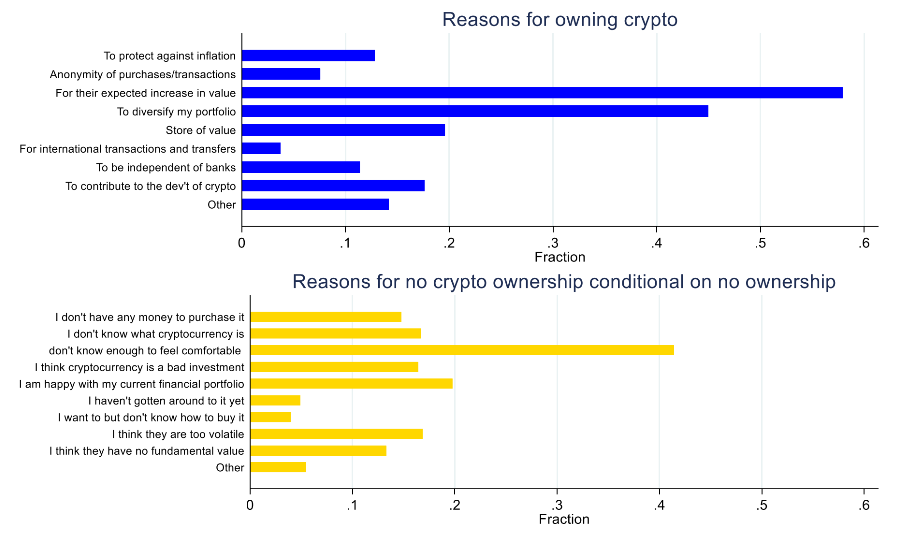
That dynamic is particularly striking because cryptocurrency remains poorly understood by a large share of the population. In the researchers’ 2021 survey, 87% of people who did not own crypto said they didn’t know what return to expect from it over the following year. Among crypto owners, the figure was still 54%.
Related: Canadian crypto ownership increases to 25%: Ontario survey
Ownership linked to double-digit returns expectations
For those willing to make a forecast, however, the gap was enormous. Crypto owners expected an average 22% return over the following year, compared with just 7% among non-owners. Owners also tended to view crypto as less risky than non-owners did.
The researchers found that expected returns were unusually powerful in determining ownership. A one-percentage-point increase in an individual’s expected crypto return was associated with a 0.8-percentage-point increase in the probability of owning cryptocurrency. Expectations about returns and risk together explained considerably more variation in crypto ownership than observable characteristics such as age, income and gender.
That makes crypto an outlier compared with stocks, bonds and gold. For traditional assets, demographic and financial characteristics generally have much more explanatory power than differences in expected returns. Crypto reverses that relationship.
Source: Federal Reserve Bank of Cleveland
The demographic profile of crypto investors nevertheless remains distinctive. People under 40 were 13 percentage points more likely to own cryptocurrency than those over 60, even after controlling for other characteristics. Men were about 4 percentage points more likely than women to own crypto, while higher-income and wealthier households were also more likely to participate.
The experiment provides perhaps the paper’s most consequential finding for crypto markets.
In 2025, researchers randomly assigned households to receive information about BTC, stocks, GameStop or inflation. Participants who were shown Bitcoin’s previous 12-month return increased their desired crypto portfolio allocation by roughly 2 percentage points, or about a 47% increase relative to the 4.3% desired allocation among the control group. Actual subsequent crypto purchases also rose by about 2.5 percentage points.
The authors describe the result as “providing information about recent Bitcoin returns induces some households to start buying cryptocurrency.”
The effect was concentrated among people who said they didn’t own crypto because they lacked sufficient information. Those who already believed crypto was a bad investment generally did not respond to the information treatment.
The paper also finds that crypto wealth can spill into household consumption. A doubling in BTC’s price made a household whose entire financial portfolio was in crypto 1.4 percentage points more likely to buy a durable good, equivalent to roughly a 7% increase relative to the unconditional probability of such a purchase. But the effect did not persist into ordinary spending.
That led the researchers to a stark comparison: crypto gains appear to be treated more like “gambling income” or lottery winnings than a permanent increase in wealth.
The broader implication is that crypto’s volatility may be rooted partly in disagreement and learning rather than simply market fundamentals. The authors conclude that cryptocurrency stands out because it is poorly understood, investors form sharply different views about its prospects, and new information about past returns can change both expectations and behavior.
“The absence of common information and beliefs about crypto across investors,” they write, “suggests that price volatility will continue to be one of the most defining characteristics of this new asset for the foreseeable future.”
For crypto markets, that suggests a potentially uncomfortable conclusion: the next wave of retail demand may depend not only on Bitcoin’s price, but on what investors are told about the price that came before it.
Magazine: The 100x obsession: Fundamentals grow in importance as crypto matures
