


In a field on the outskirts of London, thousands of people settled onto picnic rugs and camping chairs, slathering on sunscreen for the unusually hot English summer. A few people had uncorked bottles of sparkling wine, though it was not quite 10 a.m. One woman knitted while a couple in Panama hats tiptoed to a spot with a prime view of the stage.
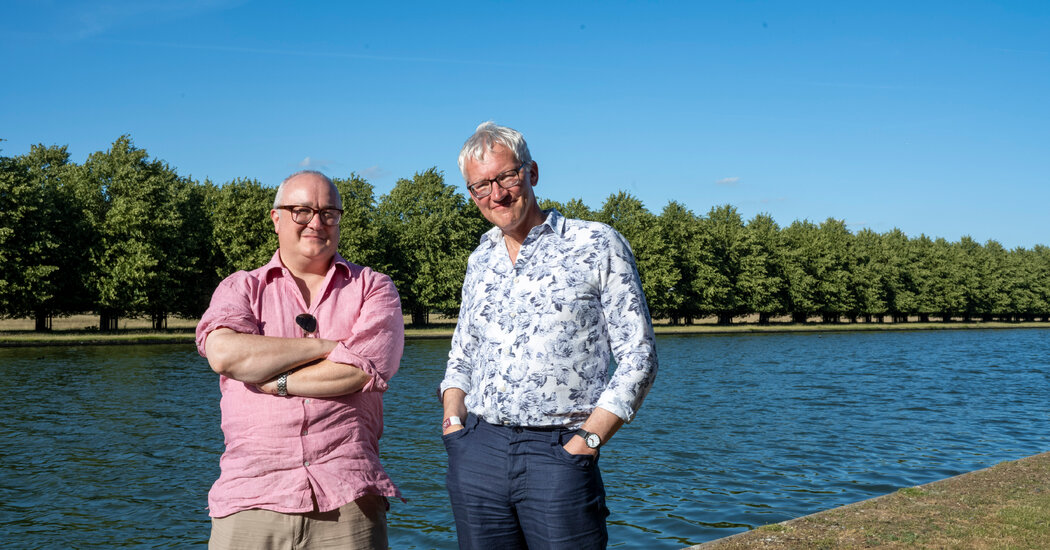
Then a familiar song began playing, and a ripple of excitement ran through the crowd. The rock stars of the event had arrived: two middle-aged British historians.
“The Rest Is History” is the most popular history podcast in the United States, Britain and Australia, with some 30 million downloads and streams a month. This was its first live festival — a sort of mini-Lollapalooza, if Lollapalooza were a sedate, two-day event on the grounds of an English palace.
The show’s almost 800 episodes span millenniums and continents, covering the fall of the Aztecs, the French Revolution, the assassination of Abraham Lincoln, and history’s greatest monkeys, among other things. Its fans include a current prime minister, Mark Carney of Canada, and a former one, Julia Gillard of Australia; the actors Matthew McConaughey and Tom Hanks; and the musician Nick Cave.
In February, a hearing at England’s Supreme Court was interrupted when a judge’s phone played the introduction to an episode on Jimmy Carter. “The Rest Is History,” he acknowledged sheepishly. “It was switched to silent. Do carry on.”
How did it become such a juggernaut? And what does it say about our tumultuous, accelerated present, a time of news fatigue and thrumming anxiety over the future, that so many of us are drawn to a show about the past? There is reassurance, of course, in reminding ourselves that humans have survived difficult times before. There is the pure escapism of immersing yourself in, say, six riveting episodes about Mary, Queen of Scots, as I did when I first latched on to the podcast. And then there are the podcast’s hosts, Tom Holland, 58, and Dominic Sandbrook, 51, who give the show a charm all of its own.
Almost 5,000 people bought tickets to the festival, which was held at Hampton Court Palace, Henry VIII’s favorite retreat. Fans from Argentina, New Zealand, Europe and the United States filed through courtyards, whose stone floors had been polished smooth by centuries of use, into acres of picturesque gardens for two days of an epic history chat.
‘An Enormous Cuckoo’
Like several other disruptive cultural forces, “The Rest is History” was born in the pandemic. Mr. Holland was, at the time, “kind of contemptuous and oblivious as to what podcasts were,” he told me recently at his home in the south London neighborhood of Brixton. During a family holiday after England’s first lockdown, his brother James, who is also a historian, told him about a World War II podcast he was recording for a British company called Goalhanger.
Mr. Holland, who had written several popular classical history books and made history documentaries with the BBC, was intrigued. He met with Tony Pastor and Jack Davenport, two former sports producers who created Goalhanger with the former England soccer player Gary Lineker. The idea for a more general history podcast was born.
“Who would you enjoy talking to, week in, week out?” he recalls being asked. It was an easy question. “Dominic was the most entertaining historian that I knew,” Mr. Holland said. They had met more than a decade before at a writers’ charity quiz.
Mr. Sandbrook agreed to co-host, in part because of Mr. Holland’s exuberant, if hyperbolic, salesmanship. “I can hear him saying it now, he said: ‘It will be literally no work. It will be no work whatsoever,’” Mr. Sandbrook told me over coffee at a tiny Gloucestershire cafe near his home. The idea was that “we’d choose random things that we knew a lot about, and just witter about them for half an hour.”
That idea has, let’s say, evolved. They now produce three episodes a week, two of which are about an hour long, and a 30-minute bonus episode for paying subscribers. A ton of research goes into each. Their biggest audience is in the United States, which accounts for 34 percent of plays, according to Goalhanger, while 33 percent comes from Britain and Ireland, followed by Australia, Canada and New Zealand. Listenership is surprisingly young, with 61 percent under 44, and it is 78 percent male.
Mr. Holland described the podcast as an “enormous cuckoo that slowly elbowed out everything else.” He is currently very behind, he told me ruefully, on a book he is writing about the Beatles and “the new Reformation of the 1960s” that was due at Christmas.
Mr. Sandbrook said his working life was “unrecognizable, compared to what it was before.”
“I do spend a ridiculous amount of time now reading history books,” he added. “But there are worse things to do.”
The Spirit of a Viking and a Cringing Monk
Mr. Holland arrived onstage at Hampton Court in a Henry VIII-style velveteen hat. Tall and energetic with a crop of white hair, he is a natural impresario who later took great pleasure in overseeing a bout of medieval combat, one of the diversions that punctuated the live talks with historians. Mr. Sandbrook is a more grounded figure, with twinkling eyes and a warm handshake. He is, by his own account, less inclined to cosplay as a historical character.
The rapport between the two men is central to the podcast’s appeal. They have much in common. Both were privately educated, attended top universities (Mr. Holland at Cambridge and Mr. Sandbrook at Oxford), and radiate warmth and humor. Their expertise, however, is in different historic periods — “He’s ancient and I’m modern, basically,” Mr. Sandbrook said — and they play on their differences.
There is a lot of banter. In an episode on the Battle of Stamford Bridge in 1066, Mr. Holland says that he did not quote from his book “Millennium” because there were so many epic contemporary accounts. “This speaks to your fundamental lack of self-confidence, I think, Tom,” says Mr. Sandbrook, who readily quoted from his own book.
Mr. Holland mournfully agrees: “You have the spirit of a Viking. I have the spirit of a cringing monk.”
“By the way, please clip that and use that for social media,” Mr. Sandbrook jokes, and the two dissolve into laughter.
Mr. Holland tends to be more vocally empathetic toward historical figures, while Mr. Sandbrook is more merciless. In an episode on the First World War, Mr. Sandbrook quotes from Robert Graves’s memoir, “Goodbye to All That,” describing an unfortunate British sergeant who fired a bomb that bounced back into his face.
“Noooo, that’s the kind of thing I’d do!” interjects Mr. Holland.
Part of the delight of the podcast is in their mischievous, but fundamentally good-natured observations about life — its absurdities, contradictions and continuities. For Mr. Holland, the show is popular because it reveals the strange ways of our predecessors while illuminating the common threads that bind us.
“Without having consciously set out to do this,” he said, “I think it is a celebration of the inherent fascination of the past, as the best way to understand how infinite the ways are of being human.”
Mr. Sandbrook framed it in slightly different terms. “I think there is an inexhaustible human appetite for stories,” he said.
Both men also pointed to something else — a deliberate lack of moralizing, and, in a post-woke world, a curiosity about the past rather than a rush to judgment. “History is not a civics lesson,” Mr. Sandbrook told me somewhat sternly, after I asked about what we could learn from the past. “History is the record of human behavior, often which is very bad. And the one thing that doesn’t change, I would say, is human nature.”
‘Outside of the Swirl of Chaos’
In April, as Britain was edging toward its seventh prime minister in 10 years, “The Rest is History” did a series on Britain in the 1970s. Almost 500 people were killed in Northern Ireland in 1972. In 1974, the government briefly introduced a three-day working week to cope with an energy crisis. The following year, inflation spiked to 25 percent.
Mr. Sandbrook noticed listeners’ fascination, and, in some cases, relief, in their comments. “They were saying, ‘I thought things were awful now, but then I look back and I think, well, it’s not that bad,’” he said.
When I asked if we were living through a particularly turbulent era, both men referred to the pace of technological change as unprecedented, comparing it to the advent of the printing press in the 15th century. “Clearly what is happening now,” Mr. Holland said, “first with the internet, social media, and now with A.I., is going to be convulsively transformative in a way that we cannot yet get a handle on.”
“I think that’s why history is so valuable,” he added, “because it does kind of provide a rain check. It does enable you to get outside of the swirl of chaos.”
Wandering the gardens of Hampton Court — where actors in period dress paraded under parasols — could feel a little like stepping back in time, albeit with stalls serving overpriced iced coffees and plant burgers. I wondered to what extent the show offered some listeners a similar retreat from the uncertain 21st century into stories where the endings, however good or bad, are no longer in doubt.
Yet the past is also compelling as a means of understanding a confounding present. Onstage the first morning of the festival, Mr. Holland interviewed Prof. Ali Ansari, a historian specializing in Iran, in a conversation that jumped between ancient Persia and this year’s U.S.-Israeli war against Iran.
In the afternoon, Mr. Sandbrook spoke to Paul Rouse, an Irish historian, who talked about the common market between Ireland and Britain in the 1800s, including up to 12 sailings a day from Dublin carrying cattle to England, and later spoke of the damage wrought by Brexit. On Sunday, the historian Katja Hoyer discussed her new book on Weimar and the rise of Hitler.
“History frames so much that is significant about our present politics,” said Christoph Pike, 31, a fan of the podcast who had flown in from Toronto with his wife, Claire Davis. At the same time, he noted, Mr. Holland and Mr. Sandbrook “don’t take themselves too seriously.”
“They’re playful, they’re engaged, they both have a great sense of humor,” Mr. Pike said.
As the sun set on Saturday, Mr. Holland and Mr. Sandbrook applied their considerable intellects to questions from audience members.
“Top three mustaches of all time?” asked one.
“Great question!” Mr. Holland said. “We do love facial hair.”
Another historical debate had begun.
