


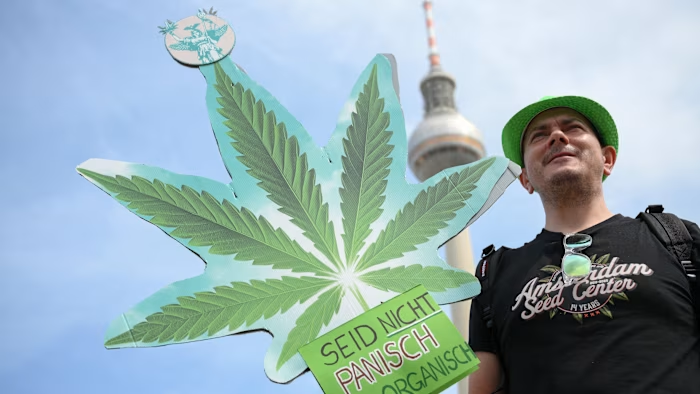
Germany has become Europe’s largest regulated cannabis market since partially liberalising the drug two years ago, as imports surge and conservative politicians warn of rising criminal activity and health risks.
Legal marijuana imports have increased sixfold since 2024, according to data from the Federal Health Institute. That year, the leftwing government led by then-chancellor Olaf Scholz passed laws allowing adults to possess and privately cultivate cannabis, while also expanding legal sales to users with a prescription.
Now critics, including from Chancellor Friedrich Merz’s Christian Democrats and its Bavarian sister party CSU, are warning of the negative effects of the marijuana industry on society and health.
CSU interior minister Alexander Dobrindt has called the Cannabis Act “a real piece of shit law” and argued that it has undermined prevention and enforcement. Karin Prien, the CDU family minister, has also called for stronger addiction-prevention measures for children and teenagers, saying early intervention remains important given the risk of cannabis acting as a gateway drug.
The health ministry has submitted a draft bill to tighten restrictions on medical cannabis use to prevent recreational abuse, but the Social Democrats disagree with the changes. The bill is set to be discussed in parliament in the autumn.
Medical cannabis imports increased from 8,143kg in the first quarter of 2024 to 50,539kg in the first quarter of this year. A recent study by the University of Hamburg found that more than 200 tonnes of cannabis were available in Germany in 2025, including 2.6 tonnes produced domestically. That year, the market had a total value of $997mn, according to the intelligence company Prohibition Partners.
The Hamburg researchers carrying out the evaluation found that hospitalisations connected with the drug have risen — driven by the increasingly potent strains.
Jakob Manthey, the scientist behind the two-year evaluation, said that “the illegal market is shrinking although overall consumption has barely changed”.
Manthey argues that the concentration of psychoactive substance (THC) should be clearly labelled and adjusted to the medical or mental conditions it is intended to treat. The other compound, CBD, which only acts as a muscle relaxant, has no psychedelic effects.
But producers “exploit regulatory gaps and market products that are not evidence-based at all”, Manthey said.
In Körnerpark, located in Berlin’s trendy neighbourhood of Neukölln, users were recently smoking joints out in the open.
Dominik, a 22-year-old from Switzerland, told the FT he suffers from attention disorder and prefers to buy cannabis in German pharmacies with a prescription because it allows him to check the THC level. “I don’t think you can do that on the dark web. They might tell you it’s one thing but then it’s not.”
Despite the partial legalisation, more than half of weed consumers do not rely on medical prescriptions to get the drug.
“Social supply”, meaning purchasing cannabis through social contacts, makes up 35.2 per cent of the market, even as selling the plant without a medical prescription remains illegal. The next biggest source, at 21 per cent, is for consumers to grow their own, according to a study conducted in the second half of 2025.
Lisa, 23, told the FT her dealer delivers directly to her house. “It’s really good weed and he had a lot of different weeds to choose from,” she said, while puffing on a joint. She also has friends growing cannabis: “It’s great because I know them and I know it’s quality stuff.”
It’s also cheaper to grow your own, according to one amateur producer, Hendrik Lieter, 45, an organiser at a workers’ council. Reversing the legalisation would be “stupid” since the law is “beneficial” to society due to its decriminalising nature, he added.
While criminal activity connected to cannabis has dropped by two-thirds and consumption has remained stable, consumption of other drugs has skyrocketed. The traces of cocaine and crack in wastewater have almost doubled over the past two years.
The increase in harder drug use started before the partial legalisation of cannabis. According to Anna Bindler, an economist at the German Institute for Economic Research, this means it “is not connected to the rise in cocaine, crack or methamphetamine.”
“If it is the political wish to reduce cannabis consumption, maybe to minimise health risks, then it does not seem like a new ban, a withdrawal from the reform, is the most effective lever,” Bindler said. Instead, she argued, lawmakers should “think about education and prevention”.
