


Reading Time: 3 minutes
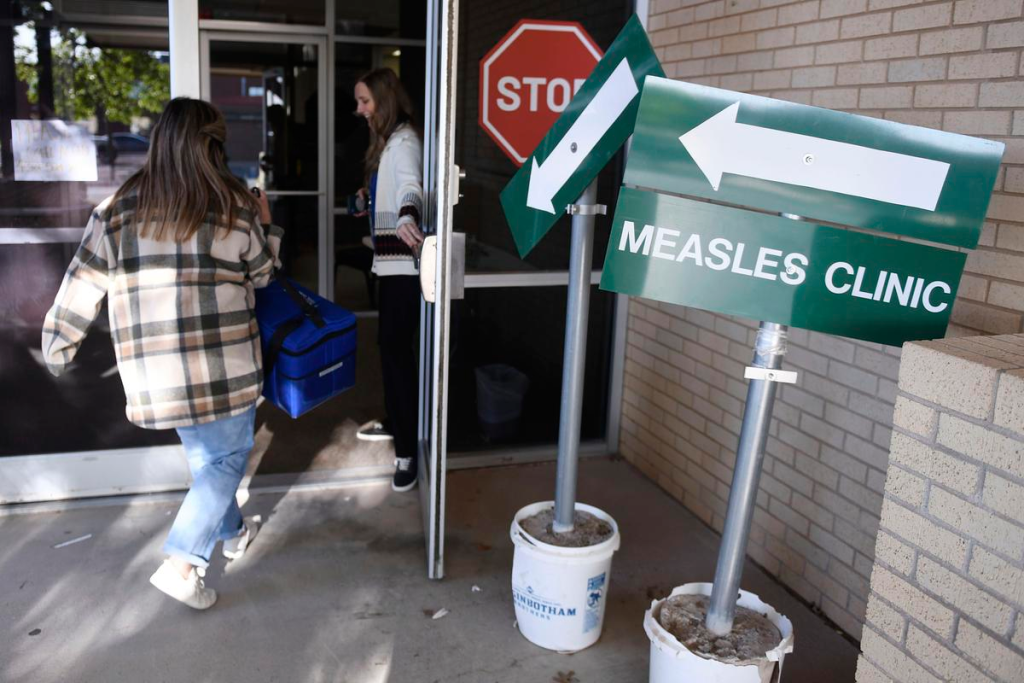
A measles outbreak in the southwestern corner of Wisconsin continues to grow.
As of Friday, the state Department of Health Services has identified 41 confirmed and 7 probable cases across Iowa, Lafayette and Grant counties.
All but one of the people infected with measles in Wisconsin this year have been unvaccinated, according to state data. Just over half of the cases have been in children and teens, while 44% are in adults.
State and local health officials are working to stop the highly-contagious virus from spreading further. But that work is being made more complicated by low vaccination rates in some communities.
DHS spokesperson Jennifer Miller said in an email that while the situation remains fluid, “we are seeing confirmed cases in pockets of our communities where individuals are under-vaccinated or unvaccinated.”
“Whenever there are pockets of lower immunization coverage — whether due to geographic location, health care access, or personal reasons — highly contagious viruses can spread quickly,” Miller wrote.
Like the rest of the U.S., childhood vaccination rates have fallen in Wisconsin as parents’ uncertainty, and in some cases skepticism, around vaccines has spread in the wake of the COVID-19 pandemic.
But state data shows some of the southwestern communities have had declining uptake of the measles, mumps and rubella vaccine series well before pandemic.
Only 60% of two-year-olds in Lafayette County had received one or more of the shots in 2025. Grant County’s rate was just under 64%.
Iowa County, where the majority of the recent measles cases have been located, had a rate similar to the statewide average at nearly 81%. But it’s still well below the threshold needed to prevent an outbreak at 95%.
Plain community may be affected
One community in the region that may be affected by lower vaccination rates are the Amish and Mennonite faith groups. The Christian communities are collectively known as Plain people because of their selective use of modern technology and conservative style of clothes.
Wisconsin has the fourth-largest Amish population of any state in the country, with an estimated 27, 535 Amish people living in the state as of 2025. The population data from Elizabethtown College in Pennsylvania shows more than 3,000 Amish live across Grant, Lafayette and Iowa counties.
Mark Louden, a University of Wisconsin-Madison professor of Germanic linguistics, is an interpreter and cultural liaison for the state’s Plain communities. He said the Plain people in Grant and Lafayette Counties have strong family ties to Lancaster County, Pennsylvania.
“There’s a lot of back and forth, just like people traveling back and forth, visiting and so forth, especially this time of year,” he said.
Lancaster County is home to the largest Amish settlement in the U.S. and is at the center of a major outbreak of measles that has sickened more than 300 people in Pennsylvania.
Louden said that while Amish and Mennonites have community standards for technology, health care choices are left up to individuals and their families.
“Even the most conservative or traditional groups out there do access Western healthcare,” Louden said. “While there may be some families that have their kids not vaccinated at all, that’s pretty exceptional.”
Louden characterized Plain communities as “vaccine cautious.” He said they’re more likely to choose which shots they want their children to get instead of just following a recommended vaccination schedule.
But he said their caution or even distrust of vaccines doesn’t just come from their cultural beliefs.
“(It) has been amplified by what they hear from their non-Plain neighbors, who are going down internet rabbit holes and watching certain networks,” Louden said.
Jack Sauer, chair of the Lafayette County Board of Supervisors, said like many places in the U.S., his county used to have higher rates of vaccination. But he questioned how much national rhetoric that questions childhood vaccinations, including from leaders of President Donald Trump’s administration, have had an impact.
“If you listen to anyone on the federal level, there’s a lot of going back and forth on whether the immunizations are good for you or bad for your or whatever they are,” Sauer said. “But I know when I was growing up, which was a long time ago, they were pretty well acceptable.”
Given the rapid spread of cases in neighboring Iowa County, he expects to see more cases in his county before the outbreak is over.
Iowa County Health Officer Debbie Siegenthaler said in an email that her department is working to identify cases and potential exposures and make sure people have access to testing and vaccination.
She strongly encouraged residents to check their vaccination status through the Wisconsin Immunization Registry or through their healthcare provider, especially as children head back to school.
“With increasing number of cases, we want residents to be aware of measles even if they have not been notified of a direct exposure,” Siegenthaler said in the email.
The county is holding a community vaccination clinic at the Mineral Point Rescue Squad office on Monday, Aug. 24 from 12 p.m. to 5 p.m.
This story was originally published by WPR.
Low vaccination rates drive southwest Wisconsin measles outbreak is a post from Wisconsin Watch, a non-profit investigative news site covering Wisconsin since 2009. Please consider making a contribution to support our journalism.
