


Reading Time: 6 minutes
This story is part of The uprising in Sherman Park: 10 years later, a Milwaukee Neighborhood News Service series examining resilience, collective action and ongoing efforts to address the inequities that sparked a pivotal moment in Milwaukee’s history.
Milwaukee County Board of Supervisors Chairwoman Marcelia Nicholson-Bovell remembers hearing the pain of community members who felt unheard and disenfranchised during the Sherman Park uprising of 2016.
The unrest occurred after Milwaukee Police Officer Dominique Heaggan-Brown shot and killed 23-year-old Sylville Smith. Heaggan-Brown was acquitted of Smith’s killing but was later sentenced to prison on unrelated sex crimes charges. His death sparked days of protest in Sherman Park, with clashes between residents and police and significant damage to property.
“I think a lot of it had to do with the community’s relationship to public safety, but also the historic disinvestment,” said Nicholson-Bovell, who was a new county supervisor representing parts of Sherman Park in District 10 at the time.
Milwaukee’s manufacturing industry once supported good-paying jobs for Black residents, said U.S. Rep. Gwen Moore. But when many of those family-sustaining jobs vanished, residents faced structural inequalities that impact maternal health outcomes, incarceration rates and poverty and unemployment, she said.
“Years of facing disinvestment and these challenges cultivated tensions that reached a breaking point after Sylville Smith’s death,” Moore said.
In the aftermath of the uprising, many government leaders, community members and philanthropists shared an interest in addressing longstanding systemic issues that contributed to the summer’s tensions.
Ten years later, those investments have led to some changes, although it’s unclear how many Sherman Park residents directly benefited.
Home renovations
An investment of $4.5 million in state funding to improve housing stock and employment opportunities in Sherman Park and Milwaukee was announced a few weeks after the uprising by then-Wisconsin Gov. Scott Walker, Milwaukee Mayor Tom Barrett and Milwaukee County Executive Chris Abele.
The initiative promised $1.5 million for employment programs, $2 million to help the city demolish and renovate tax-foreclosed properties and $1 million in Wisconsin Fast Forward grants awarded to Milwaukee businesses and nonprofits for job training.
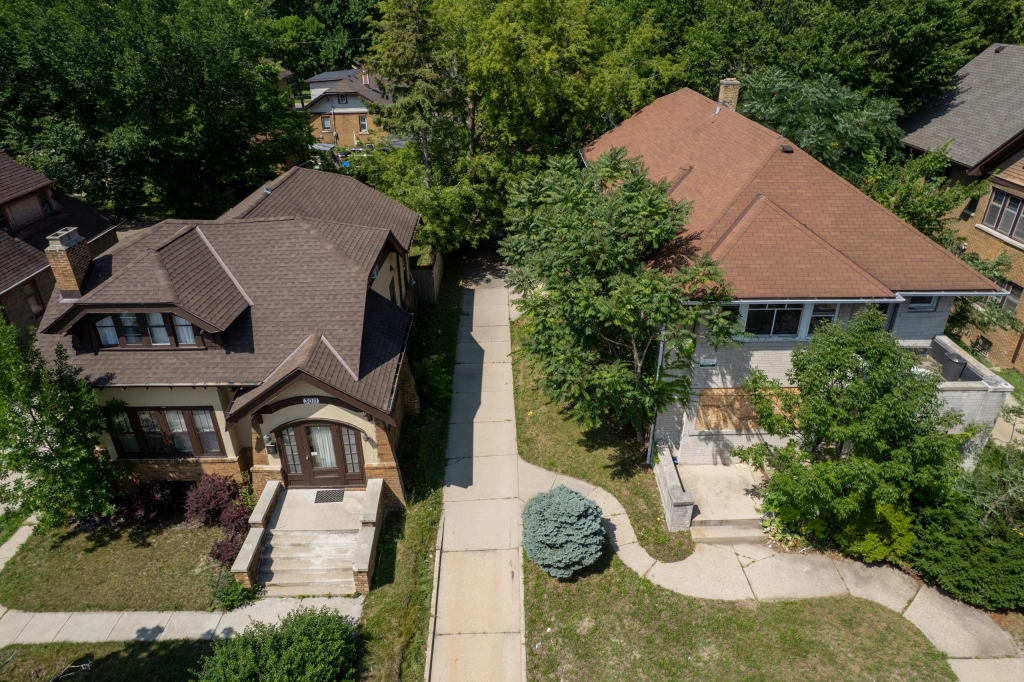
With $1 million, the city launched the Milwaukee Employment/Renovation Initiative, or MERI. The program helped six developers purchase distressed tax-foreclosed homes for $1 and receive grants of $10,000 per property to rehabilitate them to go back on the market.
The program faced early criticism from residents, and progress was slow initially.

The developers eventually renovated and sold 104 homes, 81 in the greater Sherman Park area, with most projects wrapped up by mid-2019, according to a presentation to a Common Council committee at the time. Additional private donations and funding led to a $7.9 million total investment in the properties.
Each property renovation had to employ at least one worker certified in the city’s Residents Preference Program for unemployed, underemployed or low-income workers. A total of 33,000 hours were logged by Residents Preference Program workers.
Jim Gaillard, vice president of Ezekiel Community Development Corp., said the initiative fit naturally with the nonprofit’s model of training chronically unemployed people, minority contractors or those impacted by the justice system to develop skills in the construction trades while rehabbing homes. The nonprofit, also known as Ezekiel HOPE, works to sell the properties to first-time homeowners.
“We needed to show some people that they could do more than what they thought they could do, so it gave people hope,” Gaillard said.

The city later launched another round of funding, dubbed MERI 2.0, that was open to a wider boundary of tax-foreclosed properties.
Lafayette Crump, commissioner of the Department of City Development, said both iterations helped shape the Homes MKE program, under Mayor Cavalier Johnson’s administration, which has fully renovated 77 homes with 20 more properties still in progress.
“It’s really a great example of how strategic public investment could improve property values, return homes to the tax rolls but also strengthen neighborhood stability by moving more of these properties back into productive use,” Crump said.
Ezekiel renovated five homes through MERI, three during the second phase and three in Homes MKE.
“I think the other big thing is that it opened people’s eyes to what can be done if you put a concentrated effort together,” Gaillard said.
Reasons for Hope MKE Fund

Darlene C. Russell, director of community engagement for the Greater Milwaukee Foundation, remembers the period of unrest as a painful and emotional time.
“I also remember neighbors checking on one another, community leaders stepping forward and residents asking what they could do to help,” she said.
That spirit of community care inspired the Greater Milwaukee Foundation to launch Reasons for Hope MKE with $200,000 in initial funding. The micro-grant fund is designed to provide immediate and flexible support for community-led efforts throughout the city, Russell said.
Over the last 10 years, the fund awarded 312 grants totaling over $2 million.
While Sherman Park was central to its creation, the fund is open to grassroots organizations throughout the city for neighborhood-strengthening initiatives such as youth and arts programming, community events and leadership development, according to Russell.
“It was never intended to be a quick fix to systemic issues. Instead, it was designed to invest in trusted neighborhood leaders already doing the work,” Russell said.
Residents from a variety of neighborhoods serve on the fund’s Community Advisory Council and receive training on grant administration. The current 13-member council reviews Reasons for Hope MKE grant applications and makes funding recommendations.
Community members have donated $146,800 to the Reasons for Hope MKE Fund in addition to institutional funding.
This year, the fund has supported Sherman Park through grants for activities like community gardening and wellness programming with Iwigara Holistic Hub in the 2800 block of North 35th Street and the UpStart Kitchen Food Crawl with PRISM Economic Development Corp.
Other projects

The BMO bank branch, O’Reilly Auto Parts, Jet Beauty Supply and a former BP gas station, which were damaged or destroyed during the uprising, were rebuilt. The BP gas station is now a Citgo.
Other investments supported the Sherman Phoenix Marketplace development, the county park and other initiatives.
The city provided $225,000 for the Sherman Phoenix Tax Incremental District. Moore and Sen. Tammy Baldwin advocated for federal funds for the neighborhood, including a $750,000 grant to the Wisconsin Women’s Business Initiative Corp. to support the Sherman Phoenix and neighborhood entrepreneurs.
Milwaukee County received a $250,000 Community Development Investment Grant in 2018 from the Wisconsin Economic Development Corp. to support construction costs of the entrepreneurial hub, according to Nicholson-Bovell.
Milwaukee County funded $2.3 million in heating, ventilating and air conditioning system upgrades for the Mary Ryan Boys & Girls Club at Sherman Park in 2016.
More recently, Nicholson-Bovell and the County Board helped leverage nearly a million dollars of American Rescue Plan Act funding to build public and private partnerships to support a multimillion-dollar revitalization of the park. Improvements included a new splash pad, improved lighting and pathways, resurfaced athletic spaces and more.
“When you go into Sherman Park today, it looks a lot different than it did 10 years ago,” Nicholson-Bovell said. “It feels more open, more airy, it’s better lit.”
Reflections
Looking back, Crump said he’s glad there was political will at local and higher levels of government to make some determinations after the Sherman Park uprising, and later in 2020 and 2021 after the COVID pandemic and death of George Floyd prompted similar conversations.
“But it’s unfortunate that it takes those major incidents that draw a lot of attention in order to make those things happen,” he said.
Going forward, Mabel Lamb, who became executive director of the Sherman Park Community Association in 2018, said she would like to see even more investment in the neighborhood’s housing stock, upgrades for businesses and the community as a whole.
As their work continues, Moore, Crump and Nicholson-Bovell plan to keep listening to residents.
“My constituents didn’t want just jobs, but an opportunity to have a voice in their community and to feel respected,” Moore said. “There is still so much work to do.”
Russell said after 15 years with the Greater Milwaukee Foundation, she’s learned that hope is not simply an idea.
“It is something you can witness. It is something you can nurture. It is something you can invest in,” she said.

Jonathan Aguilar is a visual journalist at Milwaukee Neighborhood News Service who is supported through a partnership between CatchLight Local and Report for America.
Investments changed Milwaukee’s Sherman Park after 2016 uprising, but who benefited remains unclear is a post from Wisconsin Watch, a non-profit investigative news site covering Wisconsin since 2009. Please consider making a contribution to support our journalism.
