


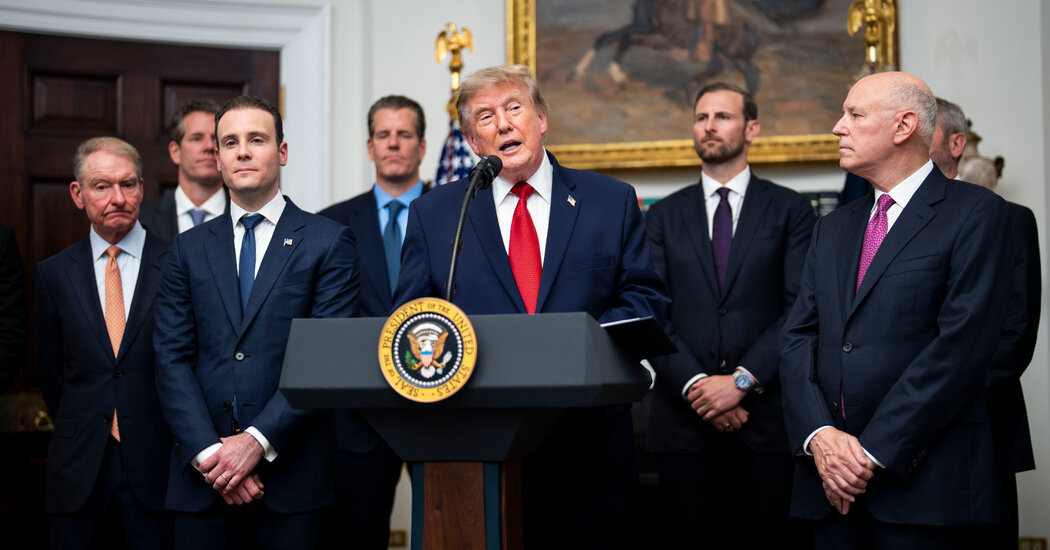
President Trump met with crypto executives at the White House on Wednesday, voicing his support for an industry that has generated enormous wealth for him and his family and calling on Congress to pass a major cryptocurrency bill.
Mr. Trump convened the group in the Roosevelt Room, where he reeled off the names of his industry visitors, some of whom are business partners of his family’s crypto company.
“Great group of people,” Mr. Trump said as he surveyed the room. “Tremendous investors, brilliant people.”
Officially, the meeting was a kickoff event for a new “innovation advisory committee,” a group of business leaders assembled to advise the Commodity Futures Trading Commission, one of the regulatory agencies that oversees crypto. But it was also a vivid display of Mr. Trump’s tangled relationship with the crypto industry, a business that brought in $1.4 billion for him last year, creating enormous conflicts of interest.
Among the attendees was Sergey Nazarov, the co-founder of Chainlink, a company that formed a partnership last year with the Trump family’s crypto start-up, World Liberty Financial. Another executive, Mike Belshe, heads BitGo, a World Liberty partner that Mr. Trump described at the meeting as “a big deal.”
Also in the room were Brian Armstrong, the founder of the crypto exchange Coinbase, and Arjun Sethi, the chief executive of the Kraken exchange. Both companies offer venues for buying and selling several coins launched by the Trumps. The White House and World Liberty have repeatedly denied any conflicts of interest.
“The New York Times apparently thinks the president of the United States praising the leaders of well-known American companies is a controversy,” said David Wachsman, a World Liberty spokesman.
Mr. Trump met with the executives at a high-stakes moment in the crypto world. The industry’s top priority is the passage of a bill called the Clarity Act, which would create business-friendly rules for the technology. In recent weeks, the bill has faced hurdles in the Senate, where Democrats have pushed for language that would bar public officials, including the president, from selling digital currencies.
At the White House meeting, Mr. Trump steered clear of the major questions surrounding the legislation. But he called on Congress to pass the Clarity Act, describing it as “very, very powerful structured legislation, which will keep us ahead of China.”
A onetime crypto skeptic, Mr. Trump embraced the technology on the campaign trail in 2024 and soon turned it into a cornerstone of his family business. Last year, the Securities and Exchange Commission ended a long-running crackdown, dropping lawsuits against some of the largest crypto firms, including Coinbase and Kraken.
Mr. Trump also signed a bill called the GENIUS Act, which he joked on Wednesday he had named for himself. The law created rules for stablecoins, a popular cryptocurrency tied to the U.S. dollar.
But lately the industry has run into problems in Washington.
For years, crypto executives have lobbied Congress to create a broad regulatory framework governing the industry. The aim was to cement some of Mr. Trump’s pro-crypto policy changes, ensuring that a future president would be unable to reverse them.
A version of the Clarity Act passed the House of Representatives last year, with support from Democrats and Republicans. So far, however, the Senate has not held a vote, because Democrats have demanded tougher rules to stop Mr. Trump from profiting from crypto.
As the executives gathered at the White House on Wednesday, Democrats in Congress were voicing outrage over a new commingling of the interests of the Trump family’s business with the administration’s duties.
Last week, a Treasury Department office granted an affiliate of World Liberty preliminary approval for a limited bank charter. The president and his sons have a hefty stake in World Liberty. The Treasury’s Office of the Comptroller of the Currency supervises banks.
A charter would save World Liberty money by allowing it to issue its stablecoin on its own. Right now, it pays BitGo to do that. The license would not allow it to take deposits from retail customers or issue loans.
Senator Elizabeth Warren, Democrat of Massachusetts, called the pending charter “the most brazen act of self-dealing our financial system has ever seen” and said she would introduce a bill to try to stop it.
Anna Kelly, a White House spokeswoman, denied that a bank charter for World Liberty would present any conflict of interest. “This is the same tired narrative that Democrats have pushed against President Trump, his family and his administration for a decade,” she said. “President Trump only acts in the best interests of the American public.”
At the meeting, crypto executives celebrated some of their recent victories, including a push from the S.E.C. to give them new leeway to raise capital without federal oversight.
The agency on Tuesday proposed rules that would allow companies to raise up to $75 million per year without registering. Generally, businesses are required to register with the S.E.C. to solicit funds from investors.
The S.E.C. chairman, Paul Atkins, stood alongside Mr. Trump at the White House. “We’re all happy with Paul,” Mr. Trump said from the lectern. “He’s been absolutely fantastic.”
As the session ended, Mr. Trump led the visiting crypto executives into the Oval Office.
“We’re going to show them a real office,” he said. “Their offices are nice, but this is nicer.”
