


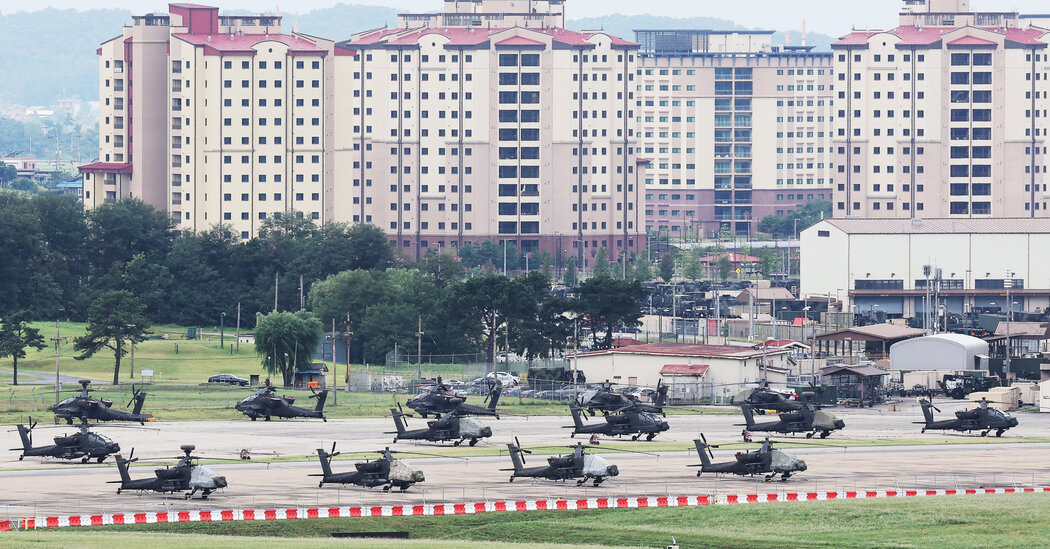
The Pentagon said late on Tuesday that it was ending a major training exercise with South Korea one week earlier than scheduled, on Aug. 21, and scaling back many remaining live-fire training drills to computer simulations or canceling them altogether.
The moves came after President Trump on Sunday ordered the Defense Department to reduce joint military exercises with South Korea, a longtime U.S. ally and a linchpin of America’s national security strategy in the Asia-Pacific region.
Mr. Trump’s order was aimed at rekindling talks with Kim Jong-un of North Korea at a time when efforts to resolve the Iran war have hit an impasse, as well as punishing the South Koreans for declining to join in the conflict against Iran, a position that deeply angered Mr. Trump.
In a statement released on Tuesday night, the Pentagon said it was slashing in half the 11-day training exercise in South Korea, called Ulchi Freedom Shield, “while continuing training that enhances tactical capability.”
“These adjustments preserve essential readiness and training objectives,” the statement continued. “There will be no degradation to U.S. training objectives.”
On Wednesday, the South Korean military said that despite the cutback, the allies had agreed to “discuss and implement various measures to achieve the objectives of the Ulchi Freedom Shield exercise and establish a combined defense posture.”
Even before the Pentagon’s announcement, Mr. Trump’s order had heightened fears among Asian allies over what the United States is now willing to do to deter China in its territorial ambitions, given the enormous distraction and resource drain of the Iran war. The United States is running low on crucial weapons and has been moving military resources from Asia to the Middle East.
Current and former U.S. military commanders have said that abruptly scaling back the duration of the exercise and converting many of its live-fire components to computer simulations would not only stoke those fears but also erode American military readiness on the highly militarized Korean Peninsula.
In Seoul on Wednesday, South Korea’s foreign minister, Cho Hyun, said at a parliamentary hearing that neither his country nor the United States had been given advance warning about Mr. Trump’s order on Sunday to scale back joint military drills.
“Neither our government nor U.S. officials had any prior knowledge of what President Trump revealed,” Mr. Cho said. “We received no advance notice.”
The exercises are held most summers with South Korea’s armed forces and with other U.S. allies in the Asia-Pacific region. They focus on how the allied militaries can counter a wide range of security threats, including drones and cyberattacks, while also strengthening combined defenses. They are designed to help U.S. allies defend against threats from North Korea, which in recent years has been increasingly belligerent toward the South.
Col. Ryan Donald, director of public affairs for the Combined Forces Command, United Nations Command and U.S. Forces Korea, said in a news conference with the South Korean military on Aug. 10 that the exercises reflected the changing character of war, including the growing use of unmanned systems, electronic warfare and cyberoperations.
In the convoluted social media post, Mr. Trump complained on Sunday that Seoul did not “join us in the Denuclearization of the Islamic Republic of Iran.” In the same post, he said that North Korea had been “unthreatening and respectful” while he has been president. U.S. drills with the South, he added, had been “totally inappropriate and hostile” toward the North. The U.S. and South Korean militaries have held joint exercises for more than 70 years, since 1955, after the 1953 armistice that ended the Korean War.
While his announcement rattled Seoul, it was not the first time Mr. Trump has denounced the joint military drills. During his first term, he unilaterally canceled or scaled down major exercises with South Korea, calling them “expensive” and “provocative” — a concession that helped pave the way for three summits with Mr. Kim.
Those talks collapsed in 2019 without an agreement on rolling back North Korea’s nuclear ambitions. But since returning to the White House, Mr. Trump has repeatedly signaled a desire to revive his personal diplomacy with Mr. Kim.
It is unclear whether Mr. Kim will agree to revive the summitry. Mr. Kim’s nuclear arsenal has grown considerably since 2019. He has more diplomatic leverage now that North Korea has sent weapons and troops to support Russia’s war in Ukraine.
“Even if talks take place, it is doubtful whether they will yield meaningful results,” an editorial in the Dong-A Ilbo, a conservative South Korean newspaper, said on Wednesday. “It is all the more concerning that there is no sign of reflection on past failures from President Trump.”
Still, the government led by President Lee Jae Myung of South Korea is hopeful that Mr. Trump can help break the deadlock on the Korean Peninsula. It argues that even if there is little near-term prospect of persuading Mr. Kim to abandon his nuclear weapons, Washington and its allies should still pursue dialogue aimed at capping North Korea’s nuclear arsenal and its stockpile of fissile material as a first step toward an eventual denuclearization.
