


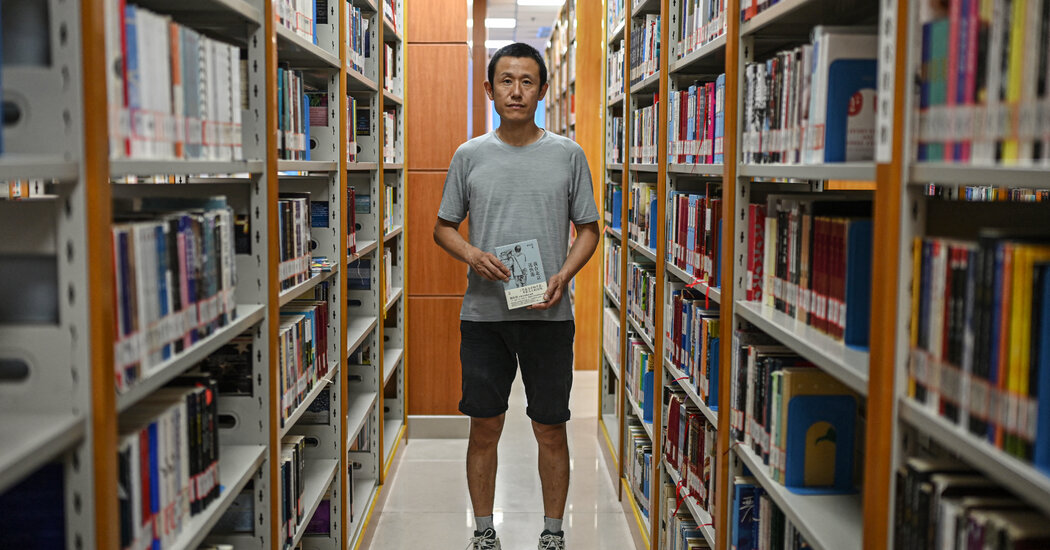
A Chinese food delivery driver rushes from gig to gig, measuring time by the number of jobs he completes instead of by the passing of the seasons. He toils in cities across China to send money back to his family, but has been away for so long that his son calls him “that man” instead of “Dad.”
These are scenes from the poems of Wang Jibing, a food delivery driver, one of several Chinese poets and authors who have turned their experiences of repetitive factory labor and insecure gig work into art.
This literary genre has ballooned in popularity in recent years, as many Chinese have grown pessimistic about the economy. For a wide swath of society, wages have stagnated, youth unemployment is high and the promise of a better life in return for hard work has faded. Some authors use their writing to call attention to the harsh realities of life for migrant and gig workers, while others celebrate the humanity that flourishes in spite of those conditions. Their styles are often raw and straightforward.
Writers like Hu Anyan, a courier who wrote a best-selling memoir about the jobs he has worked across the gig economy, and Fan Yusu, who left her children behind to work as a live-in nanny in Beijing, have tapped into these themes. They have published essays online that have been shared widely and led to book deals. Some best-sellers have been translated and published overseas.
Last month, Mr. Wang’s new poetry collection, “Low Flight,” won the Lu Xun Literary Prize, in the highest institutional recognition for the genre yet.
For the Chinese public, curiosity about these workers is intertwined with anxiety about their own prospects. The concern may be particularly pronounced for members of China’s middle class. They “pay more attention to these kinds of narratives because they may represent their future lives,” said Zhu Ping, a professor of Chinese studies at the University of California San Diego’s literature department.
Gig and factory workers are ubiquitous, yet the hardship and indignities they endure are rarely depicted by China’s state-controlled media, which prefers a more positive spin. As the literary work’s influence has grown, Chinese officials, wary of the power of workers’ grievances to illuminate policy shortcomings or spawn unrest, have increasingly sought to shape it, experts said.
The Rise of Migrant Workers’ Literature
The genre known as migrant workers’ literature mirrors the trajectory of a work force that now numbers more than 400 million people.
Since the 1980s, rural workers have powered China’s factories and cities while often being denied the health insurance, unemployment and retirement benefits available to urban residents. The literary movement’s early authors wrote essays and poems about their experiences in factories, but as manufacturing jobs have begun to disappear, its new breakout stars are more often doing gig work.
One such star is Mr. Hu, the courier who wrote a best-selling memoir. The book, “I Deliver Parcels in Beijing,” was published in 2023 in China, where it was deemed that year’s best book by Douban, China’s equivalent to Goodreads. It is a diaristic account of the 19 jobs he held over two decades across China, including as a sorter at a logistics company, security guard, convenience store worker and courier.
Mr. Hu’s work first came to public attention through an essay he posted online. It detailed his year on the night shift sorting packages at a logistics firm, where the work was grueling and he struggled to get used to sleeping during the day:
I passed by a row of houses on my way in every day. I could smell the cooking going on inside, see the people collapsed on their couches, tired and content after a day’s work. That, to me, was what true happiness looked like. Meanwhile I was already more exhausted than those people, and I hadn’t even reached the warehouse. I cursed myself in those moments: My damned body cursed my willpower, and my damned willpower cursed it back. I swore I would go right to sleep when I clocked off in the morning. But then the morning came around, and everything went the same as the day before. I was trapped in a loop.
— “I Deliver Parcels in Beijing,” translated into English by Jack Hargreaves.
Ding Nan, a 35-year-old teacher in Wuhan, said Mr. Hu’s book was the first piece of migrant workers’ literature she had read, and she has since sought out more works in the genre.
She said she was drawn to stories of gig workers because of their constant presence in her own life. “They are the strangers we regularly interact with, but I never knew what their lives were like,” she said.
Some pieces approach the experience with more hope. In his poetry collection, “Low Flight,” Mr. Wang, the delivery driver, celebrates the dignity and resilience of delivery workers:
Who prescribes that with wings spread one must fly high
Low flight is also a flight
With wind rustling like birds’ chirps
And wheels speeding like shooting stars
The meal delivery note attached to a takeout
In clear black and white symbolizes urgency
Like a legal document and a magic incantation
— “Low Flight,” translated by Chen Du and Xisheng Chen
Ms. Ding said that migrant workers’ stories also changed her preconceptions about the workers. “Society has many stereotypes about them — we think their lives are wretched, that they are oppressed,” she said. “But when I read these books, I realized they are also very optimistic.”
“Low Flight” won Mr. Wang the Lu Xun prize, which is overseen by a government body and given out once every three years. Chinese state media has celebrated Mr. Wang’s win as heralding a new, utopian literary landscape in which anyone can find success.
But a tension exists between the interests of the Chinese government, which downplays stories of poverty or social inequality, and migrant workers’ literature, which lays those realities bare, said Ms. Zhu of the University of California San Diego. She saw Mr. Wang’s award as part of the government’s effort to shape the genre by elevating a more acceptable voice — one that tended toward hope and optimism, rather than criticism of the system’s inherent unfairness.
The Chinese government has said that it wants to foster workers’ voices as part of what it describes as “new literature and arts of the masses,” stories that have taken off in the online era, unconstrained by the traditional gatekeepers of the publishing industry.
That means more resources and opportunities for writers — but largely for the ones who tell palatable stories, said Maghiel van Crevel, a professor of Chinese literature at Leiden University in the Netherlands who studies migrant workers’ literature. Depictions of hardship are acceptable, he said, but linking that hardship to government policy “would be crossing a red line and make it impossible to publish.”
But Mr. van Crevel noted that receiving institutional support did not necessarily mean that a writer had “sold out.” Mr. Wang’s reception by the Chinese establishment “doesn’t necessarily make his writing less authentic,” he said.
From the Factory Floor to Worker Advocacy
Authors like Zheng Xiaoqiong have continued to speak out about workers’ rights even after achieving mainstream success.
Ms. Zheng rose to prominence in China in the 2000s for her poems chronicling the monotony and exhaustion women endured in factories. She described exploitative bosses, workers who suffered from severed fingers or occupational diseases and young women forced into prostitution:
the flowing products and interlocking time are swallowed up quickly
aging ten years flowing past like water enormous weariness
floats through the mind for many years she’s stuck by
the screws one screw two screws turning to the left to the right
fixing her dreams and her youth to some product look
at her pale youth running from an inland village
to a factory by the sea all the way to a shelf in America
— “Woman Worker: Youth Pinned to a Station,” translated by Eleanor Goodman.
Ms. Zheng has received literary prizes and parlayed her writing into a better life and a magazine career. She has also continued to speak out about the issues facing workers in China and around the world.
“I’ve always hoped that those in China who have been fortunate enough to achieve upward social mobility can look back and offer a hand to those who are still bogged down, just as they once were,” she said in an interview.
“We cannot change reality with poetry,” she said, “but we have a responsibility to speak out.”
Siyi Zhao contributed research.
