


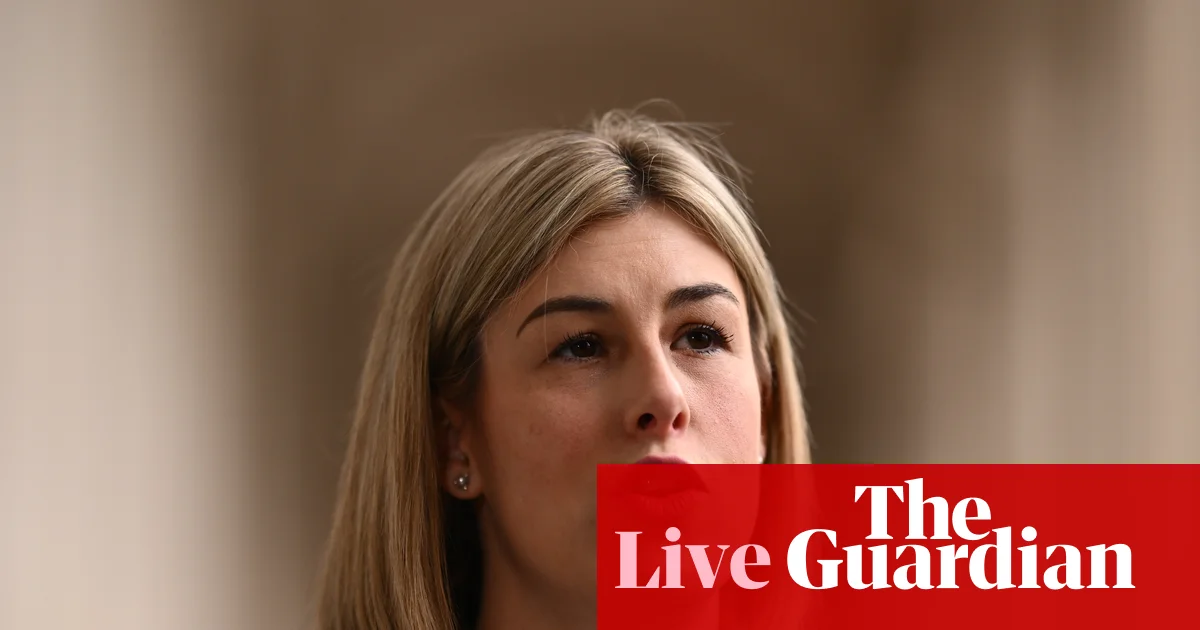
Victorian Liberals pledge to scrap power link to NSW and ‘throw open the doors’ to gas
Benita Kolovos
The Victorian Coalition has pledged, if elected in November, to scrap VNI West, a proposed 240km transmission line linking Victoria to New South Wales.
The project was designed to connect the Victorian and NSW electricity grids and integrate power generated from wind and solar projects in both states. But as we reported earlier this year, backlash to the project has been strong, thanks in part to new laws that will allow the state body overseeing the project to access private land without a landholder’s consent.
In a statement this morning, the opposition leader, Jess Wilson, described VNI West as “unnecessary poles and wires that bulldoze through regional communities”. Instead, the Coalition has said it would “throw open the doors to new conventional gas projects”.
Wilson said:
Regional communities need to know that I have their back, that my Liberal and Nationals team have their back and that we reject Labor’s plans to decimate agriculture and private property rights in this state. A Liberal and Nationals Government will cancel VNI West and take immediate action to secure more gas for our state – meaning lower prices and a secure energy future.

Key events
‘Inflation challenge persists’, says Chalmers
The treasurer Jim Chalmers and employment minister Amanda Rishworth are speaking to the media following the latest wage data. For the full down low on those numbers click here.
Chalmers says that despite wages going backwards over the year to the June quarter, both Treasury and the RBA are “forecasting annual wage growth to return this financial year”.
We have seen real wage grow in the quarter but not in the year … because this inflation challenge in our economy persists.
Chalmers does have some good news though, with the Moody’s rating agency giving the government a gold star and reaffirming the AAA credit rating. Chalmers says:
This is the second global ratings agency in the last couple of weeks give what is a welcome endorsement of the government’s responsible economic management.

Sarah Basford Canales
Advance to appear before parliamentary inquiry this Friday
The rightwing lobby group Advance will appear at a parliamentary inquiry into the 2025 federal election this Friday following members of the Plymouth Brethren Christian church.
While the group’s executive director, Matthew Sheahan, will not be fronting up, Advance’s chair, Vicki Dunne, who served in the ACT Assembly as a Liberal member for 19 years, and its secretary, Mark Spencer, will answer questions about their campaign last election.
Advance mounted attack ads against the Greens and Labor in a number of seats, claiming to have spent $13.8m on the campaign.
An interim report from the inquiry in July made 14 recommendations, including calling for a review of the threshold for entities to be considered significant third parties, and therefore subject to regulation, under federal electoral laws.
It also urged for the introduction of a mandatory code of conduct that would apply to all participants at polling places. The code would be enforced in designated “campaign zones” surrounding booths, where the number of campaigners and signage would be restricted.
Read more:

Patrick Commins
Australia must do better on productivity: RBA deputy governor
Andrew Hauser, the RBA’s deputy governor, says lifting productivity is “the number one challenge for most of the developed world”.
Hauser, speaking at the Queensland Futures Institute Annual Regions Summit, said our weak productivity performance “gives a speed limit to the economy of about 2% GDP growth a year”.
Now that isn’t a bad number, actually, if you’re from the UK or if you come from Germany. But from Australia’s perspective, that has a must-do-better mark on it in terms of its history. It means our real earnings growth won’t be as high. It means our government receipts won’t be as high. It means our wealth won’t be as strong.
The RBA’s second-top official said that, besides the United States, we aren’t alone in trying to deal with these issues.
In Australia – as is true in Germany and the UK, in Korea and other countries – productivity growth, which had been relatively strong and had been the basis of Australia’s enormously successful growth model over decades, has slowed.
I think that fact that it’s shared with other countries who have very different governmental systems and technology setups and social welfare programs and all the rest of it shows you that although it’s right to focus on local issues and the issues that can be dealt with in the country and locally in the state, there’s probably something bigger going on.

Benita Kolovos
Environment groups criticise Victorian Coalition plan to scrap transmission line project
The Victorian Coalition’s election pledge to scrap VNI West has been criticised by environment groups.
Joy Toose, Environment Victoria’s climate campaign manager, said the move would expose Victorians to higher power prices and less reliable electricity:
You can have alternative plans, but you can’t have alternative facts. Renewables and the transmission that carries them are the only thing actually bringing bills down, cancelling that to burn more gas is a plan for higher bills and blackouts, dressed up as the opposite.
She said there was “no such thing as cheap new gas any more”. Toose continued:
Jess Wilson needs to explain where this mysterious “new gas” is coming from. Victoria has already used up 90% of its commercially viable gas reserves – what’s left costs up to twice as much to produce … But what we do have are endless reserves of solar and wind.
RE-Alliance – a not-for-profit working with rural and regional Australians on the renewable energy shift – said cancelling VNI West would mean fewer opportunities for communities. Its national director, Andrew Bray, said:
The loudest opponents do not speak for every farmer. Many farmers have actively chosen to host projects so they can diversify their income, strengthen their farm businesses and keep farming through droughts and volatile commodity prices.
Bray said communities deserve better consultation and a role in shaping the developments but failures in this space “will not be fixed by cancelling essential infrastructure and wiping out opportunities for people in the regions”:
They will be fixed by delivering the renewable energy rollout properly, with hosting communities at the table.
Victorian Liberals pledge to scrap power link to NSW and ‘throw open the doors’ to gas
Benita Kolovos
The Victorian Coalition has pledged, if elected in November, to scrap VNI West, a proposed 240km transmission line linking Victoria to New South Wales.
The project was designed to connect the Victorian and NSW electricity grids and integrate power generated from wind and solar projects in both states. But as we reported earlier this year, backlash to the project has been strong, thanks in part to new laws that will allow the state body overseeing the project to access private land without a landholder’s consent.
In a statement this morning, the opposition leader, Jess Wilson, described VNI West as “unnecessary poles and wires that bulldoze through regional communities”. Instead, the Coalition has said it would “throw open the doors to new conventional gas projects”.
Wilson said:
Regional communities need to know that I have their back, that my Liberal and Nationals team have their back and that we reject Labor’s plans to decimate agriculture and private property rights in this state. A Liberal and Nationals Government will cancel VNI West and take immediate action to secure more gas for our state – meaning lower prices and a secure energy future.
‘Oh, there’s definitely a difference’: Farley and Hanson’s migration policies differ
David Farley might not understand exactly what net overseas migration is.
For any of you who might be in a similar boat, net overseas migration is the total number of people coming into Australia minus those going out.
Ok, let’s continue.
One Nation says its NOM target is 130,000 per year, but Farley – the One Nation MP who won the seat of Farrer earlier this year, says his position is different to his boss’s.
He tells the Michelle Grattan Podcast:
That’s the net [130,000]. Now on top of that is our PALM (Pacific Australia Labour Mobility) programme, which we use in our meat workers. On top of that is our aged care skilled nurses, our medical skills as well. Now they’re coming in on rotating visas that are there. Now they have the option to apply to become long-term citizens of the country, which is that’s when it refers you back to the net number.on top of
Grattan asks then how many total migrants are coming in according to him. He says, “it’s probably circa another 40,000 a year on top of it.”
So what he’s really saying is that his policy is for net overseas migration to be around 170,000, not 130,000.
Grattan: So do you now have a different position from Pauline Hanson on migration? When we spoke to you during the Farrer campaign, there was a difference.
Farley: Oh, there’s definitely a difference.

Cait Kelly
Disability orgs say NDIS ‘reforms’ strip away the right to live with dignity, autonomy and equal participation.
The National Mental Health Consumer Alliance, the national peak body for mental health consumers including people with psychosocial disability, says the passing of the NDIS Reform Bill is a step backwards.
CEO of the Alliance Priscilla Brice said:
That is not reform. It’s a fundamental retreat from the promise of the NDIS: that people with disability are entitled to the supports they need to live with dignity, autonomy and equal participation.
This legislation ignores the original rights-based framework the Scheme was built on and reduces it to a cost-containment mechanism, where human rights are subordinated to economic efficiency.”
The organisation pointed to the independent report by the Grattan Institute, which showed these cuts may help meet short-term fiscal targets, yet they fail to address the real challenges facing the NDIS in the long-term. Brice said:
Reducing SCCP supports will shift costs to more expensive crisis and health systems in the absence of adequate alternative psychosocial supports and put more people at risk.
News bargaining incentive passes lower house
Just a little earlier in the House of Representatives the government passed the news bargaining incentive, after making an amendment this morning to increase the levy on tech giants if they don’t sign the mandatory number of deals with publishers.
Under the incentive, which updates the Morrison-era news media bargaining code, platforms including Google, Meta and TikTok will have to sign deals with at least eight publishers or pay 2.75% of their digital ad revenue to the government (who will then distribute it to news organisations).
Independent MPs including Allegra Spender and Kate Chaney put forward several amendments to the bill but they were rejected by Labor.
Australian workers’ real wages go backwards
Patrick Commins
Wage rates failed to keep up with inflation over the past year, in the latest sign that Australian workers are struggling to deal with high and rising cost of living pressures.
The ABS’s wage price index (WPI) climbed by 3.2% in the year to the June quarter, unchanged from the previous quarter but down from the 3.4% this time last year.
This pace of wage growth would normally be considered pretty good – it’s well above the 2.2% annual rate leading into the pandemic (although also below the peak growth rate of 4.3% in 2022).
But after factoring in cost of living – including higher consumer prices and rising interest rates – real wages are now falling again, in annual terms.
Jim Chalmers, the treasurer, in a statement said:
Real wages were up in quarter but down through the year, not because wages have been too low but because inflation is still too high.
Chalmers added that “even with today’s figures annual real wages have grown for eight of the last 11 quarters”.
Public sector wages grew by 3.4% through the year to June, largely reflecting state government pay rises, compared with 3.1% growth in the private sector.
It’s worth noting that the WPI measures change in rates of pay for a given bundle of jobs, so does not include the impact on pay from people changing jobs or working more hours.
Gambling reforms ‘progress’ but evoke mixed emotions, Peta Murphy’s husband says
Rod Glover, the husband of the late Labor MP Peta Murphy, who chaired the “you win some, you lose more” inquiry, says the legislation is a “breakthrough of sorts” but describes it as far from what Murphy originally recommended.
Writing on LinkedIn, Glover praises the Greens, independents, advocates, experts and those with lived experience for pushing the government and the Coalition to strengthen the original legislation.
He says acknowledging some of the failures of the bill and the process of getting to this point “shouldn’t stop us recognising what has now been achieved, or understanding how it became possible”.
The package is far from everything that is needed, and it has taken too long to get here. That delay has had real human consequences … The final package falls well short of the Murphy Report recommendations, which remain the benchmark for comprehensive reform. The limits of the reforms reflect, in large part, the considerable lobbying power of the gambling industry, major sporting codes and media organisations.
Major policy change is rarely a single act. This package is a big improvement on the status quo – and a demonstration that our democratic system can still find ways to make progress on hard and contested problems.
‘Fatally flawed’: Scarr rebukes gambling reforms bill
Liberal senator Paul Scarr says the gambling reforms bill being debated in the Senate today is “fatally flawed”.
He’s visibly frustrated and angry at the changes, promising to cross the floor and support amendments from independent MP David Pocock.
Scarr commends the opposition communications minister, Sarah Henderson, for making some changes to the bill, but says he “won’t be part of it”.
I think this is such a serious issue for millions of Australians impacted by gambling harm, and this is such a flawed piece of legislation that I have no choice but to cross the floor.
Scarr, a Queenslander, says the State of Origin (which from the age of six, “wild horses” couldn’t keep him away from watching), starts at 8:05pm, which means there would be no gambling ads during breaks for just 25 minutes of the game.
That’s the loophole … How many kids are going to be watching State of Origin from 8:05 to 8:30 and then go to bed at 8:30, and after 8:30 it becomes open slather?
It’s an absurdity and I won’t be part of it.

Josh Butler
Gambling reforms ‘not going to please everyone’ as Labor and Coalition put positive spin on bill
The Labor and Liberal parties are more positive about the gambling changes, unsurprisingly.
Shadow communications minister Sarah Henderson said the changes struck the right balance between addressing gambling harms while still preserving the “personal choice of people who choose to gamble”.
Henderson called the opt-out register “a very significant initiative”, claiming it was “untenable” that people would be expected to individually opt out of ads on each website, streaming service and social media platform. But she also demanded the government “get it right”, raising concerns about security of data which people provide to the register.
She also accused Labor of “three years of delay, deflection and deception” on gambling, criticising the “greatly flawed bill” Labor initially introduced because it didn’t originally include action on inducements. Henderson said of the register:
This is a huge warning to the gambling companies – every single Australian will have the opportunity to opt out.
Labor senator Michelle Ananda-Rajah conceded the changes were “not going to please everyone” but paid tribute to Peta Murphy, the late Labor MP whose “seminal work kicked off this response”. Ananda-Rajah said:
We didn’t fulfil all of Peta’s requests, but I think we delivered highly significant reforms which will make a tangible difference.
A medical doctor, Ananda-Rajah said she had seen the health effects of gambling, which stretched into mental health, family violence, homelessness and family breakdown.
Everyone is paying for this harm.
‘What an absolute joke’: Hanson-Young doesn’t mince her words on gambling reform bill
Debate on the gambling reforms continues in the Senate, where a number of emotive contributions are coming from across the aisle. Greens senator Sarah Hanson-Young accused Labor and the Coalition of having “failed the moral test” on the issue, after failing to legislate a total ban on gambling ads.
She also questioned the national opt-out register, raising doubts about whether it would work. Hanson-Young said:
What an absolute joke … It’s as if people in this place, the prime minister’s office, don’t understand how the internet even works.
How will this opt-out register even work? The government can’t even answer it … It beggars belief the government and opposition can come in here today and think they can sell this rubbish.
Details of the register are scant at this stage, and are being developed as we speak. It could take up to 12 months to implement, Labor sources said.
Hanson-Young was also livid that inducements would only be partially scaled back, not ended altogether.
“If inducements are so harmful, they should be banned,” she said.
We’re going to let the gambling companies decide who is vulnerable to their inducements? [Liberal MP] Andrew Wallace is right, this is putting Dracula in charge of the blood bank.
