


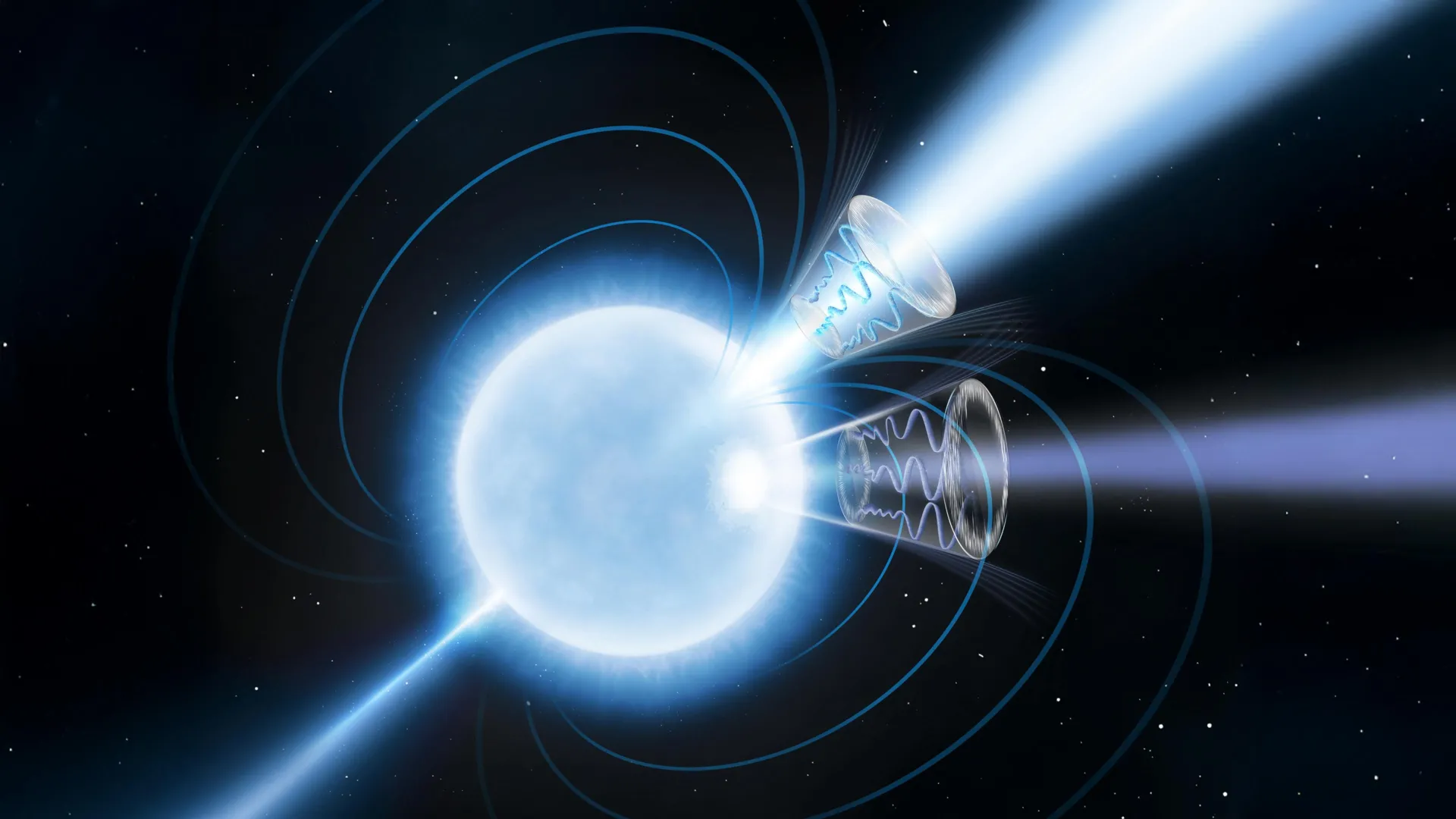
Astronomers may have found some of the strongest evidence yet for one of quantum mechanics’ strangest predictions: even apparently empty space can influence the way light travels.
Known as ‘vacuum birefringence’, the phenomenon was predicted nearly 90 years ago by Werner Heisenberg, one of the pioneers of quantum mechanics. His work suggested that a perfect vacuum is not truly empty. Instead, it should contain ‘virtual particles’ that briefly appear and disappear.
Researchers, including Dr. Marcus Lower from Swinburne University of Technology, investigated this long-standing quantum mystery by studying a magnetar, a rare type of neutron star that possesses the strongest magnetic fields known in the universe.
Their observations may represent the first detection of vacuum birefringence occurring within a magnetar’s extraordinarily powerful magnetic field. If confirmed, the result could give scientists a new way to investigate the quantum universe. The findings were published recently in Nature.
How Extreme Magnetic Fields Can Change Light
According to the theory, an exceptionally strong magnetic field can affect the sea of virtual particles associated with the vacuum. Under these conditions, the particles are expected to influence how light travels, refracting it in a specific way and producing vacuum birefringence.
Magnetars provide a rare opportunity to search for this effect because their magnetic fields are powerful enough to make the predicted quantum behavior potentially observable.
Dr. Lower was part of an international research team that studied the magnetar 1E 1547.0-5408 (or 1E1547 for short) with NASA’s Imaging X-ray Polarimetry Explorer (IXPE). The observations were supported by the NICER X-ray telescope aboard the International Space Station and Murriyang, CSIRO’s Parkes radio telescope, which is owned and operated by Australia’s national science agency.
Radio observations collected by Dr. Lower using Murriyang, followed by analysis on Swinburne’s Ngarrgu Tindebeek supercomputer, helped the researchers investigate what could be the first direct detection of this previously theoretical quantum phenomenon.
Although vacuum birefringence was predicted in the 1930s, Dr. Lower said scientists have yet to obtain a definitive detection.
“Detecting vacuum birefringence requires a magnetic field that is over 100 million times stronger than any we’ve ever made on Earth. Thankfully, nature has provided us with magnetars, which are the perfect cosmic laboratories to go looking for this effect,” Dr. Lower said.
A Magnetar With Ideal Viewing Geometry
The researchers closely followed how the radio waves coming from the magnetar changed direction as the star rotated (their ‘polarization state’). From those measurements, they determined that the magnetic and rotational axes of 1E 1547 are almost aligned. The magnetar is also observed from a nearly pole-on perspective.
Together, those characteristics give scientists an unusually favorable view for searching for vacuum birefringence around 1E 1547.
The team then found two important clues pointing toward the quantum effect. X-rays generated by the magnetar and detected by IXPE showed extremely high levels of polarization. In addition, the direction of that polarization remained tied to the magnetic field of 1E1547 in the same way seen in the radio observations.
“Because of the magnetic field’s strength, Heisenberg’s virtual particles become aligned with the direction the field is pointing,” Dr. Lower said.
“By carefully tracking the direction the radio waves and X-rays oscillate as the magnetar rotates, the team found that the alignment of 1E1547’s magnetic and rotational poles were ideal for detecting vacuum birefringence.”
Closing In on a 90 Year Quantum Mystery
If the interpretation is confirmed, the result could help physicists test how established theories of quantum physics behave under some of the most extreme conditions found anywhere in the universe.
Dr. Lower said additional observations and more advanced computer simulations could help establish whether the signal truly comes from vacuum birefringence. Those improvements should make it easier for researchers to distinguish the predicted quantum signature from other physical processes taking place around magnetars.
“With these future data on hand and our updated simulations, we may finally be able to complete the quest started by Heisenberg nearly 90 years ago.”
The paper titled “Vacuum birefringence and the polarized X-ray emission of a radio magnetar” has been published in Nature.
