


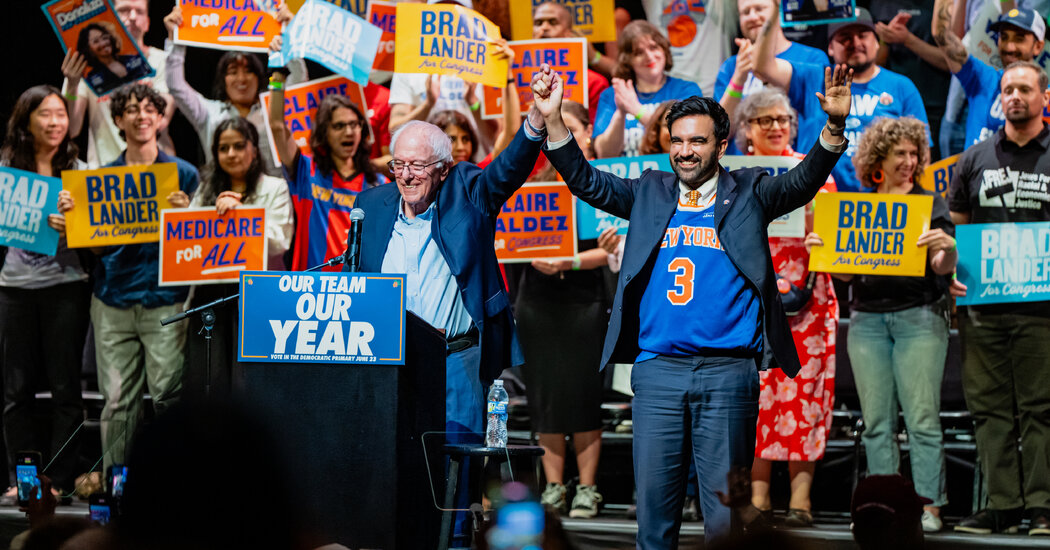
A movement of young, progressive outsiders has stormed Democratic politics this year, sparking a wave of contentious primary contests across the country and fueling a fraught debate over whether these new, left-wing candidates are remaking the party in their image.
But as primary season winds to a close, the results reveal not only the strength but also the potential limitations of this insurgent movement.
In Minnesota last week, Peggy Flanagan, the lieutenant governor, won a Senate primary by a double-digit margin, pressing a fiercely progressive message to defeat a more moderate opponent. Just a week earlier, Dr. Abdul El-Sayed, a left-leaning Democrat, won a Senate primary in Michigan despite being vastly outspent. And Francesca Hong, a member of the Democratic Socialists of America, came close to winning a primary for governor in Wisconsin, falling short by less than one percentage point.
The results marked a new level of political strength for candidates affiliated with a resurgent, activist left, showing that their movement can be competitive in statewide primaries, well beyond deep-blue House districts.
Yet while a vocal group of strategists, activists and college-educated voters have raced to embrace these pugnacious, boldly liberal — and in some cases untested — candidates, some of the voters who have historically been most crucial to the party’s fortunes remain skeptical.
In Michigan and Wisconsin, both pivotal battleground states, the progressive candidates appeared to have struggled to sway voters who have long been the backbone of the party — including Black, more moderate and older Americans who vote reliably.
As left-wing candidates have notched victories in primary after primary, many progressives hope they will be able to move the Democratic Party further to the left — mirroring, in some ways, how the rise of the Tea Party movement nearly two decades ago pushed the Republican Party much further to the right. But the results raise questions about whether these candidates can piece together a broad enough coalition of Democrats, independents and moderates to win general elections in swing states that could determine whether Democrats are able to regain power in Congress and, eventually, the White House.
“Would I put a D.S.A. member up for governor in New York or Massachusetts?” said Chris Walton, the former chairman of the Democratic Party of Milwaukee County. “Sure, we can take a chance. But it makes it harder in a state like Wisconsin, where you’re starting out at the 48-yard line and have to figure out how to get to 50.”
The next major tests for the left will come this fall in a smattering of battleground House districts, and as Dr. El-Sayed and Troy Jackson, a progressive former state senator in Maine, fight to win seats that Democrats need to capture control of the Senate.
The primary results indicate that to win, some of those nominees must not only persuade independent voters, but also shore up their own bases.
In Michigan, Dr. El-Sayed trailed in majority-Black townships across the state. While he was popular with younger voters, there were signs that he was weaker than his Democratic primary opponent, Representative Haley Stevens, among older voters, who vote more reliably.
In Wisconsin, Ms. Hong, who had been the heavy favorite in polling, lost her primary to David Crowley, the Milwaukee County executive who would be the state’s first Black governor, in a shock upset. Mr. Crowley had an edge in metro Milwaukee and in rural counties, while Ms. Hong showed strength in smaller cities and suburbs, as well as counties that are home to college towns.
Senator Bernie Sanders, the Vermont independent who championed progressive candidates across the country including Dr. El-Sayed and Ms. Flanagan, said he is confident that Democrats, as well as independents, will rally behind the nominees in the fall.
“If our candidates keep talking about the issues that are relevant to ordinary people — the issues of affordability, the issues of health care, the issues of education, housing, basic necessities of life, protecting Social Security — against Republicans who want to cut Social Security, you know what?” said Mr. Sanders. “Our guys are gonna win, and they’ll win big.”
But even in some of the most heavily Democratic neighborhoods in America, there are signs of fissures. In New York, Black and Latino leaders have expressed alarm over democratic socialist victories in gentrifying neighborhoods, worrying that the day-to-day concerns of longtime residents will be overlooked.
Representative Adriano Espaillat, a New York Democrat and chair of the Congressional Hispanic Caucus, lost his primary earlier this summer to a far-left challenger, Darializa Avila Chevalier, a democratic socialist who had voiced support for abolishing the police, borders and prisons and seizing property from landlords.
In an interview, he nodded to precinct-level data showing that while his opponent did better in whiter, younger, and higher-income areas, he was strong across many older and majority-Hispanic areas.
“They claim to have the agenda of the working class, but that’s not what the people in those in those communities feel,” Mr. Espaillat said. “Those neighborhoods, I believe, are concerned about affordability, but they’re also concerned about public safety. You know, they’re also concerned about the types of issues that D.S.A. may have a different position on than they do.”
The growth of a new insurgent left was supercharged by the Democrats’ loss in the 2024 presidential race, which created a fresh opening for a new kind of politician who could channel Democratic anger with what they saw as a sclerotic party establishment.
The following year, Zohran Mamdani — fueled by an activist, progressive left that was animated by the Palestinian cause and fury toward billionaires — won a surprise victory in the New York City race for mayor, prompting a new class of Democratic candidates to embrace a similar bold vision.
The candidates share some unifying principles: Support for “Medicare for all,” opposition to A.I. data centers, a commitment to ending corporate money in politics and a view that opposition to American support for Israel is a moral litmus test, fueled by a belief that the Gaza war amounted to a genocide.
But beneath that broad platform, there are real differences among the candidates.
“There is a wide range of candidates who have been able to position themselves as either progressive or populist or even under the D.S.A.,” said Matt Barreto, a Democratic pollster who worked with former President Joseph R. Biden Jr.’s campaign. “It’s way looser ideologically than people think.”
Ms. Hong, a state lawmaker, is a member of the D.S.A., which is not officially part of the Democratic Party.
Dr. El-Sayed, who calls himself a “capitalist,” is not a D.S.A. member, nor was he endorsed by the group. He does have a yearslong relationship with the organization, speaking at several local events during the first Trump administration.
And in Minnesota, Ms. Flanagan eagerly embraced progressive policies and allies like Mr. Sanders but is a lifetime member of the Democratic-Farmer-Labor Party, the Democratic Party’s engine in the state, which endorsed her bid.
Ms. Flanagan, who defeated Representative Angie Craig by 20 percentage points, said she focused on organizing support in every corner of her home state.
“The coalition that we have built is faith, labor, young people, folks in greater Minnesota, farmers,” she said in an interview. “When you build relationships with people, even if you don’t see eye to eye on everything, I think that’s the way that we won this election.”
Still, despite the differences, all three races illustrated how Democratic views of what makes a candidate electable has shifted — within some limits.
In both Minnesota and Michigan, voters rejected an argument made by Democratic leaders that the more moderate candidates — Ms. Craig and Ms. Stevens — were better positioned to win statewide.
But in Wisconsin, Ms. Hong’s baggage from pandemic-era statements that she struggled to explain — including one in which she suggested canceling Thanksgiving and another describing her young biracial son as offering her “proximity to whiteness” — appeared to be too much for voters.
“People are less willing to trust the political class and what we think is electable,” said Lauren Hitt, a Democratic strategist who has worked for candidates across the ideological spectrum. “They’re looking for people who break the mold, but if you break the mold so much that you’re eccentric, that’s not the solution either.”
Charles Franklin, the director of the Marquette Law School poll in Wisconsin, said that since the rise of Mr. Mamdani, it has been “maybe easy to be caught up in just how strong democratic socialists were doing.”
But now, he added, “when you go to statewide races with that more heterogeneous electorate, I think you’re seeing some limits on that, even within Democratic primaries.”
Ruth Igielnik contributed reporting.
