


This spring, during Holy Week, a priest visited a Ukrainian drone unit near Zaporizhzhia. He prayed with the combatants for their protection, then sprinkled holy water on a Gara strike drone, consecrating the machine before it flew against Russian lines. That drone still required a human operator, but many of those envisioned by the world’s advanced militaries do not. As weapons become increasingly autonomous and artificial intelligence displaces human decision-making, wars can become easier to start and harder to control.
Few leaders have addressed these concerns as pointedly as Pope Leo XIV did in his first encyclical, Magnifica Humanitas: On Safeguarding the Human Person in the Time of Artificial Intelligence. The pope’s treatise on the promise of AI and its threats to human rights and dignity received global attention.
This spring, during Holy Week, a priest visited a Ukrainian drone unit near Zaporizhzhia. He prayed with the combatants for their protection, then sprinkled holy water on a Gara strike drone, consecrating the machine before it flew against Russian lines. That drone still required a human operator, but many of those envisioned by the world’s advanced militaries do not. As weapons become increasingly autonomous and artificial intelligence displaces human decision-making, wars can become easier to start and harder to control.
Few leaders have addressed these concerns as pointedly as Pope Leo XIV did in his first encyclical, Magnifica Humanitas: On Safeguarding the Human Person in the Time of Artificial Intelligence. The pope’s treatise on the promise of AI and its threats to human rights and dignity received global attention.
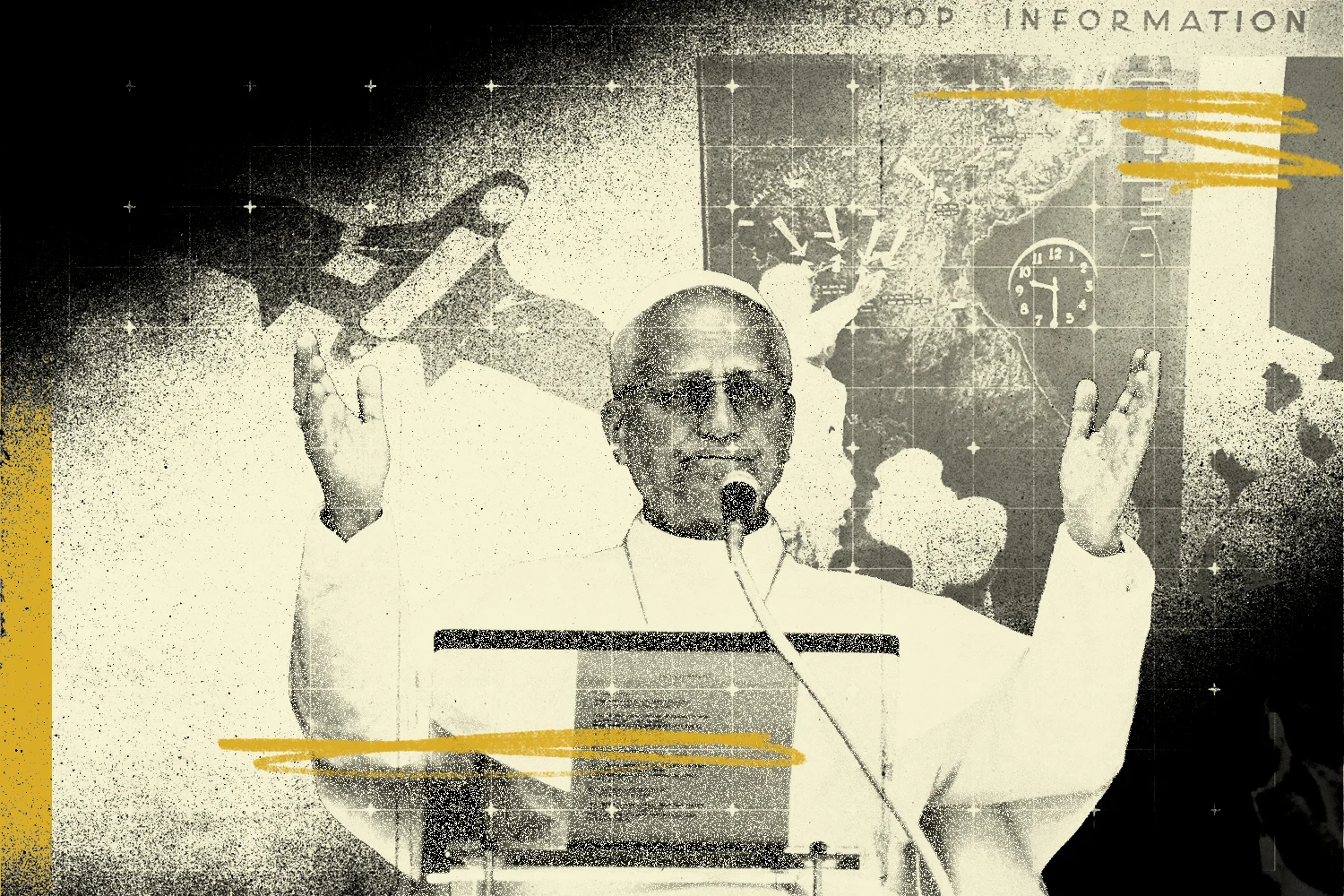
Pope Leo XIV attends the presentation of his first Encyclical Letter “Magnifica Humanitas” focused on the rise of artificial intelligence, in The Vatican on May 25.Alberto PIZZOLI / AFP via Getty Images
But the encyclical’s thoughtful development of ethical constraints for the use of autonomous weapons received less coverage. The same is true of the document’s challenge to the very possibility of “just war” in the 21st century. “[M]ore than ever, without prejudice to the right to self-defense in the strictest sense,” the pope wrote, “it is important to reaffirm that the ‘just war’ theory, which has all too often been used to justify any kind of war, is now outdated.”
Pope Leo is right that the theory has been abused and right to emphasize dialogue and diplomacy. But strip away just war theory and states do not become pacifists. Politicians do not become saints, and commanders do not become ethicists. All lose a shared, intelligible standard by which wars have been judged and constrained for centuries—one that, if updated, can still guard against war’s worst abuses in an age of machine-speed conflict.
What just war theory requires is not retirement, but a rethink for modern war. That revision must contend with war that is increasingly mediated. Technology and great-power competition allow those who benefit from conflict to distance themselves from its costs.
The pope’s skepticism regarding just war theory reaffirms that of his predecessor, Pope Francis. But it is bolder still coming from Leo. He is an Augustinian, from an order of priests that traces its origins to a saint who wrestled with how rulers could wage war without abandoning the Christian obligation to pursue peace. St. Augustine’s writings became the wellspring of just war theory, a framework that Thomas Aquinas systematized and the Dutch jurist Hugo Grotius helped to secularize.
Leaders have grappled with the dilemma for centuries: War is awful but sometimes necessary; just war theory establishes when and how. The decision to go to war must be in response to an act of aggression. It must come from the right intention and the right authority. Equally important, war must be a last resort and carry a reasonable prospect of ending in a just peace. In its conduct, combatants must use force proportional to the value of the military target. They must avoid direct targeting of civilians and take extra measures to lower the risk of civilian harm, even if it means assuming additional risks themselves.
The criteria are taught at every U.S. service academy, embedded into the law of armed conflict, and applied daily by the targeting cells of modern militaries. What started as a Catholic possession has become the West’s longest-running intellectual project on the restraint of violence. The pope is right that rulers invoke the theory to bless whatever war they wish to fight. But as Michael Walzer observed, this hypocrisy is “the tribute vice pays to virtue.” By paying it, rulers invite judgment by the very standard they invoke.

Left: Chinese philosopher Mozi. Center: philosopher Mencius. Right: Philosopher and military strategist Sun Tzu. Wikimedia Commons
Nor is the logic behind just war theory exclusively Western; there are common features to war that all cultures must wrestle with. During the Warring States period, Mencius held that a tyrant who destroyed benevolence and righteousness could forfeit the standing of a ruler. Mozi condemned offensive war while preparing the state of Song to resist an unprovoked siege. Sun Tzu regarded subduing an adversary without fighting as the highest form of generalship and warned repeatedly about war’s costs. Just war theory does not map neatly onto the Chinese tradition, but the common ground could prove valuable in restraining the conflicts to come.
On both sides of the Pacific, the incorporation of artificial intelligence into military capabilities encourages a kind of warfare that creates additional layers between decision-makers and the killing. They can make the resort to violence more likely, even as it grows more precise. They endanger accountability, a feature critical to any normative regime’s survival. And whatever precision machines achieve, they remain incapable of mercy and the other human dispositions that not only make war a little more humane but help set conditions for a better state of peace.
The just war tradition therefore requires an update for new ways of mediated war. And the strongest evidence that one can be built may come from the pope’s encyclical itself. Even as Leo challenges the theory’s relevance, the criteria he outlines to constrain the use of autonomous weapons employ the tradition’s same vocabulary and conditions.
For the use of autonomous weapons, the pope demands a chain of responsibility that is “identifiable and verifiable,” running from those who design and train a system to those who authorize and employ it. In fact, the Pentagon’s Responsible AI Strategy demands much the same chain of accountability. Enforcing it is harder. When machines mediate the act, the law struggles to locate intent, inviting either an unfair standard that holds humans liable regardless, or the machine as an alibi for those who act badly.
The pope also insists on a “moral timeframe” for judgment, warning that “speed and efficiency should never be the supreme motivating force for the irreversible decisions made in the context of war.” The decision to use lethal force, the pope writes, must remain under “effective, self-aware and responsible human control,” and systems built so decisions can be retraced and reconstructed—so that accountability is not collapsed into “the machine.” This is the tradition’s oldest demand, that a human answer for the killing, now recast as an engineering requirement. Yet the same Pentagon that requires traceable AI also prizes speed and efficiency—pressures that can deepen dependence on the machine, shrinking, if not displacing, that moral timeframe.
The pope, in reckoning with these developments, has not retired just war theory. Through his own reasoning and the ethical constraints he places on the use of emerging military capabilities, he has shown that no one can. Confronted with the newest weapons in history, the encyclical could find no moral vocabulary but the tradition’s own. It is not that the criteria for just war have become obsolete, but that their application to modern warfare has.
Seven years ago in these pages, we argued for one such update, explaining how another form of mediated conflict, proxy war, introduces complications that just war theory does not sufficiently address. Much of this comes from a single flawed assumption: that if a proxy’s cause is just, then a benefactor’s support for them is just. But once a proxy has a benefactor’s support, they have greater resources and greater reason to escalate a conflict rather than resolve it. Support for proxies also increases the risk of diffusion, that weapons migrate beyond the conflict they are provided for, as the Stinger missiles of Afghanistan later surfaced in Bosnia and Kashmir. Finally, if a nation provides a proxy with advanced weapons without instituting practices to prevent their indiscriminate use, then that nation bears some responsibility for their crimes, what scholars call the problem of dirty hands.

Taliban commandos with U.S.-made heat-seeking Stinger missiles pass by a hijacked Indian Airlines plane at Kandahar airport in Afghanistan, December 30, 1999. SAEED KHAN/AFP via Getty Images
Escalation, diffusion, and dirty hands are the same risks Leo identifies concerning the rise of autonomous weapons. Machine-speed decision cycles amplify the risk of escalation. Autonomous systems run on software, which can proliferate faster than any missile, magnifying the risk of diffusion. Machine-based targeting creates a responsibility gap that may hide, and often worsens, the problem of dirty hands. “No algorithm can make war morally acceptable,” the pope wrote. Proxy war and autonomous weapons present similar moral dilemmas from different removes. Still, the just war tradition, once updated, give us the means to evaluate and restrain both.
What the tradition does not need is to be replaced whole cloth. Earlier this summer, Leo gathered 178 cardinals in an extraordinary consistory to debate an update to the teaching. The Vatican’s doctrinal chief, Cardinal Víctor Manuel Fernández, argued that just war theory, rather than preventing wars, now helps justify them. He lamented a political culture that perceives the pursuit of peace as utopian, puts a premium on discrediting opponents, and values inconsistency as strategy. The consistory reportedly considered a narrower standard of “proportional defense” as a replacement, permitting self-defense in the strictest sense. But the proposed alternative answers only whether to fight, and only reactively. Proportional defense provides little to the military planner, the targeting cell, or the soldier on the ground.
Leo closed the consistory by acknowledging the need to reconsider legitimate defense in light of changes in contemporary conflict, saying that this reflection “deserves to be developed further with the necessary theological and pastoral rigor.” His encyclical’s criteria for autonomous weapons show the development is already underway. But the work must also include engagement with the people who depend on the criteria and make them operational: commanders, ethicists, military lawyers, the drafters of rules of engagement. They must be joined by the engineers and systems analysts who design the machines already altering the way war is waged.
A renewed just war doctrine would address the challenges of mediated warfare by reconnecting benefit to cost, ensuring that they are shared appropriately. It will also have to better connect action to consequence so that the application of principle does not become muddled by outdated concepts of accountability. One way of doing so is to integrate ethics in advance, building in mechanisms to prevent civilian harm before systems become operational, rather than sorting out accountability afterward, when soldiers who trusted those systems are the ones left holding the blame.
The original tradition arose because a fractious Roman Empire was reaching for ethical guidelines and constraints on wars it was already fighting. The priest in Ukraine, blessing a drone before sending it toward the enemy, is Augustine’s conundrum in its newest form. Wars are different now and changing fast. The need to judge them carefully, and to restrain their worst abuses, remains.
