


Welcome back to Foreign Policy’s Latin America Brief.
The highlights this week: A deadly earthquake rattles Colombia, the United States threatens visa bans for Argentines doing business with Huawei, and the final season of One Hundred Years of Solitude drops on Netflix.
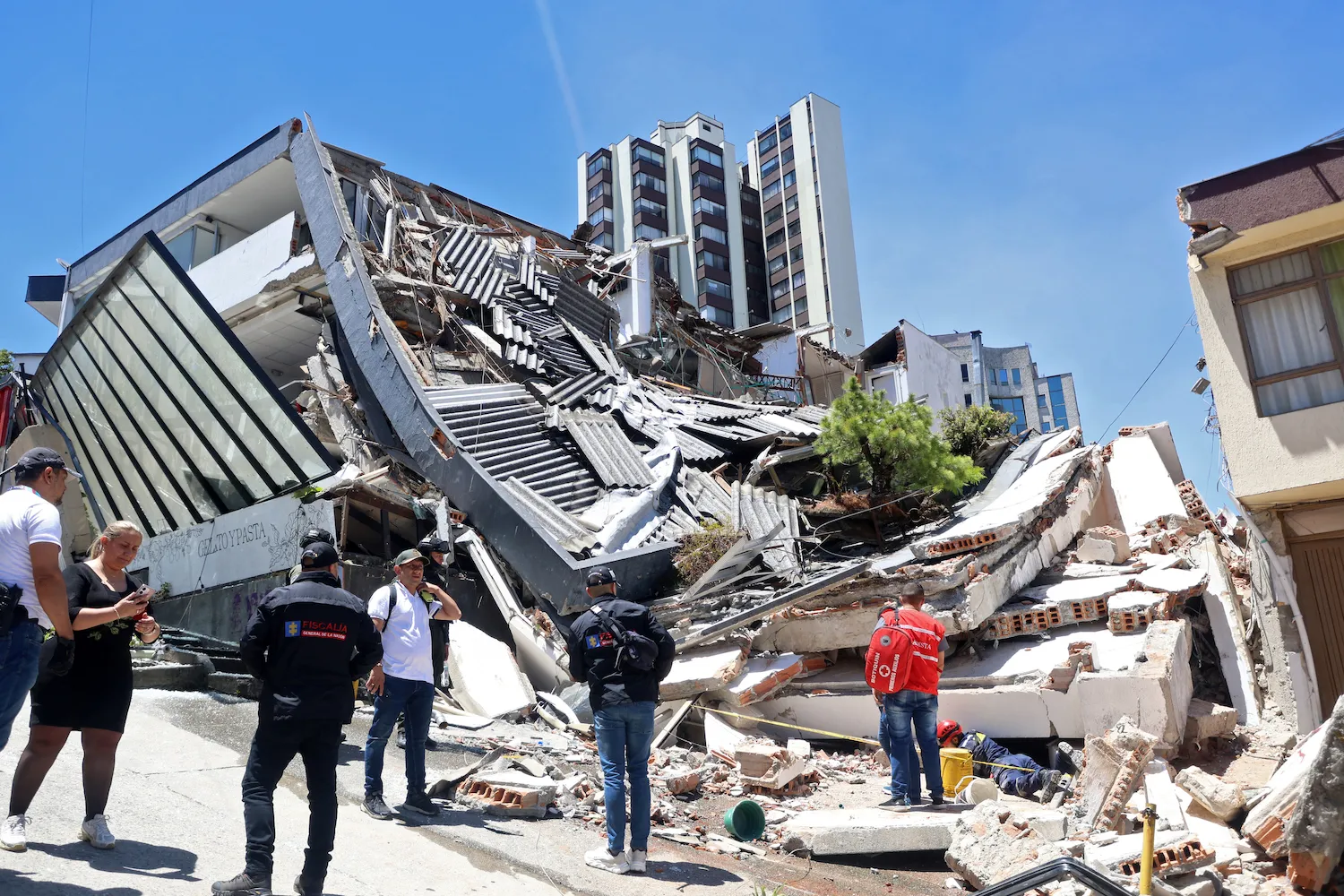
Colombian President Abelardo de la Espriella had been in office for less than three days when a 7.4-magnitude earthquake hit the country on Monday.
The epicenter of the quake was in the Chocó department, which is located between Bogotá and the Pacific coast and lies on a few fault lines. Colombian officials said on Thursday that at least 273 people had died, while a civilian-created tally reported that more than 4,000 were still missing.
Earthquake response has dominated de la Espriella’s first days in office and led to global offers of support. But the new president was slow to embrace those overtures—highlighting a foreign-policy shakeup that he was already carrying out.
Because finding survivors is most likely in the first 72 hours after an earthquake, search and rescue specialists from across the world often travel to quake zones immediately after disaster strikes to help local governments, as they did following Venezuela’s June earthquakes.
Countries including Chile, Ecuador, El Salvador, Israel, Mexico, Peru, and the United States all offered assistance to Colombia early this week. But de la Espriella’s administration at first said that it sought help only with equipment, not personnel. That sparked domestic criticism; in some cities, untrained volunteer groups were struggling to try and rescue their trapped neighbors.
On Wednesday, Bogotá changed its tune, saying that it would accept search and rescue help from Ecuador, El Salvador, Israel, and the United States. Colombian officials said that those four countries were chosen because they were internationally certified. But commentators wondered whether the decision reflected de la Espriella’s sharp turn toward the Trump administration and its allies.
When de la Espriella took office, the United States announced a new $1 billion security partnership with Colombia and plans to carry out joint military operations on Colombian soil. Colombia also ended diplomatic ties with Cuba and Nicaragua and restored them with Israel—moves that hewed closely to U.S. positions.
What’s more, de la Espriella added Colombia to the small list of countries that recognize Moroccan sovereignty over the disputed Western Sahara region. Colombia also became the only country besides the United States and Israel to recognize Israeli sovereignty over the occupied Golan Heights, triggering a formal protest to the United Nations by Syria and several of its neighbors.
On Wednesday, Colombian Foreign Minister Omar Bula denied that the government had chosen which rescuers to accept based on “ideological consideration.” But political analyst Sandra Borda pointed out that many other countries beyond those selected by Bogotá appeared to have U.N.-administered international certification for search and rescue operations.
“It’s going to cost us a lot to understand why we continue having difficulties rescuing so many people while at the same time deciding not to accept help,” Borda posted.
As the key 72-hour window for saving survivors neared its close on Thursday, little heavy equipment had arrived in the remote cities of Quibdó and San José del Palmar to clear rubble. “We’ve felt abandoned,” San José del Pamar’s mayor told France 24.
Even so, the Colombian government’s response to the earthquake has been quicker, more effective, and more transparent than Venezuela’s response to its June disaster, thanks in large part to the functioning state institutions that Caracas lacks after years of autocracy.
In the hours after Colombia’s disaster, local and national officials gave updates on estimates of dead and injured. It was a contrast with Venezuela, where the government slowly released statistics that civil society groups widely considered a vast undercount. Colombia’s military also arrived more quickly on the scene to help.
Colombia’s institutions may be further tested during de la Espriella’s presidency. The president made radical claims on the campaign trail, saying he would “gut” the political left and jail its members. Some swing voters who aided in de la Espriella’s victory trusted that Colombian institutions would constrain him, the podcast El Hilo reported last week.
“It’s not the president who can arrest someone,” former Colombian official Luiz Guillermo Vélez, who voted for de la Espriella, said on the show. “This has been a country very resistant to authoritarian models since its independence.”
Sunday, Aug. 16: The official campaign advertising period begins ahead of Brazil’s October elections.
Mexico’s server export boom. Mexico posted better-than-expected economic data in the second quarter of the year. After its economy shrank by 0.6 percent in the first quarter, it grew by 1.5 percent between April and June, propelled in part by what is now Mexico’s top export to the United States: computer servers used in artificial intelligence data centers.
Mexico has provided 40 percent of U.S. imports of such servers so far this year, the Financial Times calculated. The inputs for those servers mostly come from outside of Mexico; they are shipped from Taiwan and other Asian countries and assembled in industrial hubs such as Ciudad Juárez, a quick drive across the border from El Paso, Texas.
While the upswing in server assembly might be boosting Mexico’s economy, it’s not supporting as many jobs in Mexico as the country’s previous top export to the United States: cars.
Global panel talks geopolitics. The U.N. Economic Commission for Latin America and the Caribbean is an agency devoted mainly to economic development, not geopolitics. So, it’s noteworthy that the group convened a global committee to produce a report arguing that the region’s limited geopolitical muscle is holding it back from its economic potential.
Chaired by former Chilean President Michelle Bachelet—who is running to be the next U.N. secretary-general—and former Colombian President Iván Duque, the panel included experts on geoeconomics from the region and beyond, including China, Germany, India, and the United States.
To thrive as a “world of power” threatens to replace a “world of rules,” the panel argued, Latin America and the Caribbean should practice active nonalignment between great powers when possible, shore up multilateral systems, and boost internal cooperation on infrastructure, energy, and trade.
Given how embedded U.S. security ties are in the region, the report found, it could make sense for countries to align more with Washington on security and with other partners in realms such as trade, tech, and climate governance. In an example of this nonalignment strategy, Brazil announced plans to buy one U.S. and one Chinese supercomputer on Wednesday.
The report also listed detailed recommendations for how to leverage Latin America’s natural and human resources into stronger agriculture, tourism, and energy sectors.
Actors Jacqueline Arenal and Jairo Camargo pose on the red carpet at the premiere of One Hundred Years of Solitude in Bogotá on Dec. 9, 2024.Pablo Vera/AFP via Getty Images
Classic adaptation nears its end. Film fans eager for text-to-screen adaptation discourse beyond The Odyssey need look no further than the second and final season of Netflix’s version of Colombian literary classic One Hundred Years of Solitude, which premiered last week.
The show is Netflix’s largest and most expensive project in Latin America to date. The final season gives lush and suspenseful production design to the dramas of hungry outsider businessmen arriving in the fictional rural town of Macondo.
Author Gabriel García Márquez famously spun magical realism into his story. But the producers behind Netflix’s adaptation were careful to keep some details faithful to real events. They modeled the set of a labor massacre based on historical archives about the United Fruit Company—where a 1928 killing of striking workers inspired García Márquez’s narrative.
The showrunners said they aimed to depict themes of the novel that remain relevant in Colombia. One protagonist achieves “his dream of connecting Macondo to the world,” but it means “the characters start to experience other problems,” director Carlos Moreno told El Comércio, including pressures from industrial bosses and harsh labor conditions.
Another character’s battle-hardened nature speaks to the “endemic violence in Colombia and how it transforms young boys into warriors,” screenwriter Natalia Santos told El Espectador.
In what year did García Márquez publish One Hundred Years of Solitude?
1967
1972
1977
1982
Fifteen years later, García Márquez won the Nobel Prize in literature.

People visit the Huawei booth at the World Artificial Intelligence Conference in Shanghai on July 18.Hector Retamal/AFP via Getty Images
The United States and China got into a diplomatic dust-up last week over U.S. pressure against Huawei’s growth in Argentina. The largest electricity distributor in southern Argentina, known by its initials CALF, said the United States threatened to revoke U.S. visas of CALF executives who were in talks with Huawei about expanding a partnership.
U.S. officials did not deny the account. A U.S. State Department spokesperson said Washington wants its partners to “make informed choices” about a Chinese law that can require Chinese companies to send information to Beijing. The U.S. ambassador to Argentina posted on social media that revoking a visa is “a decision made to protect the country’s security and interests.”
The visa threats come after a U.S.-Argentina deal in February that pledged to “reduce reliance on imports from non-market actors” in the energy sphere—language that the United States often uses to refer to China. That’s a complex prospect in Argentina, where China is a top trade partner.
The Chinese Embassy in Buenos Aires came out strong against the U.S. threats, calling them “a serious disregard for the sovereignty of other countries and a grave undermining of free-market principles.” Argentina’s government did not immediately comment, but its central bank announced around the same time that it had renewed a $13 billion swap line with China.
The U.S. threat echoes visa revocations in February for three Chilean officials who were working on a deal to build an undersea cable to Hong Kong. Former Chilean diplomat Jorge Heine told Rest of World those revocations ventured into “uncharted territory.”
