


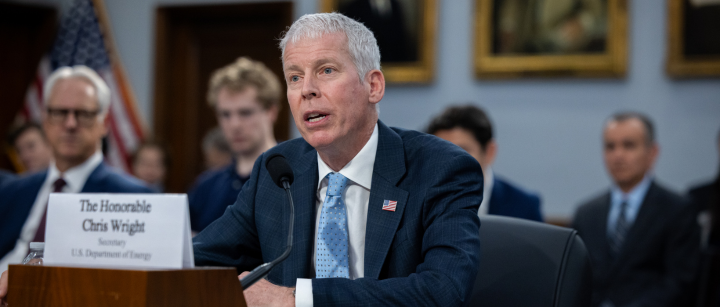
Energy Secretary Chris Wright has repeatedly denied that politics were involved in the termination of more than 280 grants last October. A court filing made public in July, however, shows that Energy Department lawyers admitted that the only reason why those awards and not others were canceled is that the grant recipients were in states that vote for Democrats.
Wright and the department have maintained that political considerations did not factor into the original selection of grants for termination, which included awards in both blue and red states for clean energy or energy efficiency projects. But in terms of which grants were ultimately cut, whether they were located in a state that voted for President Donald Trump mattered.
According to a court document, after reviewing about 2,300 grants, DOE designated 624 for termination and sent the list to the Office of Management and Budget in September. All but one of the 284 grants that then received termination notifications from DOE in October were located in states that both voted for Democratic nominee Kamala Harris in the 2024 presidential election and have two Democratic-caucusing senators. (The one exception was in Canada.) The remaining 340 grants — which were all in states that had voted for Trump and have at least one Republican senator — did not get such notices, and haven’t been terminated as of mid-May.
DOE agreed in the filing that “the inclusion of grants in the October notice tranche was based solely on the political identity of the grant recipient’s state, i.e., whether the recipient’s location and/or place of performance was in a Blue State or a non-Blue State,” and not “based on any programmatic, statutory, cost-reduction, or performance-based factor.”
In an October CNN interview, Wright denied punishing blue states, saying that more terminations in both red and blue states would come and that the department’s decisions were “all based on facts.”
When CNN’s Kaitlan Collins asked why awards for hydrogen hubs in the Pacific Northwest were canceled while those for hubs in Republican-controlled states were not, he replied, “The decisions on the others haven’t been announced yet.”
In testimony before Congress in April, Wright said that all of the more than 2,000 projects DOE evaluated “were not evaluated in any way, shape or form based on where they were.” He later made a distinction between the evaluation of the projects – which he said had been done on their merits, and did not involve politics – and the cancellation announcements, which he called “a timing question.”
“We did not involve politics in the decisions,” Wright also said in testimony in June. When Democratic Rep. Gabe Amo of Rhode Island asked directly about the “outcomes,” Wright again distinguished between a “choice of the announcements,” which he said was not made by his department, and the decisions to terminate.
“No decisions were made on politics,” he said. “I keep hearing that charge. It’s bullshit. We’re going to say it a million times. It’s not true.”
When asked whether he thought grant decisions should be based on how a state votes in an election, Wright replied, “They shouldn’t and they weren’t.”
Following the release of the court document on July 15, which was a set of stipulations agreed to that avoided discovery, or the process of fact-finding prior to a trial, Amo and fellow Democratic Rep. Zoe Lofgren of California referred Wright to the Department of Justice for allegedly lying to Congress. In an Aug. 4 letter, they called his June testimony “unambiguously false and misleading.”
A DOE spokesperson told us that Wright’s “statements in his testimony are correct. None of the termination decisions were based on political considerations.”
Experts told us that the referral is unlikely to go anywhere, and that Wright had a plausible defense against lying to Congress – but that it seemed clear that the government had allowed politics to determine grant cancellations.
“It is really splitting hairs,” Romany M. Webb, the deputy director of the Sabin Center for Climate Change Law at Columbia Law School, told us of Wright’s argument that he was referring to the original evaluations. “The fact is that they are admitting here that the final set of grants that were terminated, the sole factor that decided they would be terminated was the fact that they were going to blue states.”
Grant Cancellations
DOE first announced the grant cancellations in a press release on Oct 1. “DOE determined that these projects did not adequately advance the nation’s energy needs, were not economically viable, and would not provide a positive return on investment of taxpayer dollars,” the release said, saying the cancellations would save about $7.6 billion.
Earlier that day, OMB Director Russell Vought previewed the terminations, posting on X, “Nearly $8 billion in Green New Scam funding to fuel the Left’s climate agenda is being cancelled.” He then said the projects were in a list of 16 states, all of which had voted for Harris in the 2024 election.
This first raised speculation that the grants, which had already been awarded with funds appropriated on a bipartisan basis by Congress, had been terminated based on politics. In particular, several projects, which were comparable, but just in different states, were treated differentially.
Several of the canceled grantees sued the government, and in two court cases, a federal judge restored the funding or determined the cancellations were unlawful. In both cases, the DOE agreed that a “primary” reason for selecting those grants for notification of cancellation and not others was whether the grantee was in a blue state.
Then, in May, as part of another case involving the University of California, the DOE agreed that the inclusion of 284 grants in the October notification was “based solely on the political identity of the grant recipient’s state.” It also agreed to statements explaining that the DOE had first identified 624 grants for cancellation in blue and red states; that OMB had “identified … for inclusion” the grants for the October termination notice, none of which were in red states; and that “DOE subsequently announced it had terminated those grants.” The stipulation became public on July 15.
It’s true that the court admission only refers to what the document refers to as the “October tranche,” and not the decisions themselves. But it does not appear that the distinction is meaningful.
“The difficulty is that ultimately only the Department of Energy can actually terminate these things. The Office of Management Budget doesn’t have the statutory authority to terminate them. Only the Department of Energy does,” William Funk, an emeritus professor at the Lewis & Clark Law School who previously served as an assistant general counsel at the DOE, told us.
The DOE may not have been politically biased in their evaluation, and the idea to only cancel the blue state grants may have come from OMB, he said, but “nevertheless they were implementing a political decision.”
“The actual doing of that decision – the actual execution of that decision – was done by DOE,” Funk said.
Moreover, after more than nine months, the other red state grants originally selected for termination do not appear to have been terminated, undermining the DOE defense that it was just a timing issue.
We asked the DOE whether any red state grants had been canceled or were scheduled to be cancelled. The agency did not directly answer the question.
In a statement, a spokesperson said that after some Senate confirmations in October, “a number of new DOE senior leaders undertook a fresh review” of the grants, and that “final action” had now been taken. It is unclear if any red state grants were canceled. As of mid-May, the government agreed in the stipulation document there had been none.
The agency again iterated that “none of the underlying program office determinations to terminate an award was based on an award recipient’s location … or any other political considerations.”
Given that the referral for potentially lying to Congress goes to Todd Blanche, the now-confirmed attorney general for the Trump administration, Funk said he “absolutely” does not think the DOJ would proceed with prosecution.
But the information in the stipulations may well go on to affect the litigation over the grant terminations, Webb said.
“These admissions are really remarkable and show a level of activity that is, you know, so blatantly inconsistent with the law that it’s hard to imagine” the plaintiffs not succeeding, she said.
Editor’s note: FactCheck.org does not accept advertising. We rely on grants and individual donations from people like you. Please consider a donation. Credit card donations may be made through our “Donate” page. If you prefer to give by check, send to: FactCheck.org, Annenberg Public Policy Center, P.O. Box 58100, Philadelphia, PA 19102.
