


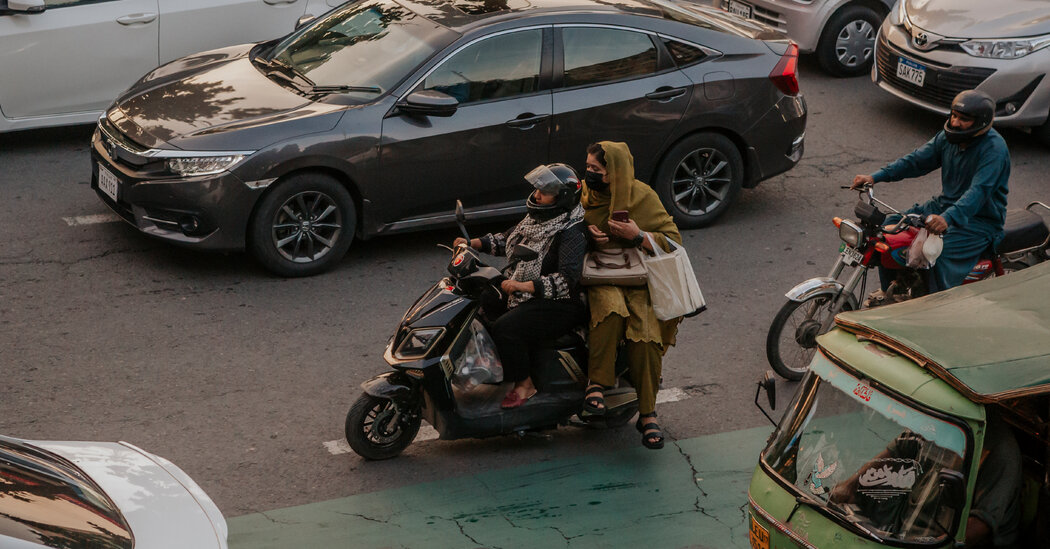
It’s Friday, and as promised I have something fun for you: My colleague Chico Harlan, our global climate correspondent, is taking you on a high-adrenaline motorcycle ride through Lahore. And not just on any motorcycle. The bike he rode was electric — as are an increasing number of motorcycles on the streets of Pakistan.
Thrills aside, Chico’s reporting shows something intriguing: The war in Iran has sped up the clean energy transition. In the countries most vulnerable to higher gasoline prices, like Pakistan, the most common vehicles tend to have two wheels, not four. In those countries, the electric motorcycle era has arrived. Hang on tight!
I went to Pakistan last month to learn about the country’s electric motorcycle boom.
Electric motorcycles scarcely existed in Pakistan three years ago, but now sales are surging. The switch signals how quickly, and perhaps permanently, people in developing countries are pivoting away from fossil fuels as the war in Iran keeps oil prices high.
I visited showrooms and an assembly plant and interviewed company founders and would-be buyers. As the trip neared its end, I figured I’d learned just about everything I needed to know.
Except what it feels like to actually ride one.
“Do you want take it out for a drive?” Abdul Rafay, the owner of a new Vlektra electric motorcycle, asked me after we finished an interview.
I looked out at the city of 14 million, as motorbikes pinballed around rickshaws and four-wheelers, and muttered something about journalists not making themselves a part of the story.
But OK, I’d accept a ride. I borrowed a helmet and climbed on the back of Rafay’s bike, just one among the hundreds of thousands of newish, gasoline-free vehicles humming along across Pakistan.
E-bikes and war
Electric motorcycles, it turns out, are a good indicator of the changes driven by the war in Iran. That’s because in poorer countries, where people are most vulnerable to energy-price shocks, two-wheelers are far more common than cars.
Electric vehicles typically cost more to buy than gasoline-powered versions. But rising gasoline prices have given electrics a big advantage: It’s much cheaper to charge a battery than to fill up a fuel tank.
In Vietnam, where the streets teem with motorcycles, the biggest domestic producer, VinFast, has reported soaring sales. In Kenya, about 25 to 35 percent of new motorcycle sales are electric, said Gagan Gupta, the founder of Spiro, the largest electric vehicle company operating in Africa. He said the war’s energy shock had helped “multiply everything by two times.”
People in the industry increasingly talk up the idea that future generations will never operate gasoline-powered vehicles. “The demand is effectively open-ended,” said Josh Whale, the founder of Ampersand, an electric motorcycle company that operates in Kenya and Rwanda.
In Pakistan, motorbikes make up about 80 percent of vehicles on the road and are often the most valuable thing a person owns. The new proliferation of electric motorcycles comes from a mix of homegrown ingenuity and China’s manufacturing prowess.
Some Pakistani companies use chassis and tires manufactured domestically, and batteries and motors from China. But other companies depend on China almost entirely. They import ready-to-assemble bikes that need little more than a logo. Pakistan, aiming to clear up its polluted skies, imposes duties of only 1 percent on such imports.
Sales of electric two-wheelers rose 173 percent during the first half of the year in Pakistan, according to a market data firm, thanks to a government subsidy program and the increase in oil prices that came with the U.S. war with Iran.
“Trump is the biggest salesman — salesman of the year,” said Muhammad Salman, managing director of Yadea Pakistan, the national distributor of Yadea bikes, one of the major brands in China.
‘You got scared, didn’t you?’
On the bike, I hung on tight as Rafay, 24, merged into a roundabout. We were in a relatively upscale part of the city, with painted lane markers and smooth roads. But drivers in Pakistan, I think it can be said, have a strong stomach for adventure.
Rafay clearly wanted to show off his new bike’s power. So he seized on a small opening and accelerated past a rickshaw. He zipped toward two orange vehicles, two or three feet apart. As Rafay darted toward them, a gap opened just large enough to let us through.
The video I was taking with my iPhone doesn’t convey my visceral certainty that one of those orange vehicles was going to clip my knee.
I’d clenched my legs hard enough that Rafay could feel it.
“You got scared, didn’t you?” he asked, looking back.
“Yes,” I said, heart racing a bit, but happy.
Rafay, a gearhead, said he’d loved his previous motorcycle, a Honda CD 70, Pakistan’s most popular gas model. He’d driven it more than 60 kilometers each day to and from his job as a software engineer. But then gasoline costs soared and he started thinking about the math.
“If I can save a few rupees,” he said, “I’ll do it.”
After my ride with Rafay, I thanked him for driving so capably and handed back the helmet.
Then, before the next rains came, I returned to the gas-powered Toyota car I’d been using for the week. It was a vehicle that never made me clench my knees.
TOP NEWS
TOP OF THE WORLD
The most clicked link in your newsletter yesterday was about gadgets that keep you cool.
WINTER SPORT OF THE DAY (IN SUMMER)
Although curling is decidedly a winter sport, a synthetic rink was set up in Rome in June. The surface is high-density plastic instead of ice. The stones weigh about a tenth of the regulation weight, and players use brooms to retrieve the stones rather than control their path. The goal? Get Romans to come out and play, despite the blistering heat.
MORNING READ
Thousands of software developers across Africa have turned to Chinese A.I. models in the past year. My colleagues interviewed some of them to find out why.
Many developers said they wanted something that worked well on limited resources. They preferred Chinese systems, which anyone can download and modify without payment or approval. “Why use an expensive Ferrari to do the school run when a Toyota hatchback can do the same?” one Nairobi entrepreneur said. Read more about China’s A.I. surge in Africa.
AROUND THE WORLD
Lighting up the honeymoon suite
In Bali, fireflies are revered as sacred messengers, a connection between living communities and their ancestors. But they’re disappearing across the Indonesian island because of climate change and environmental threats.
I Wayan Wardika has embarked on a quest to restore what he calls “the magic of fireflies.” He has started Indonesia’s first firefly conservation facility, where he breeds and raises them in terrariums named “honeymoon suites.” Read more and see the lab.
RECIPE
This version of the classic Southern lane cake takes all of fruitcake’s best elements — bourbon-soaked dried fruit, toasty pecans and shredded coconut — and weaves them into a rich, custardy filling set between three layers of tender vanilla cake. It’s a dessert and a nightcap, rolled into one.
Which island is this?
BEFORE YOU GO …
One of the things I love most about summer is that life slows down a little and I get to carve out time to read the books and listen to the podcasts that have piled up, literally and figuratively.
I’ll share some of my highlights in case you still have a bit of vacation time left.
My favorite nonfiction book this summer was “Peak Human” by Johan Norberg, a Swedish historian who tells the story of seven golden ages of humanity — including ancient Athens, the Abbasid Caliphate, the Song dynasty and the modern West. He explores what allowed humans to flourish in each of those periods and what we can learn from them today. (Spoiler alert: All of them were open to ideas and trade.)
My favorite novel was “The Safekeep” by Yael van der Wouden. I had to get used to the writing, which is sparse and self-conscious, and initially a little annoying, partly to channel the main character — a complicated, intensely controlling and, yes, annoying, woman. But two plot twists later, the book is kind of a masterpiece. The backdrop is post-Holocaust Europe. I won’t say more.
My favorite podcast was “The Gaza Chef,” a five-part documentary by Yassin Musharbash, an investigative journalist at the German weekly Die Zeit. It’s a compelling and balanced investigation into the death of Mahmud Almadhoun, who ran a soup kitchen in the northern Gaza Strip and was killed by an Israeli drone two years ago. I couldn’t say it better than the tagline of the podcast: “The question of why he had to die leads deep into the worrisome future of warfare.”
Musharbash once worked as a fixer for John le Carré and has written a series of novels himself. He knows how to tell a good story!
And finally, my favorite feel-good holiday song this year: “Love Chain” by Candi Staton, a summer classic. Enjoy!
Have a great weekend! — Katrin
TIME TO PLAY
Here are today’s Spelling Bee, Mini Crossword, Wordle and Sudoku. Find all our games here.
Chico Harlan was our guest writer today.
We welcome your feedback. Send us your suggestions at theworld@nytimes.com.
