


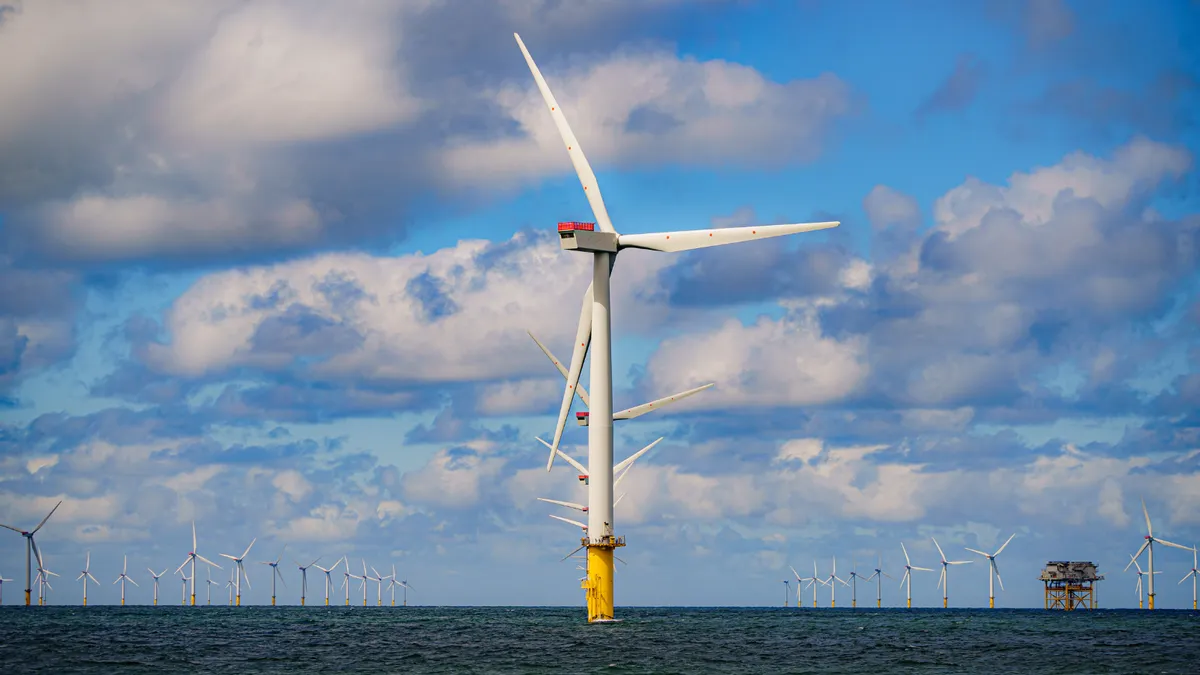
In August 2026, the Trump administration paid German energy company RWE $1.2 billion to stop building wind farms.
In August 2026, social media users claimed that U.S. President Donald Trump’s administration paid RWE, a German energy company, more than $1.2 billion to abandon the development of ongoing offshore wind projects.
One popular Facebook post (archived) suggested the government was encouraging RWE to put its money into natural gas projects instead. The caption read:
New levels of stupid just dropped. The Trump administration just wired a German energy company $1.22 billion to NOT build wind farms.
That is the fifth time this year it has paid a company to walk away from clean power, and the total is closing in on $4 billion of public money.
RWE was set to put wind turbines off the coast of Humboldt, California. Enough to power roughly 600,000 homes. Instead Doug Burgum’s Interior Department cut them a check to abandon the leases and pour the money into gas.
This is not a subsidy for wind. It is a payout to kill it.
RWE is taking the cash and dropping $900 million into a Louisiana gas terminal and a fleet of new gas plants. So the “energy security” on offer is you breathing more of what comes out of a smokestack, on purpose, because your government paid a premium for it.
Burgum’s justification is the best part. He said Americans deserve energy that doesn’t lean on “costly subsidies.” He said this while handing $1.22 billion to a foreign corporation.
The projects were legal. They were permitted under Biden. Courts keep telling this administration it cannot simply cancel wind farms, and a federal judge in Oregon was leaning against them this week.
So they found a workaround. If you cannot kill the clean energy in court, buy it and bury it.
Cheaper power, off the table. Cleaner air, off the table. Six hundred thousand homes that will now pull from gas burned somewhere a kid has to breathe it.
They will tell you this keeps the lights on and the bills low. It does the opposite. Gas peaker plants are some of the priciest power you can build. The turbines were the cheap option. They paid extra for the dirty one and called it responsible.
Your grandkids inherit the heat. A German company inherits the check.
And somewhere in Essen, an executive is still working out how he got paid a billion dollars to lose.
The story also spread on Reddit (archived) and Instagram (archived), and Snopes readers emailed us asking if the rumor is true.
In short, RWE and Secretary of the Interior Doug Burgum both announced the deal on Aug. 6, 2026, in a news release and on X, respectively (archived, archived). Therefore, we’ve rated this claim true.
RWE’s news release says the company reached a settlement agreement with the Department of the Interior to abandon the company’s offshore wind leases off the coasts of New York, California and Louisiana. According to RWE, it originally secured these leases from the U.S. government and had invested more than $1 billion in development towards these projects. RWE said the leases “represented years of planning, investment, and partnership with federal agencies.”
As part of the deal, RWE is instead investing $1.2 billion into natural gas projects, according to the news release.
That same day, Burgum took to X to say the DOI welcomes RWE’s agreement and “voluntary investment” in natural gas programs.
This is not the first time in 2026 that the Trump administration has made such a deal. In March, the administration reached a $928 million agreement with French energy company TotalEnergies to cancel two offshore wind projects. In April, the DOI announced a similar deal with two other companies developing offshore wind farms. In each agreement, the DOI described reimbursing the companies for the canceled leases.
According to Reuters, the Trump administration has reached agreements to reimburse energy companies roughly $4 billion in 2026 for canceling in-development offshore wind projects.
For further reading, Snopes has previously fact-checked several other rumors about Trump and wind energy, including a claim that Scotland approved a new wind farm shortly after the U.S. president visited the U.K. and complained about wind turbines.
