


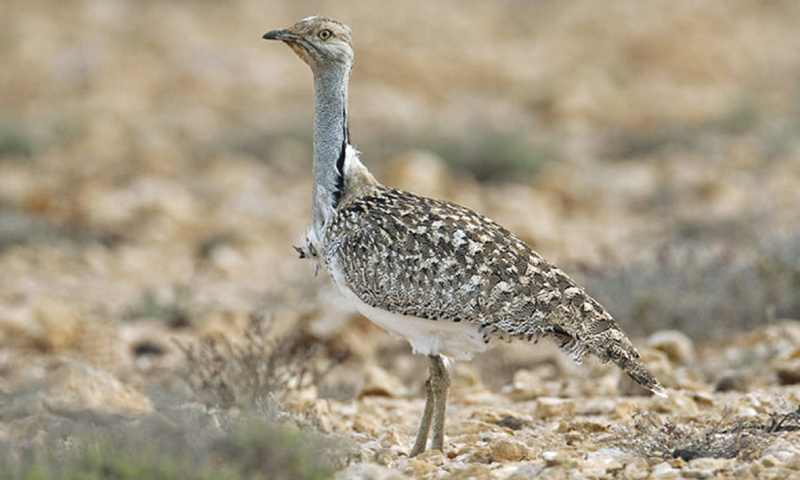
There’s no conservation motive or benefit behind the Uzbekistan government’s recent releases of more than 2,000 captive-bred Asian houbara bustards across its desert regions, according to an expert on the threatened species.
The government has touted the releases over the past three months as a wildlife restoration effort, but Nigel Collar, a conservation biologist at BirdLife International, suggested the birds are meant to serve as quarry for hunting parties.
“In reality both areas [where they were released] are hunting concessions for Gulf State falconers and these are birds being put out in the wild simply to provide ‘sport,’” Collar, who also co-chairs the Bustard Specialist Group at the IUCN, the global wildlife conservation authority, told Mongabay by email.
“[T]here is no conservation strategy related to these releases, because they are not intended for conservation except in the sense that they can absorb some of the hunting pressure on wild populations,” he added.
Neither Falcon Hunting Solutions LLC nor Uzbekistan’s National Committee on Ecology and Climate Change, both involved in the releases, had responded to Mongabay’s requests for comment by the time this story was published.
The Asian houbara (Chlamydotis macqueenii) is listed as vulnerable to extinction on the IUCN’s Red List. It migrates between Central and South Asia and the Middle East, and is hunted intensively across this range.
Uzbekistan released nearly 900 of the birds in the Aral Sea region of Karakalpakstan in May this year, followed by some 670 birds in June, according to statements from the National Committee on Ecology and Climate Change. An additional 778 birds were released in July in the Navoiy region.
The released birds were all raised at breeding centers in the United Arab Emirates, the government statements note. They add the releases were carried out under the supervision of specialists from the committee and “Falcon Hunting Solutions” LLC. The latter, according to its website, focuses on “trophy hunting development as an ecotourism segment of Uzbekistan.”
The statements also say the birds’ release into the arid ecosystems of Karakalpakstan and Navoiy contributes to the restoration of ecological balance and the conservation of the region’s unique biodiversity.
“There are already wild houbara in both regions, so it would not be a reintroduction but a reinforcement,” Collar said.
He added the releases “will not contribute to any knowledge” since no information is being gathered on the baseline population of the birds, how many are hunted, what levels of hunting would be acceptable, or what reinforcement would be appropriate.
Collar said the fundamental threats to the species remain entirely unaddressed. These include an 800-kilometer (500-mile) overhead power line across the birds’ desert habitats, which poses severe collision risks.
He said long-term survival requires running power lines underground, reducing human contact during rearing, and implementing the Convention on Migratory Species’ (CMS) Bustards Multispecies Action Plan approved by signatory countries, including Uzbekistan.
Banner image: An Asian houbara bustard in Talagang tehsil, Punjab, Pakistan. Image by Sahibzada tariq hameed via Wikimedia Commons (CC BY-SA 4.0).
