


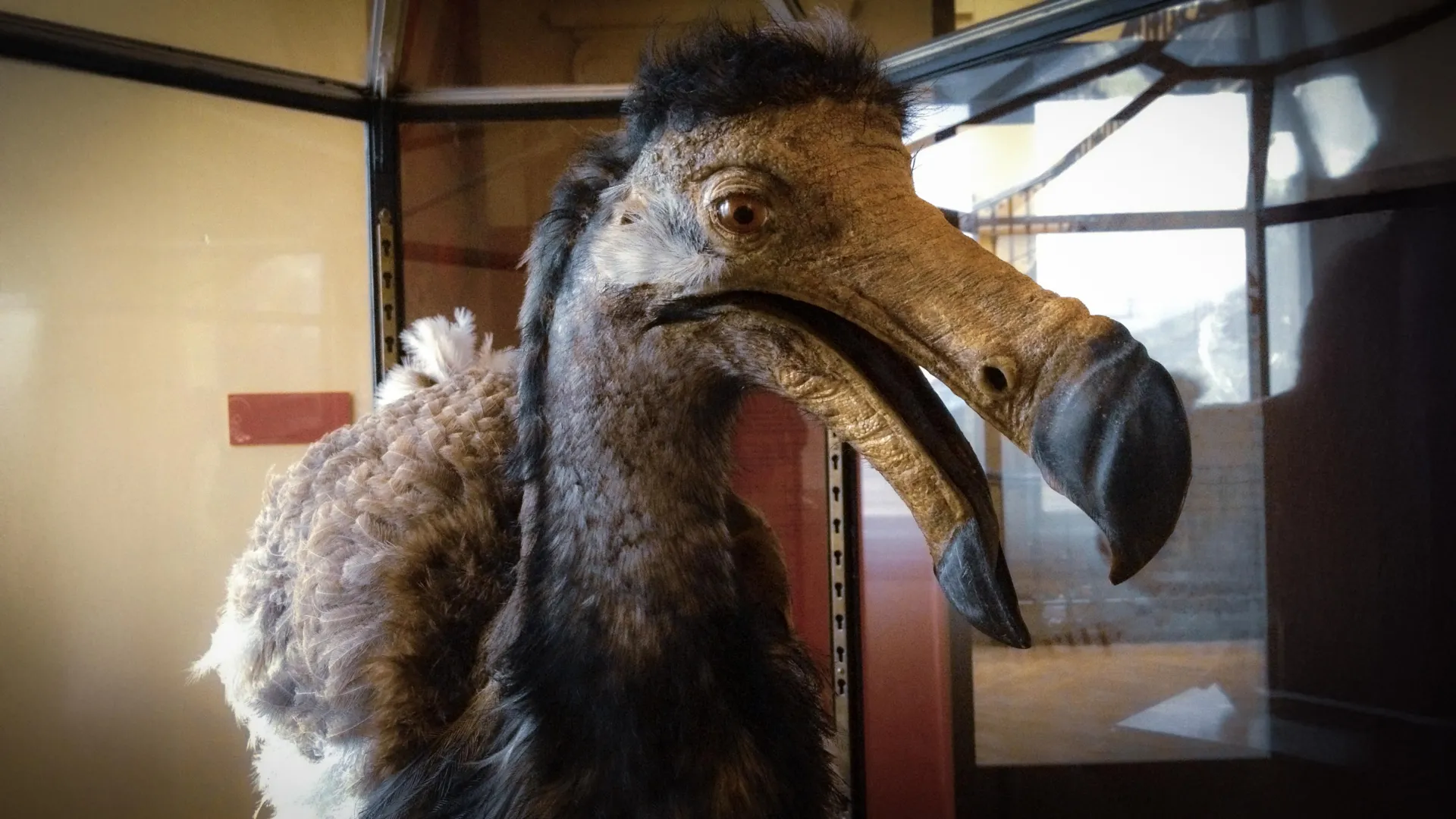
Only two complete dodo skulls are known anywhere in the world. One is housed at the Natural History Museum Denmark, while the other belongs to the Oxford University Museum of Natural History. The Copenhagen specimen has remained in the museum’s collections for centuries, and it has now played a key role in an international investigation led by researchers at the University of Lethbridge in Canada. Their goal was to explore a long-standing mystery: how did the dodo perceive and interact with the world around it?
Using digital reconstructions of the space that once held the bird’s brain, scientists were able to examine clues about the dodo’s sensory abilities. The results suggest that its sensory experience differed in several important ways from that of modern pigeons and doves. The dodo may have followed a more flexible daily schedule, with activity possibly extending into dawn and dusk. It may also have had a stronger sense of smell and a greater capacity to detect touch through its large upper beak. Together, these features offer fresh insight into how the bird may have searched for food and navigated its environment on Mauritius before becoming extinct in the late 17th century.
“The dodo is one of the world’s most recognizable extinct animals, yet surprisingly little is known about how it actually lived,” says Peter Andrew Hosner, Associate Professor and Curator of Birds at the Natural History Museum Denmark and co-author of the study published in the Zoological Journal of the Linnean Society.
“Its behavior and foraging ecology have been debated for centuries. Having access to one of only two complete dodo skulls has given us a unique opportunity to compare the dodo with its closest living relatives and gain new insights into how it experienced and interacted with its environment,” he adds.
CT Scans Reveal the Dodo’s Hidden Anatomy
The rare Copenhagen skull has long been displayed at the Natural History Museum Denmark. Preparations for a new museum building and permanent galleries scheduled to open in 2027 gave researchers an unusual chance to study the specimen in greater detail using high-resolution CT scanning.
The imaging produced an extremely detailed three-dimensional digital model without damaging the valuable skull. Researchers could then reconstruct the skull’s interior, including the cavity where the brain once sat. As the brain develops, it leaves impressions on the surrounding bone, so those preserved structures can provide important evidence about the way an extinct animal processed information from its surroundings.
The study draws on CT data from three dodo skulls, including the only two complete specimens known to exist — one at the Natural History Museum Denmark and the other at the Oxford University Museum of Natural History. Digital models of both complete skulls gave the team a rare opportunity to compare them directly, helping researchers determine which anatomical features were likely typical of the species.
“Studying extinct animals is a bit like detective work. Although the dodo’s brain disappeared centuries ago, it left an imprint on the inside of the skull. By digitally reconstructing those spaces and comparing them with the brains of living birds, we can begin to piece together how the dodo sensed, behaved, and interacted with the world around it,” says Christy Anna Hipsley, Associate Professor at the Natural History Museum Denmark and co-author of the study.
Clues to Smell, Touch, and Daily Activity
Researchers compared the reconstructed dodo brain cavities with those of living pigeons and doves, which are the dodo’s closest living relatives. The comparison revealed a distinctive set of sensory traits. The skull anatomy indicates that the dodo may not have been active only during the daytime and could also have moved or foraged around dawn and dusk.
The bird may also have depended more heavily on smell than modern pigeons and doves. In addition, its large upper beak appears to have been well suited for collecting tactile information from the surrounding environment. Scientists cannot determine exact behavior from anatomy alone, but these findings provide new clues about how the dodo may have located food and interacted with its island habitat.
“The dodo’s skull is unlike that of any living bird, which makes it both fascinating and difficult to interpret. By comparing digital reconstructions of the world’s only two complete dodo skulls, we now have a much stronger foundation for identifying which features are truly characteristic of the species and what they can tell us about how the dodo lived,” Hipsley adds.
A More Complex View of the Dodo
Popular culture has often depicted the dodo as clumsy and unintelligent, sometimes suggesting that its extinction was almost unavoidable. The new findings do not support the idea that the bird had reduced cognitive abilities compared with living pigeons and doves. Instead, the evidence points to an animal with a distinctive combination of sensory adaptations that developed over millions of years on an isolated island.
The researchers emphasize that skull anatomy cannot provide a complete account of the dodo’s behavior. Even so, combining CT data from several specimens, including the only two complete skulls in existence, allows scientists to move beyond centuries of speculation and make more evidence-based interpretations of the bird’s biology.
Peter Hosner says the study does not answer every question about the dodo, but it gives researchers a stronger framework for understanding the bird’s behavior and ecology.
“The dodo has become a symbol of extinction, but in many ways it remains surprisingly mysterious. Every new piece of evidence helps us move beyond myths and build a more accurate picture of how this extraordinary bird lived before it disappeared,” he says.
