


The Senate passed a sweeping new package of sanctions targeting Russia and Iran on Friday, approving a measure aimed at supporting Ukraine in its fight against President Vladimir V. Putin’s war of aggression.
The 86-to-11 vote was a rare bipartisan feat for a chamber that has been divided on most meaningful legislation to back Ukraine since President Trump returned to office last year after a campaign that railed against foreign and military aid.
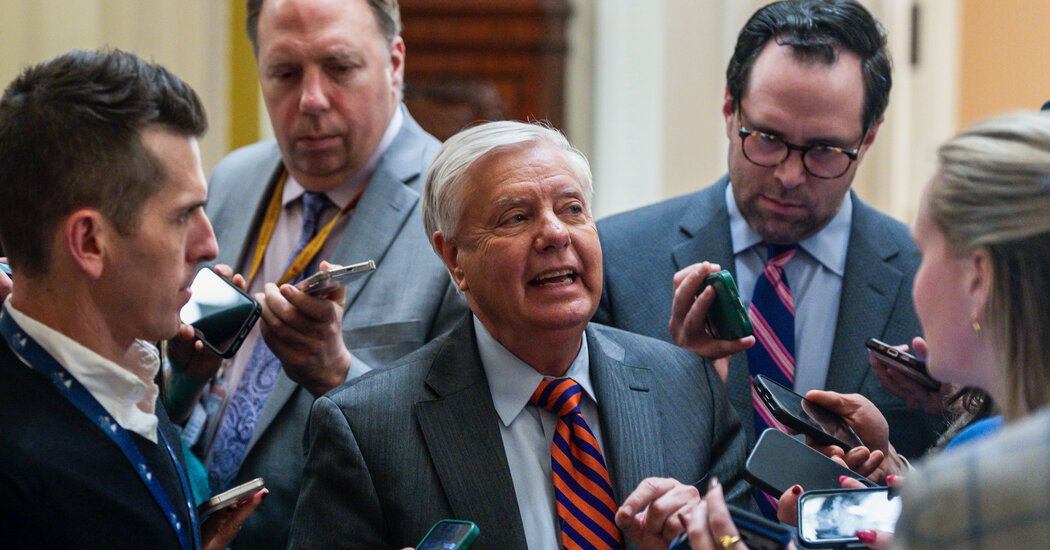
The bill’s passage came just weeks after the sudden death of Senator Lindsey Graham, its leading champion, an unexpected turn that provided a burst of momentum for the package among senators newly incentivized to push it forward in his honor.
The measure, which also would extend sanctions against Iran for five years, still must pass the House and be signed by Mr. Trump, who in recent days has indicated support.
An overwhelming consensus to advance penalties punishing Mr. Putin and his allies has existed among senators for more than 18 months, since Mr. Graham, a South Carolina Republican, introduced the legislation alongside Senator Richard Blumenthal, Democrat of Connecticut.
But the legislation stalled over objections from the White House, which resisted any bill that would force Mr. Trump to punish Mr. Putin as he pressed for a peace deal between him and President Volodymyr Zelensky of Ukraine.
The bill’s approval comes as the Kremlin carries out its most intense airstrike campaign since the start of the war amid depleted Ukrainian air defenses. Two days earlier, there were at least 17 reported deaths in Kyiv from an attack that included 24 ballistic missiles and four hypersonic missiles.
At the same time, Ukrainian forces have seen success with attacks of their own. On Thursday, Mr. Zelensky said they struck two oil refineries hundreds of miles deep within Russia.
When Mr. Zelensky traveled to Washington last week for Mr. Graham’s funeral, he met with lawmakers on Capitol Hill and made the case that the sanctions bill was a crucial piece of his strategy to vanquish Russia.
“This is the first step toward implementing Lindsey’s plans, and certainly a step toward peace,” Mr. Zelensky said in a statement following the meeting. “It is important that this tool works.”
The bill aims to cripple Russia’s economy by targeting the energy sector, a key source of revenue for the Kremlin. It would also impose steep sanctions against Mr. Putin and senior officials within the government.
A centerpiece of the measure would target countries that continue to buy significant amounts of Russian oil and gas. It would give the president the authority to impose 100 percent tariffs on the top five importers of Russian energy.
Lawmakers included a broad set of exceptions that would allow the president to issue waivers to countries, officials and businesses if he deemed it “in the national interest of the United States.”
In recent months, China and India have been the top purchasers of Russian oil, largely as a result of energy market instability following joint U.S.-Israeli strikes against Iran earlier this year and the continued blockade of the Strait of Hormuz.
The bill would target the so-called shadow fleet of Russian tankers that sail under unclear ownership and without insurance policies, by penalizing any country, company or individual that supports the operation of the clandestine shipping network.
The measure passed over the objections of Democrats who had expressed concerns that it would hand over new tariff powers to the president when Mr. Trump has already stretched the boundaries of his trade authority, sidestepping Congress.
But the Senate defeated a bid by Senator Rand Paul, Republican of Kentucky, to remove the tariff provisions. Mr. Paul castigated his colleagues for delegating their constitutional tariff authority.
“What sort of feckless Congress gives away their power?” Mr. Paul said before the vote.
And Senator Raphael Warnock, Democrat of Georgia, who had sought an amendment to limit the president’s authority under the bill, ultimately dropped his effort after securing a commitment in a letter from Jamieson Greer, the U.S. trade representative, to honor the limitations Congress set forth in the law.
Mr. Warnock ultimately voted with most Democrats in support of the measure, saying that he continued to “reject the idea that we have to choose between putting a check on Putin’s aggression and putting a check on this president’s tariff regime.”
However, 10 Democrats voted against it, along with Mr. Paul, the lone Republican to vote no.
Implementation of the new penalties is still far off, with the House out of session for the remainder of the summer.
But backers said they were hopeful that Senate passage had cleared the biggest obstacle to the measure and would send a message of support to Ukraine and a warning to Mr. Putin.
“My hope is to end this war through diplomacy,” Mr. Graham told reporters during his final trip to Kyiv the day before he died. “And the more leverage we have over Putin, the better.”
