


- In June, a bird flu outbreak at Kathmandu’s Central Zoo killed at least 65 animals from more than 20 species, exposing flaws in Nepal’s disease surveillance.
- The outbreak has raised concerns that similar outbreaks could go undetected in national parks, where wildlife is not routinely monitored.
- Experts warn that shared feeding sites, including Nepal’s renowned “vulture restaurants”, and the reliance of wild carnivores on domestic poultry could create pathways for influenza viruses to spread between birds and mammals.
- Despite the outbreak and recommendations from the zoo’s own investigation committee for contingency plans, stronger biosecurity and rapid reporting, Nepal’s wildlife and livestock authorities say they have no plans for park-specific surveillance or response programs.
KATHMANDU — In the village of Pithauli, on the edge of Nepal’s Chitwan National Park, a safe feeding site for critically endangered vultures has long been hailed as a success story by conservationists.
For visitors, the feeding site, also known as a “vulture restaurant”, provides a rare photo op for tourists: As white-rumped vultures (Gyps bengalensis) and slender-billed vultures (Gyps tenuirostris) feed on carcasses laid out by locals, greater one-horned rhinos, jackals, wild boars and crows watch and, sometimes, participate.
For ornithologist Rajendra Suwal, however, this ensemble is an eyesore, he told Mongabay, “If an infected bird comes to the site, the disease could spread to other birds or even animals.”.
Suwal’s concern stems from a recent outbreak of bird flu or avian influenza in the country’s capital. An outbreak that started in mid-June at Kathmandu’s Central Zoo is believed to have cost the lives of at least 65 animals and birds across more than 20 species. The dead included barn owls, Himalayan griffons, greylag geese, jungle cats, leopard cats, a sarus crane and two common leopards.
An investigation by the National Trust for Nature Conservation (NTNC), which manages the zoo, says the origin of the outbreak could likely be traced to two sources: Among birds, it likely started through feral crows roosting in open-topped aviary enclosures, while for carnivores, it spread through chicken meat fed to them by the zoo.
Notably, the zoo’s six tigers (Panthera tigris) were unaffected. A member of NTNC’s investigation committee told Mongabay that this is not necessarily because one species is more resistant. “Tigers at the zoo are fed roughly 5-7 kilograms of buffalo meat each per day, not chicken, so they were never on the same exposure pathway as the infected carnivores,” said the committee member, who asked not to be named as they weren’t authorized to talk to the media.
In national parks, however, carnivores often share common diets. There are also no enclosures to inspect, no feeding records to audit and no vet team to notice the first death, ornithologist Suwal said. Central Zoo lost many animals before it could contain the outbreak, but a park may not know it has an outbreak at all, he added.
Two viruses and a delayed response
A copy of the NTNC’s investigation report, obtained by Mongabay through a right-to-information request, shows two influenza viruses potentially circulating at the zoo during the outbreak.
Birds tested positive for H5 strain of the Highly Pathogenic Avian Influenza (HPAI). Jungle cats, leopard cats and the zoo’s two common leopards all tested positive for the “low pathogenic” H9, believed to cause mild or no symptom in birds. NTNC’s committee attributed the carnivore deaths, including the leopards, to the outbreak.
The central vet lab’s report to NTNC, reviewed by Mongabay, flagged the H9 finding, “Although H9 LPAI [low pathogenic avian influenza] generally causes mild disease in birds … detection of this strain in wild felids is of concern”.
Umesh Dahal, Director General at the Department of Livestock Services, confirmed the distinction to Mongabay: “We found H5 and H9 in birds. However, the mammals died due to H9, which is an influenza virus that we do not classify as bird flu.” No park-specific surveillance was needed, he added.
Asked about the lab’s own “of concern” language, he said existing regulations were sufficient.
The investigation committee’s report said the zoo administration knew of bird deaths and bird flu suspicion from June 13, but didn’t notify headquarters until July 19 — five days after the lab confirmed the outbreak. It’s the first known case in Nepal where influenza has hit both zoo birds and mammals. The zoo outbreak occurred amid a wider H5N1 wave that spread to 11 districts after starting March and led to the culling of hundreds of thousands of poultry nationwide, according to Department of Livestock Services data.

One more threat for common leopards
The health of common leopards is a particular concern in Nepal. A 2024 study suggests canine distemper virus, a serious and contagious disease, already circulates among Nepal’s wild population, potentially causing deaths. Canine distemper antibodies have also been reported in tigers.
The death of the two leopards at the zoo attributed to H9 presents a case for the susceptibility of wild leopard populations to the viral strain. Leopards across Nepal regularly prey on domestic poultry, providing H9 with a plausible route from farms into the wild population.
A 2025 DNA study of leopard scat in forests around the Kathmandu Valley found chicken made up nearly a fifth of the leopard diet by frequency. Other studies also point the same way: In the mid-hills (also known as the “lesser Himalaya”) livestock accounted for more of leopards’ dietary biomass than wild ungulates did.
Wild leopards have so far not been tested for influenza, but a wild leopard preying on an infected farm bird would face a comparable exposure route to the leopards in Central Zoo without a keeper to notice any sickness, a member of the NTNC investigation committee told Mongabay.

The vulture restaurant question
Nepal’s vulture restaurants were born after the livestock painkiller diclofenac poisoned vultures that fed on treated carcasses, triggering collapses in populations.
Nepal banned veterinary diclofenac in 2006 and opened the first “restaurant” that year at Pithauli, Nawalpur. There are now more than half a dozen nationwide. The sites are also close to the feedings grounds of crows, vultures, rhinos, jackals and wild boars, creating a contact risk analogous to the zoo’s but with no veterinary oversight.
Ornithologist Suwal said he questions how often carcasses are provided at some sites: Wild vultures feed once and go 10–12 days before eating again, so three or four feedings a week may let pat hogens accumulate. Ornithologist Hem Sagar Baral, one of the pioneers of the vulture restaurant model, went further: If bird flu risk is confirmed, feeding at the restaurants should stop.
Ankit Bilash Joshi from the NGO Bird Conservation Nepal, which supports a vulture feeding site in nearby Kawasoti, said active sites rotate every 20–30 days and are disinfected regularly
Two years ago, three vultures showed signs of illness, Joshi said. Two birds tested positive for positive for disease antibodies ,suggesting the infection wasn’t transmissible to humans, he said.
Team leader at the Pithauli site, Dhan Bahadur Chaudhary said restaurant staff are more vigilant since the zoo outbreak, no birds there have shown symptoms and no antibody testing is planned.

No plan for national parks
Nepal’s Bird Flu Control Regulations 2019 contain provisions for an inter-departmental coordinating committee that would require sample collection from bird habitats when an outbreak is suspected.
But Buddhi Sagar Paudel, Director General at the Department of National Parks and Wildlife Conservation, said there’s no park-specific program, “We consider the situation to be under control, so we have not prepared any separate plan.” Director General at the Department of Livestock Services Dahal said he backs that position.
Writing about the zoo, NTNC’s committee reached the opposite conclusion and recommended an urgent contingency plan, biosecurity guidelines and a transparent, 24-hour reporting system.
“It is unfortunate that even when all should come together to face a pandemic, treating it lightly by not informing the higher authority in time leads to a situation where risk reduction becomes impossible,” the committee said.
“We need active monitoring not just sample collection when something is already dead,” ornithologist Suwal added.
At Pithauli, restaurant team leader Chaudhary is watching his staff, monitoring his birds and waiting. So far, nothing has raised the alarm, but winter will bring migratory species and, with them, new variables. “We are being careful,” he said.
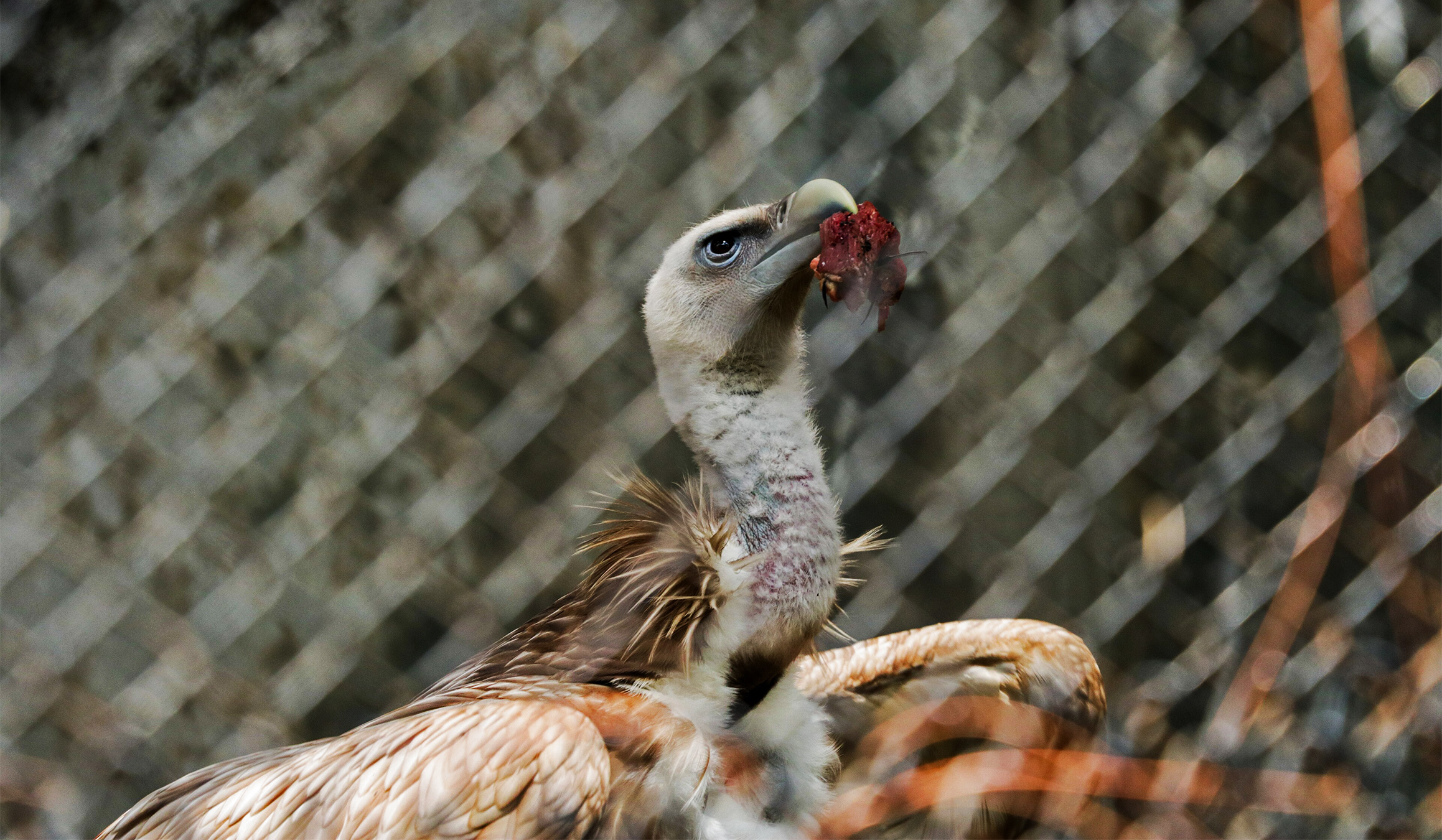
Banner image: A Himalayan griffon, Central Zoo, Kathmandu. Image by Shadow Ayush via Wikimedia Commons (CC BY-SA 4.0).
Nepal’s Central Zoo faces questions over its bird flu response
Peru’s only penguin species at risk from upcoming El Niño and bird flu, experts warn
Citations:
Baral, K., Bhandari, S., Adhikari, B., Kunwar, R. M., Sharma, H. P., Aryal, A., & Ji, W. (2024). Prey selection by leopards (Panthera pardus fusca) in the mid-hill region of Nepal. Ecology and Evolution, 14(2), e10924. doi:10.1002/ece3.10924
Manandhar, P., Pereira, K. S., Kusi, N., Joshi, J., Levin, N., Chaudhary, H. K., Wultsch, C., … Karmacharya, D. (2025). Feeding habits of leopards and leopard cats in the fragmented forests surrounding the Kathmandu Valley. Ecology and Evolution, 15(2), e70927. doi:10.1002/ece3.70927
Sadaula, A., Manandhar, P., Shrestha, B. K., Thapa, P. J., Nepali, S., Joshi, J. D., … Pandey, G. (2024). Phylogenetic analysis linked fatal neurologic disease in leopards (Panthera pardus) to Asia-5 lineage of canine distemper virus in Nepal. Virus Research, 350, 199463. doi:10.1016/j.virusres.2024.199463
Cite this article
Abhaya Raj Joshi, Mukesh Pokhrel (2026). Nepal zoo bird flu outbreak raises alarm for national parks. Mongabay Conservation news. DOI: https://doi.org/10.66709/news-325467

