


Thousands of Southeast Asians, many of them long spared from deportation since the end of the Vietnam War, are being sent back as part of a Trump administration push.
As of early March, Immigration and Customs Enforcement had deported more than 1,200 people to Vietnam and 400 to Laos, far more than in the past three presidential terms combined, according to a New York Times analysis of official records released by the Deportation Data Project.
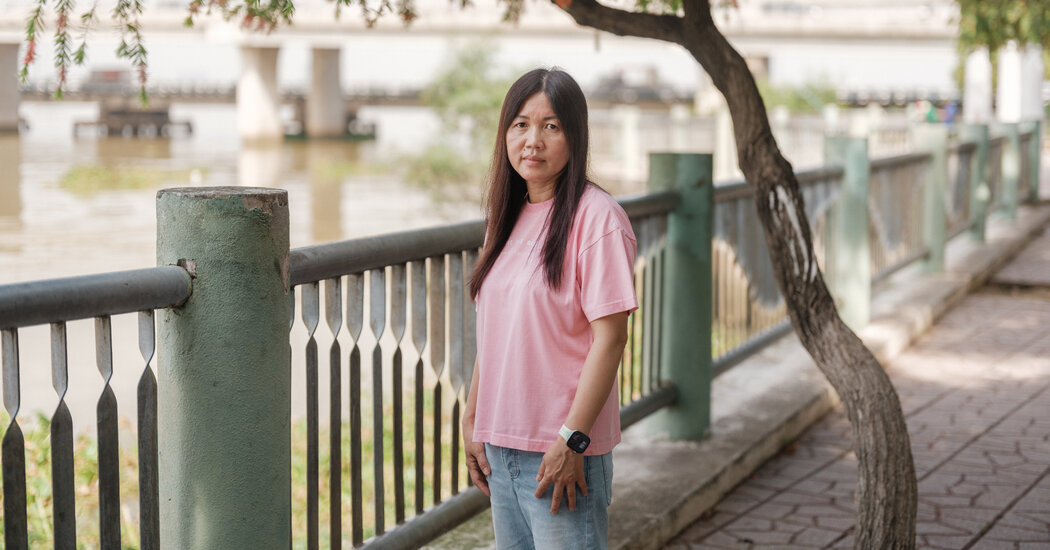
Among them is Mong Tran.
Born in Vietnam, she arrived in the United States in 1993 as an 11-year-old after living in a refugee camp in the Philippines. Her family settled in Fairfax, Va.
But at 18, she upended her life, stealing thousands of dollars from her workplace, a doctor’s office. She ended up serving four months in jail and losing her permanent residency status.
Normally, she would have been quickly sent back to her home country. But Vietnam and Laos had long refused to take refugees back. And the United States did not aggressively press the issue, even for those who had committed serious felonies — partly in recognition of America’s involvement in the Vietnam War and other regional conflicts that had displaced these refugees in the first place.
But the Trump administration, in both its first and second terms, has pressured Vietnam, Laos and other countries into accepting more deportees.
Ms. Tran, 44, was sent back last November. She left behind her husband, four children and a nail salon business. Her record was otherwise clean, said her lawyer, Vicky Dobrin.
Now in a country she barely knows, Ms. Tran, who also goes by the name Melissa, is living with distant relatives outside Ho Chi Minh City.
Her husband and children remain in Hagerstown, Md.
“Although this is the country where I was born,” she said in an interview, “I don’t feel like it’s home.”
The Trump administration’s aggressive deportation push has revived a painful question about America’s historical obligation to these Southeast Asian refugees. Should those who fled here decades ago as children and committed crimes — including nonviolent offenses — be subject to permanent exile?
There are an estimated 15,000 Southeast Asian refugees in the United States with final removal orders.
Like Ms. Tran, many of these deportees fought or had parents who fought alongside U.S. troops, endured years in Communist re-education camps or fled the chaotic aftermath of the fall of Saigon. They came legally as refugees when they were children and have called America home for decades.
But compared to the broader deportee population, these Southeast Asian deportees were much more likely to have a past criminal conviction, the data shows. And the 400 or so Vietnamese deportees who entered before 1995 all had past criminal convictions. Their crimes range in severity, from check fraud to homicide, which are grounds for revoking green cards.
Some lawmakers and immigrant groups point out that most served their sentences and were then left in limbo for years, even decades, because of diplomatic reasons beyond their control. And, they note, some people facing imminent deportation were born in refugee camps elsewhere and have never been to their home countries. Others have faint memories, and English is the only language they speak fluently.
To deport them decades later, advocates argue, is effectively a second punishment.
“We have laws against double jeopardy,” said ThaoMee Xiong, executive director for the Coalition of Asian American Leaders, a nonprofit based in Minnesota.
The Trump administration has argued that expelling criminals is necessary to maintain the rule of law and protect the safety of Americans.
“Every single illegal alien removed on these flights had full due process,” said the Department of Homeland Security, which oversees immigration enforcement, in a statement. The department credited President Trump’s “strong leadership” for convincing the Southeast Asian countries to take back the deportees.
Some supporters of immigration enforcement also say that the United States has already repaid these refugees by resettling them and offering pathways to citizenship.
“These individuals have already been accorded significant grace by the United States,” said Matthew O’Brien, deputy executive director at the Federation for American Immigration Reform, which lobbies for curbing immigration. “Does that mean that the United States is also obligated to turn a blind eye to criminal behavior?”
Between 1975 and the late 1990s, more than 1.3 million refugees from Vietnam, Laos and Cambodia were resettled across the United States, in what was the largest humanitarian resettlement initiative in modern U.S. history.
Once in the United States, adults, with little schooling or savings, often scraped out a living in low-paying jobs. Many resettled with their children in high-crime neighborhoods.
Mark Phommachanh was 5 when he and his mother landed in the United States from Laos around 1980. They eventually settled in Fresno, Calif., which later experienced high crime rates related to crack cocaine.
“I became part of a gang, to protect myself and to kind of find my own family,” he said.
Mr. Phommachanh said that like many refugees at the time, his mother, who worked full time at a doughnut shop, did not realize the advantages of acquiring citizenship. Most thought that permanent residency was all they needed.
In 2003, Mr. Phommachanh was in the process of applying for citizenship when he was arrested on charges of trafficking marijuana. In 2006, after serving more than three years in prison, he was ordered deported. Laos would not take him, and he was allowed to remain on supervised release.
The number of deportations of Southeast Asian refugees remained low over the years, until Mr. Trump’s first term, when deportations increased significantly.
But the Trump administration still faced obstacles.
The Laotian and Vietnamese governments continued to resist pressure to take back large numbers of people with old removal orders like Mr. Phommachanh.
Vietnam in particular had long refused to accept people who first entered the United States before 1995, seeing them as more likely to be loyal to the former South Vietnamese government. On the U.S. side, there was also widespread criticism, including from the U.S. ambassador to Vietnam, who resigned from the State Department in protest.
But in 2020, at the end of the Trump administration, U.S. officials quietly reached a new agreement with Vietnam to allow the deportation of people who first entered the United States before 1995. The agreement laid the groundwork for Mr. Trump’s second-term deportation campaign.
Since last year, the administration has deported more than 400 people in this pre-1995 group to Vietnam. Under the first Trump administration, only 26 people in this group were sent back over four years.
Laos, too, has been accepting deportees in much greater numbers during the second Trump administration.
Mr. Phommachanh was working as a manager at an R.V. company in Virginia last fall when he learned that immigration authorities wanted to see him, even though he had just had his annual check-in.
“I was out shopping for steaks to grill for me and my wife, and I just dropped everything,” Mr. Phommachanh, 51, recalled in an interview.
In November, he was deported to Laos. He considers himself one of the lucky ones. So far, he has been able to live off savings. And his wife, who had never traveled abroad until she recently came to visit, plans to join him. He documents his new life in Vientiane, the capital city, on YouTube.
Other deportees have had a much harder time, said Chanida Phaengdara Potter, director of ROOTS Laos, which helps people resettle in Laos. Separated from their families, some have struggled to find jobs or medical care. Depression is common.
“There’s a lot of uncertainty and isolation,” Ms. Potter said. “America was supposed to be their safe haven.”
Some refugees facing imminent deportation have found ways to stay by applying for state-level pardons or reopening their old criminal cases. But for most, the options are limited.
Ms. Tran is trying to adjust to her new life in Vietnam.
She is studying Vietnamese while working toward her English teaching certification. She plans to learn how to ride a motorbike for local transportation. She talks to her family every day and helps her younger children, ages 11 and 8, with their homework via FaceTime.
But she is up at night. She worries about her husband, Danny, who now has to run the nail salon on his own while solo parenting. She worries about her daughter Rachel, who recently paused her undergraduate studies because of stress from the deportation. And there is Jacob, her son with autism.
“For the last 20 years, I tried to be a better person and teach my children that there are always consequences,” Ms. Tran said. “But being apart from them now, that’s the hardest part for me to accept.”
Kitty Bennett contributed research.
