


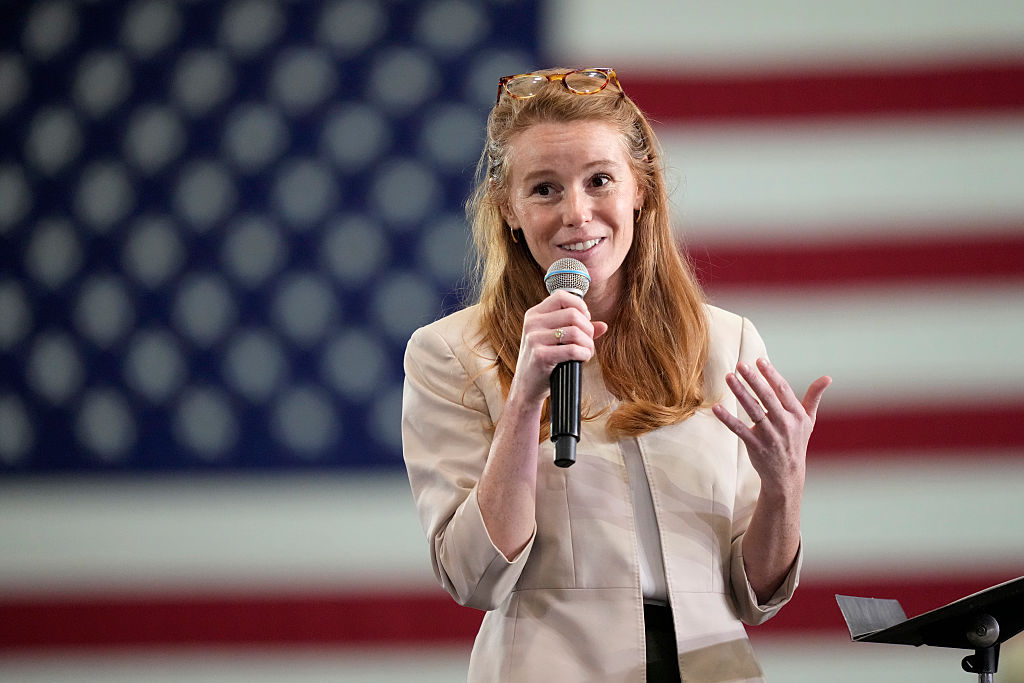
Rebecca Cooke, the Democratic nominee for Wisconsin’s 3rd district, has delayed release of her personal financial disclosure report until after the primary. (Photo by Kayla Wolf/Getty Images)
Few House challengers nationwide have raised more money than Wisconsin Democrat Rebecca Cooke. But voters in the state’s tightest congressional race won’t get a glimpse of her personal finances until after the primary election.
Cooke, running for the 3rd district seat, has raised $8.6 million as of July 22 – an unusually large haul for a House challenger and one that puts her among the top 0.4% of 3,636 House candidates ranked by the Federal Election Commission. Among non-incumbent candidates who aren’t primarily self-funding their campaigns, only one has brought in more.
But while voters have a clear, current picture of Cooke’s campaign finances in the stretch run to next week’s primary election, there isn’t yet a comparable snapshot of her personal finances.
Cooke requested an extension that moves her disclosure deadline to Aug. 13 – two days after the primary. Although she filed the request in April, it became a campaign issue during the weeks leading up to the election, prompting transparency concerns from other candidates and a formal complaint from a Wisconsin resident.
While the disclosure delay has become a talking point for both Democratic rival Emily Berge and Republican incumbent Derrick Van Orden, Cooke’s fundraising advantage is far more relevant to the primary, University of Wisconsin-La Crosse political scientist Anthony Chergosky said. Cooke has outraised Berge nearly 12 to 1 and holds 17 times more cash on hand, according to pre-primary FEC filings.
(function(){function e(){window.addEventListener(`message`,function(e){if(e.data[`datawrapper-height`]!==void 0){var t=document.querySelectorAll(`iframe`);for(var n in e.data[`datawrapper-height`])for(var r=0,i;i=t[r];r++)if(i.contentWindow===e.source){var a=e.data[`datawrapper-height`][n]+`px`;i.style.height=a}}})}e()})();
“The money is already shaping what voters see and hear, whereas the disclosure extension asks voters to react to a procedural controversy without yet knowing what the underlying report contains,” Chergosky told OpenSecrets. “That calculation could change if substantive new information emerges. For now, however, the fundraising advantage is likely more electorally consequential.”
The winner of the Aug. 11 primary will face Van Orden in November in what Chergosky described as “Wisconsin’s only true congressional toss-up.” Democrats view Van Orden as vulnerable and have targeted the race as central to their efforts to regain control of the House. The nonpartisan Cook Political Report also rates the contest a toss-up.
“The stakes surrounding each remaining toss-up seat are enormous,” Chergosky said. “Both parties understand that this district is one of a relatively small number of seats that could plausibly change hands, and they are aware that it could prove crucial in determining which party controls the House. National donors see a district where additional money could conceivably affect the outcome of the election and, by extension, party control of the chamber.”
Forms disclose candidates’ income, assets, liabilities
The controversy over Cooke’s delayed filing centers on what the disclosures are meant to provide – a standardized look at a candidate’s personal finances, business interests and potential conflicts of interest.
Federal candidates and members of Congress are required under the Ethics in Government Act of 1978 to file annual personal financial disclosures overseen by congressional ethics committees. These reports cover a wide range of activities:
- Income sources exceeding $200.
- Assets worth more than $1,000 at the end of the calendar year.
- Transactions valued at more than $1,000 at year’s end.
- Liabilities of more than $10,000, including those held by their spouses and dependent children.
- Positions with non-governmental organizations, excluding religious, social, fraternal or political ones.
- Agreements involving severance, conditions for re-employment, buyout agreements or profit-sharing plans.
- Travel, travel-related reimbursements or gifts, each valued at more than a total of $305 for the year.
Cooke filed a request April 24 for a 90-day extension. Such requests are common – she sought a 30-day extension in August 2023 and a 90-day extension in November 2021 during her previous runs for Congress, but neither of those overlapped with an election date. Van Orden sought them in 2023, 2024 and earlier this year, filing for a 30-day extension on May 12; his most recent disclosure was filed June 12.
Cooke’s request is notable because it extends past the primary and drew criticism from both Van Orden and Berge, as well as a complaint to the House Ethics Committee. Andy Olsen, who owns property in the district but lives in Madison, told the Milwaukee Journal Sentinel he filed the complaint because “the voters are due this information” before the primary, calling the delay “financial hiding.” FEC records show an Andrew Olsen of Madison made $330 in ActBlue contributions earmarked for Berge’s campaign between April 12, 2025, and May 27, 2026.
The impact of Cooke’s delayed disclosure depends largely on how many voters are even aware that it happened.
“Voters have to know about the extension requested and received to be able to use it in their evaluation of her,” said Kathleen Dolan, professor emerita at the University of Wisconsin-Milwaukee. “It isn’t likely that the average voter is paying much attention. At the same time, primary voters are different from general election voters and are likely to be more informed, so the smaller band of voters who turn out in primaries may be evaluating her on this issue.”
According to her most recent disclosure, filed in March 2025, Cooke earned $21,662 in 2024 and $7,085 in early 2025 from her waitressing job; $12,000 in 2024 from a position at the 501(c)(3) nonprofit Red Letter Grant, from which she later resigned; and $2,000 in early 2025 from her role at a commercial lender. She also reported $15,000-$50,000 in rental income in 2024 and $1,001-$2,500 in early 2025 from two rental properties in Dunn County, and she owns land in Buffalo County valued at $15,001-$50,000. In addition, she disclosed receiving more than $5,000 in 2023 for advising small businesses – work she is no longer performing – and she owes $100,001-$250,000 on a 2019 home equity loan tied to a rental property.
Van Orden’s most recent annual report shows relatively modest assets and no earned income reported – not even his standard $174,000 Congressional salary – for the filing period. He lists several small financial accounts and whole‑life insurance policies valued between $1,001 and $100,000, with minimal interest income, along with two liabilities – a $100,001–$250,000 mortgage on his personal residence from 2021 and a $10,000–$15,000 revolving charge account opened in late 2025.
Berge’s May 2026 filing shows a mix of household financial accounts and her spouse’s retirement investments along with assets spread across checking and savings accounts, IRAs, deferred stock awards and multiple 401(k) funds collectively valued from $1,001 up to $250,000. Berge reported earned income from her role as Eau Claire City Council president – $1,616 in early 2026 and $4,849 in 2025 – and from her private counseling practice, which brought in $2,000 in early 2026 and $35,000 in 2025. She lists one liability: a $15,001–$50,000 car loan opened in November 2025. Her disclosure includes no gifts, travel reimbursements, agreements or other compensation over $5,000.
In a statement to OpenSecrets issued through campaign spokespeople Nick Padesky and Michael Horecki, Berge called on Cooke to voluntarily release her updated personal financial disclosure to address transparency concerns.
“Put simply, voters are being asked to make their decision without an updated understanding of Cooke’s income, assets, financial interests or potential conflicts,” Padesky and Horecki said in the statement. “That should give them pause.”
In a statement, Cooke’s campaign did not directly answer questions from OpenSecrets about her personal finances or the disclosure extension. OpenSecrets reached out to Van Orden’s campaign but did not immediately receive a response. In a statement to La Crosse radio station WIZM, Van Orden attacked Cooke, saying she misrepresented her background.
While the timing gives Berge a campaign theme to highlight, it does not outweigh Cooke’s structural advantages – from her fundraising capacity and name recognition to the support she has received from national Democrats, Chergosky said.
“The extension gives Berge a contrast to draw, but because the actual disclosure will not be available before the primary, she is asking voters to react to the timing and the principle of transparency rather than to any concrete revelation,” Chergosky said.
Cooke’s big haul fueled by individual contributions
Neither the extension nor its timing affects Cooke’s fundraising – and her money machine is substantial. She not only leads the district in fundraising, she ranks among national leaders, particularly among House challengers.
Cooke’s haul placed her 17th among all House candidates as of Aug. 3. Of the 16 ahead of her, 11 are incumbents and four others are largely self-funding, having loaned their campaigns at least $10 million apiece. The only non-self-funding House challenger who is outraising Cooke is another Democrat, Eileen Laubacher, who is running against Rep. Lauren Boebert (R) in Colorado’s 4th District. Laubacher raised $10.3 million through June 30.
She is also one of the few House challengers who is outraising an incumbent.
Individual contributions have powered Cooke’s haul, accounting for nearly 85% of her total through July 22. That includes more than $4.6 million in itemized individual contributions, and $2.6 million in unitemized, small-dollar donations. She took in about $500,000 from PACs – primarily those affiliated with organized labor or Democratic Party entities – and $800,000 in joint fundraising committee transfers. The largest of those was a $631,000 transfer on March 31 from the House Victory Project 2026 JFC. Cooke had a $1.8 million war chest, down from $2.5 million through June 30.
Berge enters the primary having raised less than $730,000, almost all from individual contributions. She held about $106,000 in cash on hand on July 22. Van Orden raised $7.5 million – keyed by $4.4 million from individual contributions and nearly $2.1 million in transfers from multiple JFCs, most notably his own and Grow The Majority, which was launched by Speaker Mike Johnson (R-La.). Without a primary opponent, Van Orden preserved his nearly $4.7 million war chest.
Cooke’s higher fundraising total indicates enthusiasm among Democrats about the race along with “some regret that the DCCC didn’t invest enough in that race in 2024,” Dolan said. Van Orden defeated Cooke that year by roughly 12,000 votes. Cooke raised $6.4 million in 2024 to $7.7 million raised by Van Orden.
“Berge’s lower totals suggest that she would have a harder time running a general that can beat any incumbent,” Dolan continued. “But the fundamentals of many of these House races favor Democrats, so this might be a less centrally important thing. And, if she wins the primary, the money will appear.”
(function(){function e(){window.addEventListener(`message`,function(e){if(e.data[`datawrapper-height`]!==void 0){var t=document.querySelectorAll(`iframe`);for(var n in e.data[`datawrapper-height`])for(var r=0,i;i=t[r];r++)if(i.contentWindow===e.source){var a=e.data[`datawrapper-height`][n]+`px`;i.style.height=a}}})}e()})();
And in a reflection of the growing amount of national attention on the race, donations from Wisconsin account for less than a quarter of Cooke’s individual contributions and less than one-sixth of Van Orden’s, according to FEC filings through June 30. In-state donations account for 65% of the individual contributions Berge received.
The contest “is part of that dwindling collection of genuinely competitive seats, so this race naturally attracts attention and money from outside the district,” Chergosky said.
And as the race intensifies, Chergosky said, the most significant effect of Cooke’s fundraising is how voters encounter it – in waves of TV and digital ads, mailers and text messages.
“In that sense, voters will both hear about the money and experience the money,” he said. “The news coverage may tell them that this is an unusually important and nationally competitive race, while the campaign activity financed by the contributions will shape much of what voters actually see and learn about the candidates.”
