


Founder’s Briefs: An occasional series where Mongabay founder Rhett Ayers Butler shares analysis, perspectives and story summaries.
Roads through Brazil’s forests divide primate habitat and sometimes force animals that normally remain in the canopy onto the ground. Researchers in the Amazon are testing rope bridges that allow them to cross above traffic.
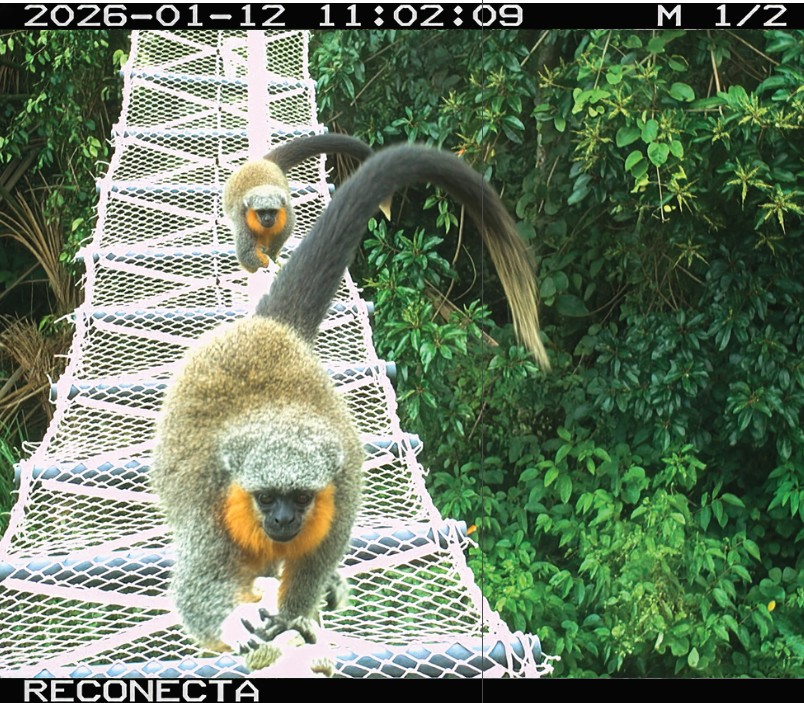
Eight bridges were installed in 2024 in Alta Floresta, in northern Mato Grosso state, reports contributor Suzana Camargo for Mongabay. Camera traps recorded 15,000 crossings by arboreal animals over the next 15 months. No roadkill was reported at the monitored sites. Six primate species used the structures, among them black-faced black spider monkeys (Ateles chamek), Schneider’s marmosets (Mico schneideri), and the critically endangered Alta Floresta titi monkey (Plecturocebus grovesi).
The bridges contain several layers of rope for species with different forms of movement. Some walk across them, while others swing by their arms or use their prehensile tails. Cameras record successful crossings as well as animals that approach and retreat. The footage suggests that some species need time to become accustomed to the structures. Tufted capuchins took seven months to use one of the bridges.
The work follows a project started in 2021 along the BR-174 highway, which passes through the Waimiri-Atroari Indigenous Territory. Members of the Waimiri-Atroari community helped select sites for 32 bridges. Cameras have recorded about 1,250 primate crossings there over the past five years, giving researchers information on which designs work best.
Roads can also separate wildlife populations and reduce gene flow. This is a particular concern for species already confined to small areas. Fewer fruit-eating primates may also mean less seed dispersal in nearby forests.
Researchers estimate that nearly 9 million mammals die on Brazilian roads each year. A bill awaiting a Senate vote would establish a national wildlife road-safety plan covering aerial bridges, underpasses, warning signs, and speed controls. Brazil’s transport infrastructure department has adopted the Reconecta bridge design as its recommended highway standard.
More bridges are planned in Alta Floresta, other parts of Brazil, and Suriname, although their value will depend on regular maintenance and continued monitoring.
Read the full story by Suzana Camargo here.
Banner image: The Alta Floresta titi monkey is the symbol of the Alta Floresta bridges program. Image courtesy of Smithsonian’s National Zoo and Conservation Biology Institute and Projeto Reconecta.
