


Unlock the White House Watch newsletter for free
Your guide to what Trump’s second term means for Washington, business and the world
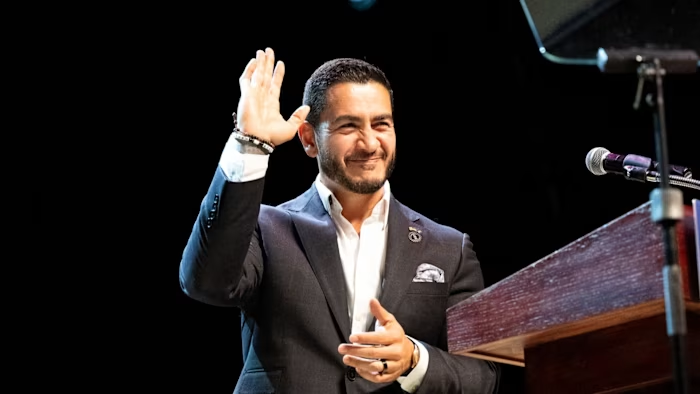
A high-stakes Democratic Senate primary in Michigan was too close to call on Wednesday morning, with fewer than 20,000 votes separating centrist congresswoman Haley Stevens and progressive challenger Abdul El-Sayed.
With 95 per cent of the ballots counted on Wednesday morning, El-Sayed, a 41-year-old former public health official, had 48.6 per cent of the votes. Stevens, a 43-year-old three-term congresswoman, was on 47.4 per cent.
The bitter and expensive primary contest in Michigan has become a proxy battle for a wider fight over the future of the Democratic Party.
The winner will face Republican former congressman Mike Rogers in what is likely to be one of the most competitive and expensive Senate races in November’s midterms.
The Stevens campaign and groups supporting her in the primary race outspent El-Sayed and his affiliated Super Pac by a nearly four-to-one margin.
But opinion polls heading into election day on Tuesday had shown El-Sayed, who had been endorsed by progressives including Vermont senator Bernie Sanders and New York congresswoman Alexandria Ocasio-Cortez, leading Stevens.
Stevens has been backed by a who’s who of the Democratic Party establishment, including the party’s Senate leader Chuck Schumer and Gretchen Whitmer, Michigan’s popular Democratic governor.
Tuesday night turned into a nail-biter as the two candidates earned near-identical vote shares, with El-Sayed’s lead much narrower than polls had predicted.
“We knew this was going to be a close race, and that’s exactly what we’ve got,” Stevens told supporters in the early hours of Wednesday. “But friends, I am feeling good about this race. I am feeling fired up.”
Minutes later, El-Sayed also sounded optimistic as he addressed his supporters with an appeal for party unity after the race is called: “Tomorrow, we begin to mend fences.”
The contentious primary in Michigan has become emblematic of the wider divides in the Democratic Party, which is at war with itself over policy and the party’s message heading into the November midterms and the 2028 presidential election.
The contest has been seen as a major test for the progressive left, which rallied behind El-Sayed, who centred his campaign on a push for universal public healthcare and fierce opposition to US support for Israel.
Stevens’s campaign touted her bipartisan record and argued that, as a moderate, she was in a better position to win over swing voters in the November vote.
Michigan is seen as a must-win for Democrats if they stand any chance of regaining control of the Senate. President Donald Trump defeated Kamala Harris in Michigan two years ago by a razor-thin margin of less than two per cent.
Polling averages compiled by RealClearPolitics in the run-up to Tuesday’s primary projected that Rogers would narrowly beat El-Sayed in a head-to-head match-up, while Stevens would defeat Rogers by nearly two points.
Tuesday’s vote also laid bare sharp divides among party members over Israel, which became a contentious issue in the final weeks of the increasingly acrimonious primary.
The United Democracy Project, a Super Pac backed by the American Israel Public Affairs Committee, spent nearly $31mn supporting Stevens’s candidacy, according to federal campaign finance records — the group’s largest investment in a single race to date.
In the final stretch of the campaign, El-Sayed accused Stevens of being beholden to the pro-Israel lobby group. She responded by saying she was only “beholden to the people of Michigan”.
Additional reporting by Ian Hodgson in Washington
