


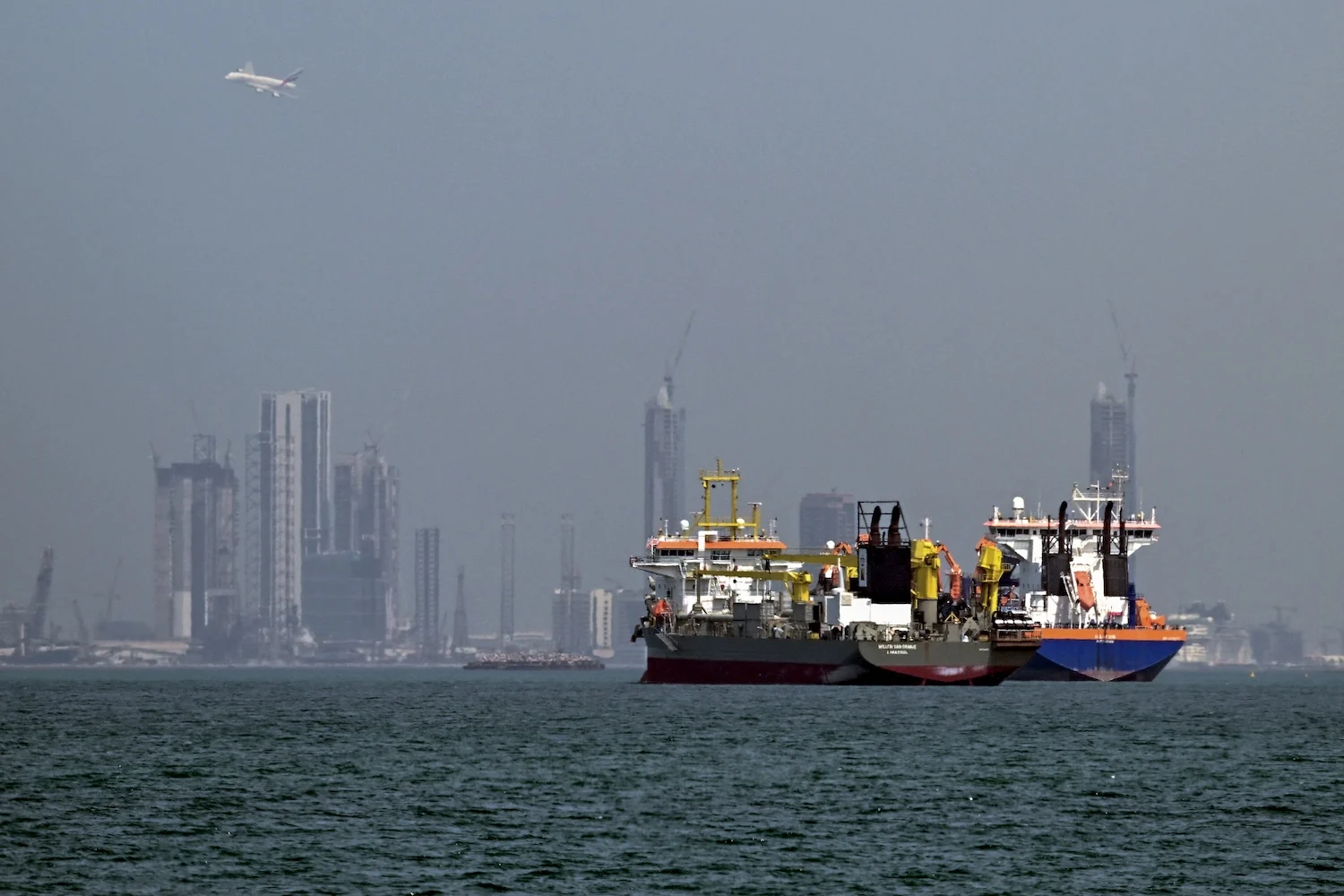
Following months of tension, senior Emirati and Saudi officials recently released what appeared to be coordinated messages affirming the strong ties between the two countries. It is too early to know if this signaling will translate into tangible actions to repair a strained relationship. But even a moderate thawing of Saudi-Emirati tensions could create an opportunity for Gulf states to forge a more effective response to continued threats from Tehran.
The need for coordination is increasingly urgent. The region faces yet another round of escalation between Iran and the United States, plus an evolving crisis with the Houthis in the Bab el-Mandeb that could create a double chokepoint crisis. Even if active fighting subsides, Tehran is unlikely to abandon its strategy of threatening neighbors and leveraging the Strait of Hormuz as the country struggles to reconstitute and rebuild. And there is little reason to think that, whatever course U.S.-Iran negotiations take, Gulf countries’ security concerns will be fully addressed.
Following months of tension, senior Emirati and Saudi officials recently released what appeared to be coordinated messages affirming the strong ties between the two countries. It is too early to know if this signaling will translate into tangible actions to repair a strained relationship. But even a moderate thawing of Saudi-Emirati tensions could create an opportunity for Gulf states to forge a more effective response to continued threats from Tehran.
The need for coordination is increasingly urgent. The region faces yet another round of escalation between Iran and the United States, plus an evolving crisis with the Houthis in the Bab el-Mandeb that could create a double chokepoint crisis. Even if active fighting subsides, Tehran is unlikely to abandon its strategy of threatening neighbors and leveraging the Strait of Hormuz as the country struggles to reconstitute and rebuild. And there is little reason to think that, whatever course U.S.-Iran negotiations take, Gulf countries’ security concerns will be fully addressed.
All this means that the Gulf states cannot rely on Washington or bilateral engagement with Tehran to address their security challenges. Instead, greater coordination between Gulf capitals offers the best path forward. Three elements are essential to make this strategy work.
The first is deterrence. The limits of the U.S. security umbrella have been laid bare. Iran’s drone warfare against Gulf economic targets makes it clear that, even with an impressive missile defense system, deterrence by denial will not be enough. Gulf states now face the difficult challenge of convincing Iran that continued attacks against the Gulf or disruption to Hormuz will result in unacceptable costs. While they should continue to invest in stronger and more integrated air and missile defenses, this means defining red lines that they are willing to collectively defend.
At a minimum, the red lines should include the principle that an attack on any Gulf country will elicit a response from all Gulf countries. This would not necessarily be a military response, but it would involve all Gulf capitals bringing their own unique leverage to bear. In theory, Gulf countries are well placed to mobilize military, economic, and diplomatic consequences for Iran, in cooperation with European and Asian partners. But the greater challenge is their willingness to deploy those tools and their impact on the calculus of a regime that has already borne so much pain, especially militarily.
As Iran seeks to recover from the war, Gulf economic and diplomatic tools are likely to prove more effective than military options. These could include cutting off the significant trade ties that still exist between some Gulf countries and Iran and shutting down the Gulf-based exchange houses, shadow companies, and transshipment routes that have played an important role in Iranian sanctions evasion for years.
Yet a coordinated Gulf deterrent will only work if Saudi Arabia and the United Arab Emirates agree on a plan for communicating and enforcing consistent red lines. If a single state seeks to mobilize a deterrent independent of its neighbors, Iran can simply isolate that country: If all ships can move through Hormuz except the UAE’s, it will be much harder to mobilize any sort of international action. If all Gulf cities are safe except for Dubai, capital, corporate headquarters, and flights will simply shift to Riyadh and Doha. Other Gulf states, particularly Oman, may choose not to participate in a Gulf response against Iran, but they must commit not to undermine Gulf deterrent actions, such as facilitating new avenues for Iranian sanctions evasion.
The second priority is conditional engagement. Conditional economic support to Tehran is an important tool for Gulf states, but it will only be effective if all Gulf capitals uphold consistent conditions on Iran’s behavior. If they do not, this strategy could end up looking more like a protection racket. If one Gulf country is willing to offer greater support to ensure calm, Iran can ramp up its demands of the others.
To mitigate this risk, Gulf countries could agree to only pursue significant conditional economic support once Iran has committed to cease all direct and indirect attacks on the Gulf and forgo attempts to impose tolls or control the passage of ships through the Strait of Hormuz. Some Gulf countries may already be providing some economic relief to Iran, such as unfreezing Iranian assets. There are clear reasons to do so, as Gulf capitals struggle to restore calm after months of Iranian attacks. But using such support to purchase a temporary calm only empowers Tehran. Conditional economic support should instead be used to reward restraint from the regime.
The third priority is freedom of navigation. If Iran is allowed to exercise administrative control over ships passing through Hormuz, it will exploit that leverage to secure a range of concessions from Gulf countries in perpetuity. The fact that Gulf countries, including Oman, coalesced around a unified position opposing Iranian mandatory fees or a single, Iranian-managed shipping lane is a positive step. Gulf states should continue their cooperation on this issue and build broader international support—including from major Asian energy consumers and European partners. As tensions heat up with the Houthis in the Red Sea, similar collective action to protect freedom of navigation there is vital. Indeed, a new status quo in Hormuz will affect the Bab el-Mandeb and vice versa.
Read More
-
Turkey’s Foreign Minister Hakan fidan, Pakistan’s Foreign Minister Ishaq Dar, Egypt’s Foreign Minister Badr Abdel Ati, and Saudi Foreign Minister Faisal bin Farhan pose for a picture ahead of a meeting in Cairo on June 21, 2026. Turkey’s Foreign Minister Hakan fidan, Pakistan’s Foreign Minister Ishaq Dar, Egypt’s Foreign Minister Badr Abdel Ati, and Saudi Foreign Minister Faisal bin Farhan pose for a picture ahead of a meeting in Cairo on June 21, 2026. The Middle East Has a New Saudi-Led Axis
The newfound bloc has emerged as a potential winner from the Iran war.
-

A billboard bearing portraits of Saudi Arabia’s King Salman, his son Crown Prince Mohammed bin Salman, The United Arab Emirates’ President Sheikh Khalifa bin Zayed al-Nahayan, and the Crown Prince of Abu Dhabi Sheikh Mohammed bin Zayed Al Nahyan in Aden, Yemen on This picture taken on November 6, 2019. A billboard bearing portraits of Saudi Arabia’s King Salman, his son Crown Prince Mohammed bin Salman, The United Arab Emirates’ President Sheikh Khalifa bin Zayed al-Nahayan, and the Crown Prince of Abu Dhabi Sheikh Mohammed bin Zayed Al Nahyan in Aden, Yemen on This picture taken on November 6, 2019. Discord in the Gulf
A brief history of how Saudi and Emirati grand strategies diverged.

These three priorities—establishing credible deterrence, conditional engagement, and freedom of navigation—do not require every Gulf state to take an identical approach to Iran. In fact, it is understandable that individual Gulf states will continue to pursue relationships with Tehran reflecting their different geographies, economies, and foreign-policy traditions. What it does require is closer coordination, particularly between Saudi Arabia and the UAE.
To be clear, all Gulf states have an important role to play: Qatar is an economic heavyweight whose mediation gives it important influence across the region and beyond, Oman’s close ties with Iran allow it to serve as a channel for mitigating miscalculation and misunderstanding, and Kuwait and Bahrain are important advocates for a coordinated Gulf approach. But Saudi Arabia and the UAE will remain the key actors because they have the most powerful military, economic, and diplomatic leverage vis-à-vis Iran.
Many differences continue to separate Riyadh and Abu Dhabi, from economic competition to their approaches to Israel. Still, both now find themselves caught between an increasingly erratic, yet essential, U.S. ally on one hand and a battered but emboldened Iran on the other. If these states can turn positive messaging into sustained coordination, they will be better positioned not only to manage Iran but also—potentially—to build the foundations for shaping an emerging security order on their own terms.
