


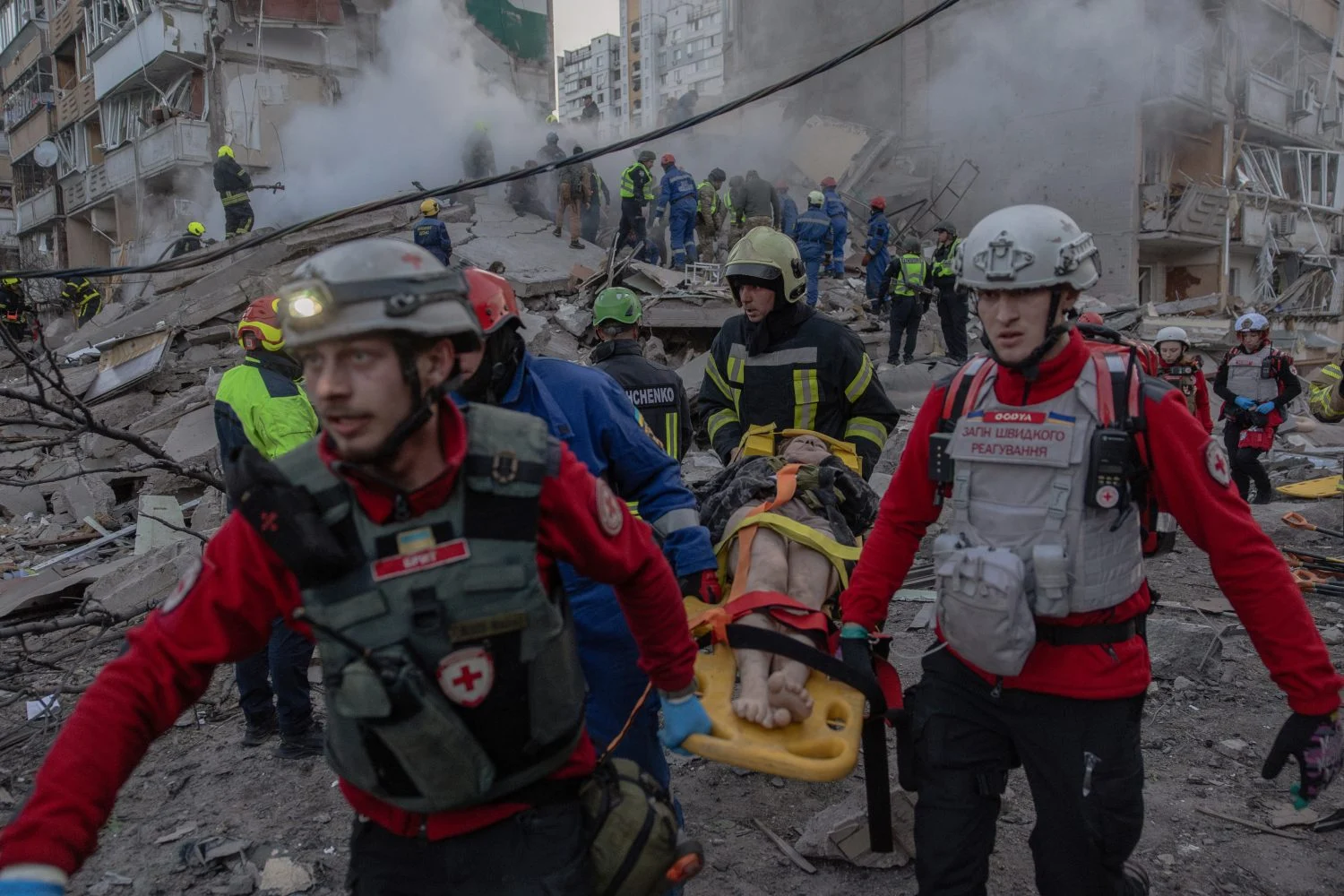
U.S. President Donald Trump has now backed away from his previous hints that he might grant Ukraine a license to build Patriot interceptors. It also seems that Washington has declined Kyiv’s request for 300 such interceptors to bolster air defense. But even if these things were to happen, they would not solve Ukraine’s immediate problem: There are simply not enough interceptors to protect its cities from Russian ballistic missiles.
It would take years to build new production facilities, and the Trump administration now seems to be unwilling to share sensitive interceptor technology, including seekers, solid rocket motors, and guidance software, with the Ukrainians. Nor would licensing resolve the underlying arithmetic. The United States produces a little more than 600 PAC-3 interceptors annually; the goal is to triple that number in the coming years. But Ukraine alone can burn through 150 to 180 in a single month of intensive Russian attacks. For the foreseeable future, Ukraine’s anti-ballistic missile defense will still depend on drawdowns from allied stockpiles and stopgap systems, complemented by ongoing Ukrainian and European projects to build alternatives to the Patriots.
U.S. President Donald Trump has now backed away from his previous hints that he might grant Ukraine a license to build Patriot interceptors. It also seems that Washington has declined Kyiv’s request for 300 such interceptors to bolster air defense. But even if these things were to happen, they would not solve Ukraine’s immediate problem: There are simply not enough interceptors to protect its cities from Russian ballistic missiles.
It would take years to build new production facilities, and the Trump administration now seems to be unwilling to share sensitive interceptor technology, including seekers, solid rocket motors, and guidance software, with the Ukrainians. Nor would licensing resolve the underlying arithmetic. The United States produces a little more than 600 PAC-3 interceptors annually; the goal is to triple that number in the coming years. But Ukraine alone can burn through 150 to 180 in a single month of intensive Russian attacks. For the foreseeable future, Ukraine’s anti-ballistic missile defense will still depend on drawdowns from allied stockpiles and stopgap systems, complemented by ongoing Ukrainian and European projects to build alternatives to the Patriots.
Ukraine’s air defense problem should trigger a serious debate among the United States and its European NATO partners—and force them to rethink how they expect to cope with massed ballistic missile attacks. That does not only involve fast-tracking large-scale interceptor production, as they strangely still have not done in year five of Russia’s war. Since the numbers are unlikely to catch up to the ballistic missile potential of Russia and other potential adversaries any time soon, political leaders also need to decide whether they would be willing to use a second type of defense: attacking the adversary’s ability to fire ballistic missiles at the source.
In tactical parlance, this is known as “shooting the archer,” as opposed to trying to intercept the arrows. This approach requires different sorts of weaponry and comes with escalation concerns, which is why military planners and political leaders need to come to grips with the idea now.
The issue has immediate importance for Ukraine. Are the United States and its European partners willing to covertly support a more proactive, likely more effective, but riskier approach to protecting Ukrainian cities? Shooting the archer would mean destroying missile launchers deep in the Russian rear and, above all, the production facilities for ballistic missiles.
With the help of European and U.S. intelligence, Ukraine has used its own long-range drones and missiles to strike oil refineries and fuel depots as well as supply ships, port infrastructure, defense-industrial plants, and other military and infrastructure targets. For example, Ukraine has used four FP-5 Flamingo missiles to hit the Titan-Barrikady plant in Volgograd, roughly 400 km (about 250 miles) from the Ukrainian border, as well as the VNIIR-Progress plant in Cheboksary, both of which produce components for various Russian missile types. The aim of the campaign is clearly to systematically degrade Russia’s ability to wage war—and in particular, reduce the number of missiles launched against Ukraine.
The other example of a shoot-the-archer approach is recent U.S. and Israeli operations against Iran. Offensive operations against Iranian launchers and command sites disrupted and reduced—even if they did not eliminate—Tehran’s ability to launch follow-on barrages. Suppressing the Iranian missile force at its source likely did more to relieve pressure on Israel’s defenses than the interceptor stockpile, which, according to various media reports, is running dangerously low. Interceptor shortages in Israel and elsewhere act as a real constraint on the United States’ ability to continue a high-intensity war against Iran.
The larger question to be asked by the United States and NATO countries is whether their political leaders is willing to pursue such an approach in the event of war against a nuclear-armed opponent.
Based on conversations that I recently had with German civilian policymakers, this is seen as very risky and escalatory. Yet this is precisely what NATO plans to do in the event of a war with Russia—at least, in theory: In the event of a conventional war against Russia or other potential adversaries, the bloc’s new multi-domain operations doctrine calls for deep strikes against air defenses, key infrastructure nodes, and critical industrial production.
Great-power war in the future will likely be characterized by deep precision strikes. Russia, too, is pursuing a systems warfare approach aimed at degrading NATO’s defense industrial base, rear logistics, and critical infrastructure.
Yet it remains unclear whether U.S. and European political leaders would actually endorse striking targets deep inside nuclear-armed Russia. From what we have seen, Russia would almost certainly attempt nuclear blackmail in the event of war. Beyond this messaging, Moscow could view deep strikes as threatening the integrity of its nuclear weapons arsenal, anti-missile defense, and early warning system.
The question of defense using deep strikes has become more timely with Germany’s intention to procure Tomahawk long-range cruise missiles from the United States. These weapons would have little deterrent value if Russia were convinced that Berlin, fearing escalation like the German policymakers whom I talked to, would never use them. Indeed, Russia would likely exploit and amplify this fear by entangling nuclear and conventional military capabilities, similar to China’s approach of mixing nuclear and nonnuclear weapons and related systems so that any strike carries the risk of hitting something nuclear.
The Western record when it comes to soberly assessing escalatory risks and the impact of deep strikes into Russia is not encouraging. Fear of nuclear escalation has repeatedly delayed the supply of various weapons to Kyiv, from HIMARS to ATACMS, as well as their use for strikes inside Russia—even at clear military targets just across the border. Most delays were eventually overcome, and Moscow’s red lines proved to be more elastic than advertised—an important data point for the escalation debate.
But to this day, Germany refuses to transfer Taurus cruise missiles to Ukraine, and U.S.-based SpaceX does not allow Ukraine to use the company’s Starlink satellites over Russian territory. (Ukrainian President Volodymyr Zelensky has reportedly asked Trump to help change that policy.) What’s more, drawn-out public debates about each type of weapon have guaranteed that Russia has been in part forewarned, reducing the weapons’ impact when they finally arrived in Ukraine.
To think that this hesitancy would simply evaporate in the event of a direct military confrontation with Russia, when the stakes and escalation risks are incomparably higher, is both naive and wishful thinking. In my conversations with NATO military officials and political leaders in various European capitals, there is indeed a gap between what military commanders assume they would be permitted to do—based on NATO concepts and doctrine—and what political leaders in each capital would authorize.
Consequently, it is past time to have a more realistic debate on what Europe would be willing to do—and risk—in a war with Russia. Ukraine’s urgent need for a more active air defense approach could be an opportunity for NATO policymakers and military planners to gain more clarity on where political leaders stand in navigating nuclear escalation in wartime.
Western political leaders need to understand what a campaign against targets inside Russia would entail, what it would demand of them, and what it would mean for deterrence and the potential for escalation. A NATO that credibly signals that it will not only attempt to defend against incoming missiles but also shoot the archer would strengthen deterrence, preventing war in the first place.
Conversely, political leaders who visibly hesitate invite Moscow to believe that saturation attacks on European cities could be sustained with impunity. Kyiv’s nightly barrages already show what that looks like.
