


President Donald Trump continues to pursue an aggressive deportation campaign that has brought federal officials into U.S. cities and towns, apparently to detain as many undocumented and documented individuals as possible. Many of those apprehended are subsequently held in detention and removed from the country.
For many Americans, the constant stream of controversy, drama, and scandal makes it difficult to grasp how far-reaching the administration’s actions have been. Under the direction of Stephen Miller, Trump has launched one of the most aggressive deportation campaigns in recent history. In contrast to President Barack Obama, who also undertook a major deportation effort (critics called him the “deporter-in-chief”), there is no longer any ambition or effort to secure a path to citizenship in exchange for the hardline stance.
President Donald Trump continues to pursue an aggressive deportation campaign that has brought federal officials into U.S. cities and towns, apparently to detain as many undocumented and documented individuals as possible. Many of those apprehended are subsequently held in detention and removed from the country.
For many Americans, the constant stream of controversy, drama, and scandal makes it difficult to grasp how far-reaching the administration’s actions have been. Under the direction of Stephen Miller, Trump has launched one of the most aggressive deportation campaigns in recent history. In contrast to President Barack Obama, who also undertook a major deportation effort (critics called him the “deporter-in-chief”), there is no longer any ambition or effort to secure a path to citizenship in exchange for the hardline stance.
One of the most dramatic pieces of evidence as to how much political attitudes about immigration have changed centers on Cuban immigrants in the United States, who long supported hardline anti-communist policies and often vote Republican in cities such as Miami. In 1966, Congress passed the Cuban Adjustment Act that provided special protections for persons who fled from Fidel Castro’s regime.
But 60 years later, Cubans who once benefited from special immigration protections for decades are now as vulnerable to removal as other noncitizens. Before the start of summer, the United States had already deported over 4,300 Cubans to Mexico. As the Trump administration accelerates its threatening rhetoric about Cuba, with some observers anticipating possible military action after a brutal economic blockade, there is little evidence that refugees who have made it to the United States can rest any easier.
These policies mark a dramatic reversal from the way many Americans thought about immigrants, refugees, and persons in exile during the 1960s. At that time, public policy focused on opening the nation’s doors and drawing on the country’s immigrant heritage to strengthen the United States in the struggle against its most dangerous adversaries. Rather than emphasizing exclusion and deportation, welcoming newcomers was a central pillar of U.S. policy in an earlier era.
In January 1959, U.S.-Cuban relations were transformed when Castro toppled the regime of Fulgencio Batista. Castro quickly consolidated power, establishing a socialist regime that developed close ties with the Soviet Union. Cuba lay just 90 miles from Florida, and U.S. policymakers were deeply alarmed by the prospect of a communist government so close to the United States. On Jan. 3, 1961, the United States severed diplomatic relations with the island nation.
At first, U.S. policymakers sought to confront Castro through military force. In April 1961, the CIA backed the failed Bay of Pigs invasion, which ended in disaster and dealt a huge blow to the new John F. Kennedy administration. Eighteen months later, Kennedy regained his footing during the Cuban missile crisis, when U.S. surveillance revealed that the Soviet Union had stationed nuclear missiles in Cuba capable of striking much of the United States. The crisis ended without a shot being fired, though the two superpowers came perilously close to nuclear war. In the aftermath, the United States continued to refuse to recognize Castro’s government and remained committed to isolating his government.
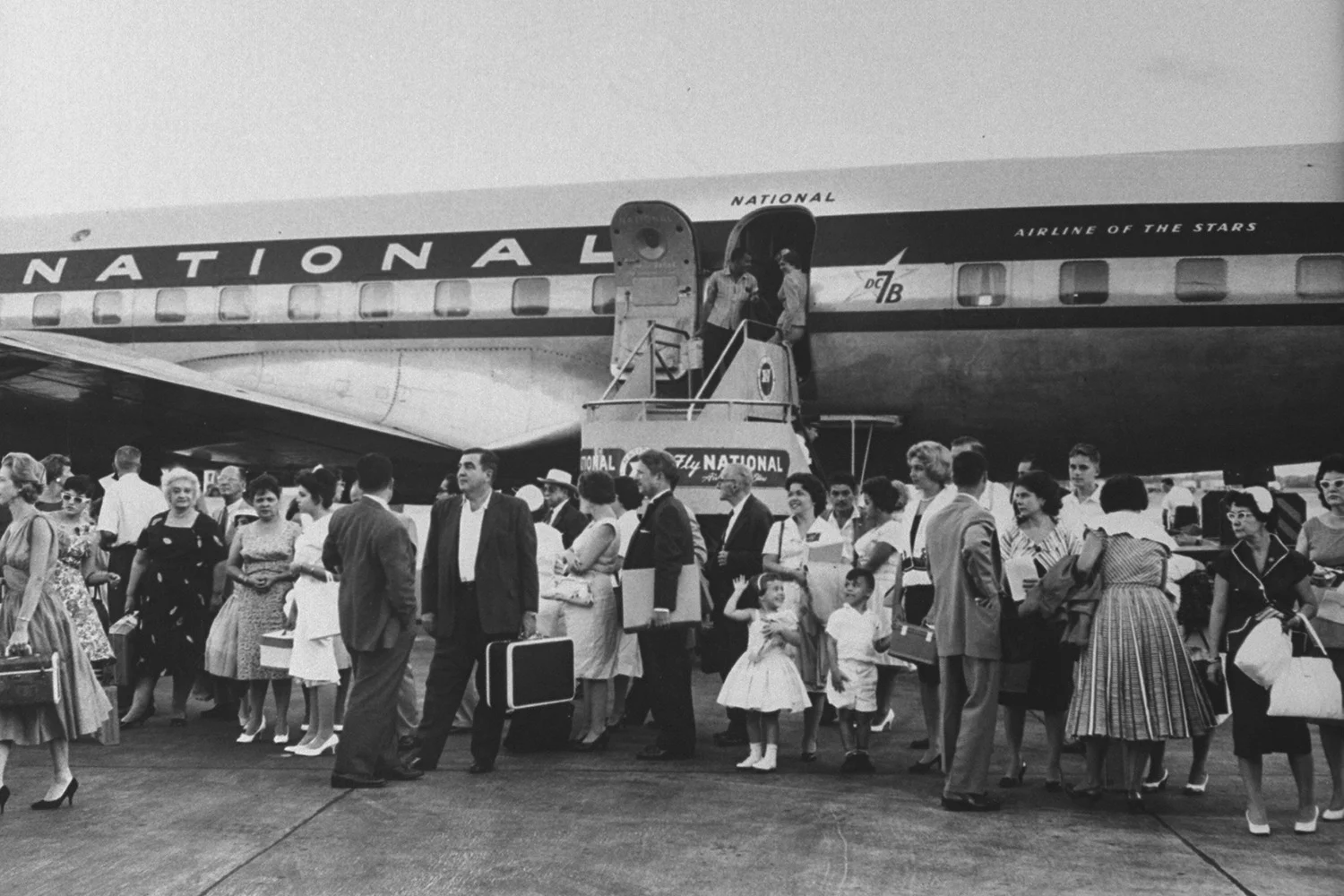
But over time, reality set in. President Lyndon B. Johnson shifted much of his attention away from overthrowing Castro—although that objective remained a priority for the CIA—toward assisting Cuban refugees who managed to reach the United States. Since the revolution, thousands of Cubans had fled the island; property owners, professionals, and businesspeople were among the first to leave. By 1962, there were programs to aid the nearly 250,000 Cubans who had already arrived in the United States, most of whom settled in the Miami area.
The influx of Cuban refugees was a challenge, however. After a sharp slowdown following the Cuban missile crisis, migration surged again between 1965 and 1966 when Castro permitted more Cuban nationals to leave. Under existing immigration law (the Immigration and Nationality Act of 1952), all immigrants seeking permanent residency were generally required to leave the United States and apply for a visa through a U.S consulate in another country.
With Johnson’s support, Congress decided to act. The Cold War provided a powerful national security rationale, building on a tradition that stretched back to the Displaced Persons Act of 1948 and other measures that opened the nation’s doors to refugees in the aftermath of World War II. Rep. Jacob Gilbert, a Democrat from New York, sponsored legislation to grant Cuban refugees a path to permanent status. The bill received crucial backing from Rep. Emanuel Celler of New York, the influential liberal chairman of the House Judiciary Committee and a leading architect of immigration reform.
Under Secretary of State George Ball testified in support of the measure, urging Congress to approve the legislation. He defended its humanitarian purpose while also emphasizing its value in the broader struggle against communism. When Rep. Frank Chelf of Kentucky asked whether the bill served the nation’s interests, Ball responded: “We would be extending to [the Cubans] the privilege of living in a free society. This is consistent with the principles that we have followed in our dealing with nations around the world, to encourage freedom, to encourage resistance to totalitarianism.”
Throughout the deliberations, committee members were careful to emphasize that consideration of the legislation did not recognize the legitimacy of Castro’s regime. Supporters ultimately overcame criticism from conservatives who argued that too many Cubans were already admitted into the United States and from liberals who worried about U.S. workers losing jobs; as support for assisting immigration and helping refugees fleeing communist countries was a strong impulse in the body politic. Sen. Ted Kennedy of Massachusetts helped shepherd the legislation through the Senate. The measure passed with broad bipartisan support, and Johnson signed it into law on Nov. 2, 1966.
Upon signing the legislation, Johnson declared, “Our beautiful America was built by a nation of strangers. From a hundred different places or more they have poured forth into an empty land, joining and blending in one mighty and irresistible tide.”
The legislation became an important gateway for Cubans seeking to come to the United States, many of whom settled in the Miami area. For decades, Cuban migrants enjoyed a distinct legal status and a clearer path to permanent residency than most other immigrant groups. Until the mid-1990s, U.S. policy generally afforded Cubans special protections, making it easier for many who reached U.S. shores to remain in the country. Republicans often performed well among Cuban American voters because of their hardline opposition to the Castro regime, even after the Cold War ended. Some experts believe that President Bill Clinton’s decision to return Elián González, a 6-year-old Cuban boy who had been found at sea in 1999, to Cuba cost Vice President Al Gore crucial Cuban American votes in Florida, which determined the 2000 presidential election.
Over time, the legislation from 1966 came under increasing criticism. After the Cold War, some argued that the special treatment afforded to Cuban migrants had become anachronistic, while others—including then-Sen. Marco Rubio, himself the child of Cuban immigrants—pointed to ways in which the policy was being abused. As the Cuban government periodically allowed large numbers of people to leave for the United States, many of whom differed from the professional and affluent emigres who had arrived in the early years after the revolution, the perception that they were so-called model immigrants weakened and criticism of the program intensified.
A key turning point had come in 1980, when Castro permitted almost 125,000 Cubans to leave during the Mariel boatlift. Among them were individuals with criminal records and others deemed undesirable by the Cuban government, developments that altered public perceptions of Cuban immigrants in parts of the electorate. In 1995, Clinton introduced tightened controls on Cuban immigration, even as he reaffirmed the legitimacy of some pathways into the country, with the “wet foot, dry foot” policy under which Cuban migrants intercepted at sea were generally returned to Cuba, while those who reached U.S. soil were allowed to remain and could later apply for permanent residency.
President Barack Obama continued to scale back aspects of the special treatment long afforded to Cubans, and Trump has gone much further, expanding deportation efforts while pursuing a more restrictive immigration agenda. His administration has also subjected Cuban migrants to expedited removal procedures.
The 1960s were a different era in terms of how mainstream politicians thought about immigration. Although nativism remained a powerful force and an enduring part of the U.S. political tradition, there was also a strong belief during Johnson’s presidency that the arrival of newcomers benefited the nation. Immigrants were seen as part of what made the United States great. There were humanitarian reasons to open the door to those fleeing persecution and oppression, and, as many conservatives recognized, there were national advantages as well. In the context of the Cold War, welcoming refugees offered a powerful demonstration of the freedoms and opportunities that the United States claimed to embody.
The current state of politics could hardly be more different. The virtues of immigration and the value of providing protections to those fleeing oppressive regimes have largely been lost from the national conversation. Instead, political debate has focused on tighter borders, aggressive deportation policies, and the costs that new immigrants may impose on the country. The pendulum has swung so far in this direction that even many pragmatic Democrats are politically wary of discussing immigration in terms other than enforcement and toughness.
