


For decades, the promise of development finance in Africa rested on a simple bargain: that capital from wealthy countries, channeled through aid budgets, multilateral banks, and private investors would unlock the continent’s economic potential. The formula shifted, but the underlying assumption held that external finance would lead, and Africa would follow.
That promise is now unraveling. Western aid budgets are shrinking, the United States has gutted its development finance ambitions, and European banks are retreating from the continent. China, too, is changing course, as private companies assume the role once filled by ambitious state lenders, shifting the model from state debt to corporate ownership. Africa is increasingly receiving capital on terms it did not set, in sectors it did not choose, through instruments it cannot control.
For decades, the promise of development finance in Africa rested on a simple bargain: that capital from wealthy countries, channeled through aid budgets, multilateral banks, and private investors would unlock the continent’s economic potential. The formula shifted, but the underlying assumption held that external finance would lead, and Africa would follow.
That promise is now unraveling. Western aid budgets are shrinking, the United States has gutted its development finance ambitions, and European banks are retreating from the continent. China, too, is changing course, as private companies assume the role once filled by ambitious state lenders, shifting the model from state debt to corporate ownership. Africa is increasingly receiving capital on terms it did not set, in sectors it did not choose, through instruments it cannot control.
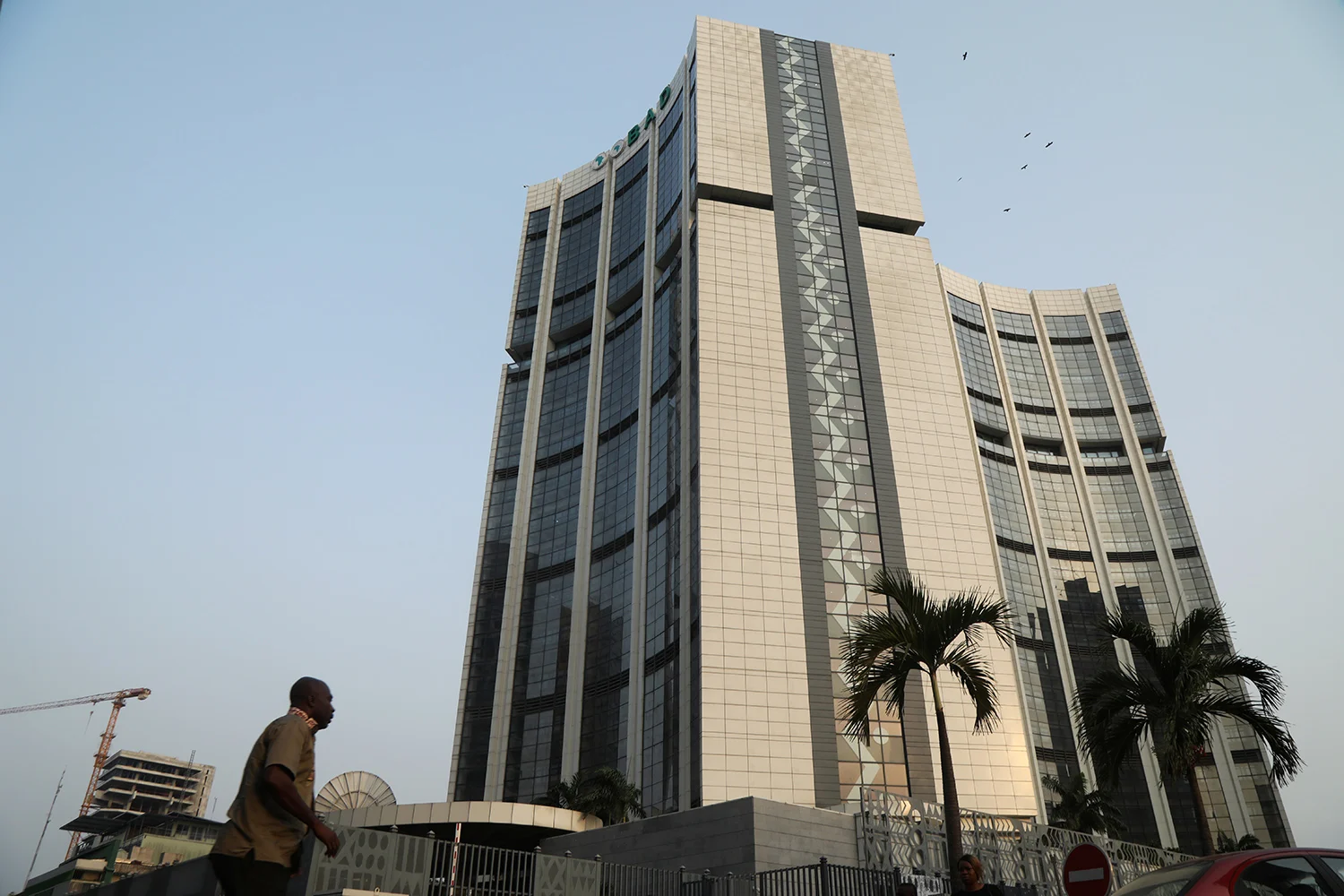
This leaves the African Development Bank (AfDB) at a crossroads. The bank was designed to be the continent’s financial architect—mobilizing capital, derisking investment, and building the institutions that markets alone would not. In practice, it has instead operated largely as a project lender to sovereign borrowers. That model functioned tolerably when external aid and lending filled the gaps around it, but now those gaps have become chasms. The AfDB’s balance sheet is too small to substitute for the capital that is leaving, and its traditional sovereign-lending model was never built to mobilize private finance at scale. The bank can now continue business as usual, or it can reinvent itself.
The path forward for the AfDB is a wholesale approach: anchoring syndicated deals that pull commercial lenders into transactions they would not otherwise touch, channeling credit through African financial institutions, and making its capital conditional on reforms intended to break the sovereign-bank nexus. Done right, this would provide the institutional architecture for a continent to fund its own transformation on its own terms.
Development finance has long swung from one big idea to the next. The so-called big push era, which dominated from the 1950s through the 1970s, put infrastructure first, responding to the challenge of newly independent nations with little physical capital and vast unmet needs. The institutions era, which came amid the debt crises and structural adjustment programs of the 1980s and 1990s, put property rights and governance first—a reaction to the failures of state-led development and the conviction that markets should allocate resources.
Finally, the evidence-based era, which took hold in the 2000s and accelerated through the rise of randomized control trials and impact investing, put measurement first, a byproduct of donor fatigue and a demand for proof that aid actually worked.
Each idea had its merits, but each proved incomplete. Infrastructure without functioning institutions produced white elephants. Property-rights reforms without political legitimacy generated backlash and instability. Rigorous impact measurement privileged small interventions over the large, complex investments that structural transformation requires.
These partial approaches prevented Western finance from fully delivering on its promises to Africa. Development assistance covered humanitarian needs and social spending but fell short when it came to infrastructure. Private capital flowed to extractive industries—oil, gas, minerals—where returns were predictable, but steered clear of roads, ports, power grids, and factories. Multilateral banks filled some gaps but were constrained by capital limits, lengthy approval processes, and conditionality that borrowing governments increasingly resisted.
By the early 2000s, the continent was growing faster than at any point in its post-independence history but without the long-term capital its transformation demanded. With Western finance failing to show up, China became the default alternative, offering the speed and scale that Western finance never had without the lectures. Between 2000 and 2024, Chinese lenders provided an estimated $180.9 billion to African governments, which Beijing leveraged into political relationships, U.N. voting blocs, and commercial footholds.
Today, however, that model is retrenching. Debt distress in Angola, Ethiopia, Ghana, and Zambia has driven a sharp pullback in new Chinese sovereign lending, which after peaking above $28 billion in 2016 fell to just $2.1 billion in 2024. But in the first half of 2026, Chinese Belt and Road investments on the continent surged 254 percent from the previous year to a historic $33.5 billion. Many of these investments now take the form of private equity in strategic energy, metals, and manufacturing. The instrument has changed—from state loans to corporate ownership—but the logic has not, and investment continues to flow to sectors prioritized in Beijing, not in Accra or Kinshasa. What began as a geopolitical breakthrough has left a legacy of debt obligations and foreign control over strategic assets, without a financing model that serves Africa’s own development priorities.
Facing this landscape, Africa needs a new big idea that moves beyond this binary: private-sector-led transformation financed through Africa’s own institutions. The central challenge, however, is how to achieve this vision in an era of debt distress, heightened uncertainty, and retreating foreign direct investment.
Across much of Africa, banks dominate the financial system, with few alternatives for households seeking credit, entrepreneurs seeking growth capital, or governments seeking to develop the long-term bond markets that could fund infrastructure without external borrowing. Too often, banks have shifted away from lending to private borrowers and toward financing public fiscal deficits through government bonds, which have high yields and are seen as less risky than issuing credit to individuals in weak economies. This may be a rational choice for banks, but it is ruinous for economic development.
When private lending occurs, it often goes to politically connected incumbents and import-trading monopolies rather than to the small- and medium-sized enterprises (SMEs) that create most new jobs. Surveys find that access to finance is the most commonly cited obstacle for SMEs in sub-Saharan Africa, with only 10 percent of those surveyed financed by bank lending. Most SMEs turn instead to informal lenders, family networks, or their own retained earnings, paying effective interest rates that can reach 60 percent where formal credit is available at all.
For many African entrepreneurs, the cost of capital exceeds the return on productive investment, which itself explains why job creation has lagged so far behind demographic growth.
Established banks are insulated from meaningful competition by regulatory barriers, licensing restrictions, and privileged access to government business and thus face little pressure to innovate or lower costs. This has slowed the rise of fintech firms capable of delivering cheaper credit and better financial services to the communities that banks have historically found unprofitable to serve.
Where fintech has broken through, as with M-Pesa in Kenya or Wave in Senegal, the results have been transformative. But these remain exceptions in a landscape where regulatory incumbency protects the status quo.
Breaking this status quo requires a change in incentives to make lending to the private sector more attractive than parking capital in government bonds, to reward banks for building credit relationships with small businesses, and to open the market to competitors. It also requires a credible partner capable of reducing risk during the transition.
As large European banks have scaled back or sold their African franchises, the AfDB is the only remaining institution that can attract cross-border capital at scale. But rather than trying to finance every project itself, the AfDB should leverage its money, convening power, and preferred creditor status to bring in private lenders alongside its own financing.
The way to do this is through syndicated loans—large loans provided jointly by multiple lenders and, specifically, the A/B loan structure that was pioneered by the International Finance Corporation to solve the problem of persuading commercial lenders to extend credit in risky markets. For such loans, the AfDB would commit part of the financing itself—the “A” portion—and then invite commercial banks to provide the rest—the “B” portion.
Because the AfDB’s charter enshrines it as a preferred creditor, it is repaid ahead of commercial lenders and enjoys a strong record even in distressed environments. In an A/B loan, commercial lenders can shelter under the umbrella of that preferred creditor status, as well as the AfDB’s tax exemption and its capacity to weather transfer and convertibility risk—making these lenders more willing to participate than they would be on their own. The result is that every billion dollars the bank commits can unlock several billion more in financing.
Just as important, the AfDB should lend through African financial institutions, not around them. Local banks know their markets best, and the AfDB can provide them with credit lines and risk-sharing facilities, requiring that the money be lent to productive sectors and SMEs. Guarantee schemes—in which the AfDB agrees to absorb a defined share of losses if a loan or investment goes bad, reducing the risk that private lenders or investors bear—can similarly unlock the vast pool of savings currently sitting idle in government bonds.
But money alone will not revitalize Africa’s banking system. The AfDB should condition its syndications and credit lines on a reform agenda, securing concrete commitments from borrowing member states to: reduce the regulatory incentives that make government bonds more attractive than private loans; strengthen insolvency and collateral regimes so that lenders can recover assets when borrowers default; close the credit-information gaps that make it impossible to assess the creditworthiness of borrowers without a formal history; and dismantle the barriers and preferences that protect banks from competition.
To lead this effort, the AfDB must also put its own house in order, ensuring that its own balance sheet remains strong enough to retain its preferred creditor status, pricing risk properly, and dealing decisively with arrears and nonperforming exposures.
Better economic data would also make a real difference. Today, investors attach high risk premiums to Africa simply because reliable information is scarce. This uncertainty inflates the cost of capital for the whole continent, as investors demand higher returns to compensate for what they cannot measure. Filling those chronic statistical gaps with a continental data hub would make investing in Africa less risky and less expensive.
Ultimately, the AfDB was created to be more than a lender—it was created to be the continent’s financial architect. With every U.S. aid cut, every European bank that sells its African franchise, and every Chinese megaproject that fails to materialize, the case for Africa financing its own transformation grows more urgent. This time, the continent should seize the opportunity for its own institutions rather than those in Washington, Brussels, or Beijing.
