


The 250th anniversary of U.S. independence has revived a debate on what it means to be American. This has spotlighted at least two competing stories on American identity: One hinges on a conventional understanding of national identity as a state-centered project characterized by jurisdictional boundaries and physical separation between peoples; a competing story, based on shared experiences, cultures, and diasporas, claims that “American” is a term that cuts across national differences and refers to the entire Western Hemisphere.
Both accounts of American culture and identity have been taken up recently in public discourse. U.S. President Donald Trump’s administration has made the go-it-alone, state-centered narrative a central dimension of its historical nostalgia. As the White House states, the goal of its 250th anniversary programming is to “inspire a renewed love for American history.” In response, popular discourse has embraced a hemispheric conception of American culture that celebrates diasporic traditions while critiquing the imperial tendencies of the United States. This framing was famously deployed by Bad Bunny during the Super Bowl LX halftime show, but it has also been used to think about language, history, and artistic production.
The 250th anniversary of U.S. independence has revived a debate on what it means to be American. This has spotlighted at least two competing stories on American identity: One hinges on a conventional understanding of national identity as a state-centered project characterized by jurisdictional boundaries and physical separation between peoples; a competing story, based on shared experiences, cultures, and diasporas, claims that “American” is a term that cuts across national differences and refers to the entire Western Hemisphere.
This article is adapted from A New World of Revolutions: Popular Imaginations and Movements Across the Americas by Arturo Chang (Princeton University Press, 256 pp., $39.95, June 2026).
Both accounts of American culture and identity have been taken up recently in public discourse. U.S. President Donald Trump’s administration has made the go-it-alone, state-centered narrative a central dimension of its historical nostalgia. As the White House states, the goal of its 250th anniversary programming is to “inspire a renewed love for American history.” In response, popular discourse has embraced a hemispheric conception of American culture that celebrates diasporic traditions while critiquing the imperial tendencies of the United States. This framing was famously deployed by Bad Bunny during the Super Bowl LX halftime show, but it has also been used to think about language, history, and artistic production.
Recent scholarship on the so-called age of revolutions—the period from around 1775 to 1840 characterized by popular uprisings against colonial rule—has supported this latter definition, as it has uncovered shared concerns, bonds, and political innovations throughout the Western Hemisphere. In my new book, A New World of Revolutions, I argue for this approach as well, situating the U.S. revolutionary tradition among the publics, identities, and cultures that spanned from the Northern Arctic to Patagonia. These histories reinforce the notion that American identities and ideas far exceed the institutional and physical boundaries of the nation-state.
Despite evidence of these hemispheric bonds, Trump likes to return to this period to justify U.S. intervention across the world. Celebratory programming around the 250th anniversary explicitly connected his America First approach to the Monroe Doctrine, a 19th-century foreign-policy principle that Trump’s White House interprets as a declaration that Washington should lead the hemisphere and guard it “against communism, fascism, and foreign infringement.”
Yet, while the Trump administration clearly admires the Monroe Doctrine, it does not appear to understand the hemispheric politics, histories, and identities that undergird its argument or its era more broadly.

An undated cartoon depicting American expansionism with Uncle Sam straddling the Americas while wielding a big stick inscribed with the words “Monroe Doctrine 1824-1905.”Louis Dalrymple, National Museum of American Diplomacy
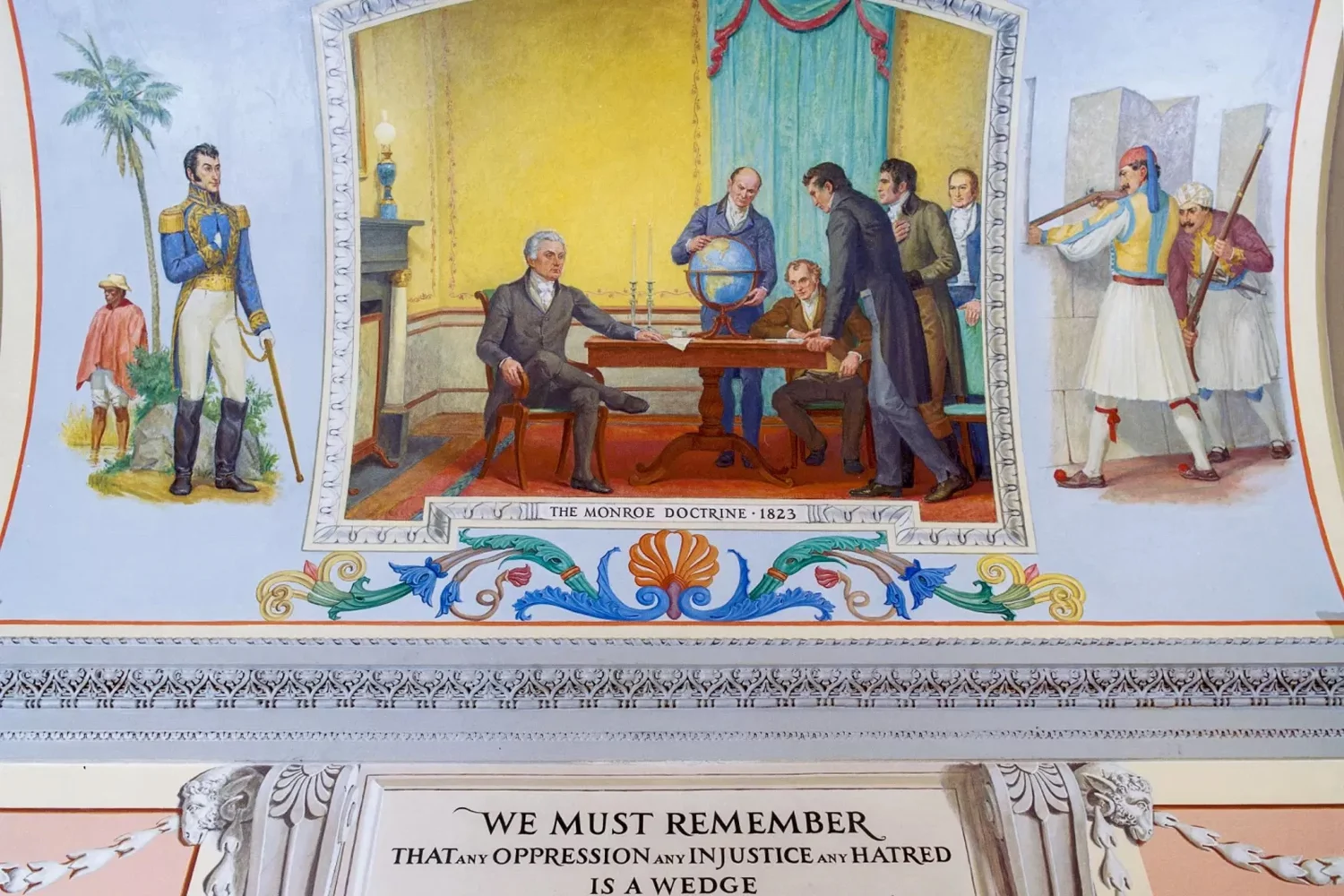
What is now referred to as the Monroe Doctrine is the set of principles laid out in President James Monroe’s seventh annual message to Congress on Dec. 2, 1823. In his address, Monroe set out a plan for the defense of Americans and the Americas, one that proved much more hemispheric than nationalist. As he stated in his opening remarks,
In the discussions to which this interest has given rise and in the arrangements by which they may terminate the occasion has been judged proper for asserting, as a principle in which the rights and interests of the United States are involved, that the American continents, by the free and independent condition which they have assumed and maintain, are henceforth not to be considered as subjects for future colonization by any European powers.
In other words, Monroe’s speech opened with a rejection of European colonial power in the region while also recognizing the sovereignty—the “independent condition”—of the incipient American states that had emerged from recent revolutions.
The remainder of Monroe’s speech is similarly committed to hemispheric bonds, identities, and politics. He went on to address the shared political investments and destinies of American “brethren,” and his account of colonial emancipation emphasized the necessary interdependence of American states. As such, his doctrine signaled a need to establish a practice of mutual defense. As he concluded, European intervention anywhere in the continent would lead to “endangering our peace and happiness.” Far from a claim of national superiority, Monroe’s remarks centered solidarity and shared trajectories as the American anti-colonial tradition began to take hold during the second decade of the 19th century.
Read More
-

A bronze monument featuring a group of heroic figures holding large, draped flags. The central figures wear historical military uniforms, with one holding a flag aloft while others look forward with determined expressions. A stone obelisk rises behind them against a partly cloudy sky. A bronze monument featuring a group of heroic figures holding large, draped flags. The central figures wear historical military uniforms, with one holding a flag aloft while others look forward with determined expressions. A stone obelisk rises behind them against a partly cloudy sky. The Other American Anniversary
The 1826 Congress of Panama sought to resist the predations of great powers. It was as relevant then as it is now.

-

1912 painting by Clyde O. DeLand titled “Birth of the Monroe Doctrine.” From left to right: John Quincy Adams, William Harris Crawford, William Wirt, President James Monroe, John Caldwell Calhoun, Daniel D. Tompkins, and John McLean. 1912 painting by Clyde O. DeLand titled “Birth of the Monroe Doctrine.” From left to right: John Quincy Adams, William Harris Crawford, William Wirt, President James Monroe, John Caldwell Calhoun, Daniel D. Tompkins, and John McLean. Trump’s New Corollary
The president’s invocation of the Monroe Doctrine is rhetorically satisfying but carries real risks.
Monroe’s call for hemispheric solidarity was not out of the ordinary for the politics of the period. The age of revolutions was marked by the rise of hemispheric discourses and identities, with both everyday people and prominent political leaders arguing that the political innovations of the “new world” would be led by American minds. For example, Mexico’s 1814 constitution called for universal citizenship for all Americans born in the hemisphere. Works of cultural production, including foundational plays such as Peru’s The Patriots of Lima on the Happy Night (1821), celebrated the emancipation of all Americans, not only of their national citizenries.
These ideas influenced the development of states and their institutions. As Joshua Simon shows, for example, it was precisely shared political and ideological investments that led to conceptions of American nation-building that envisioned expansive republican states. Before the age of revolutions, European thinkers such as Montesquieu and Jean-Jacques Rousseau argued that only small republics were sustainable. American thinkers such as Alexander Hamilton, José María Morelos, and Simón Bolívar leaned on the exceptional conditions of the Americas to argue that large, diverse republics were not only possible, but potentially more resilient. These ambitious visions looked to hemispheric solidarity as a defense against colonial reconquest—an argument that reverberates strongly throughout Monroe’s 1823 address.
This kind of solidarity was not just found among political elites. As Caitlin Fitz shows, there was popular investment in the success of the “sister” revolutions of the Americas, such as the independence movements in Mexico and Gran Colombia. For U.S. citizens, successes in Latin America added to the mounting evidence that colonial European powers would ultimately fail to maintain authority in the region. Revolutionaries from Philadelphia to Buenos Aires were speaking, writing, and thinking about the shared fate of American nations, and that level of ideological and political convergence is difficult to toss up to coincidence.
The aftermath of Monroe’s speech also demonstrates that some other American leaders were interested in pursuing the idea of shared bonds with the United States. Consider the Panama Congress of 1826, which sought to bring together regional states with the goal of establishing a cohesive political and economic front against foreign intervention. As the assembly was being organized, debate arose about whether to include the United States. The vice president of the Republic of Gran Colombia, Francisco de Paula Santander, decided to invite U.S. representatives, partly on the basis of the principles outlined in Monroe’s speech. These efforts were supported by leaders in Mexico and Central America. Bolívar, however, opposed their inclusion due to skepticism that the United States could be a reliable ally. (A U.S. delegation did not end up attending due in part to a domestic political debate regarding participation.)
In many ways, the legacies of the Latin American reception of the Monroe Doctrine in the 19th century remain clearly relevant today, as leaders continue to question the reliability of U.S. ties under the Trump administration.
If hemispheric identities were so salient during the first decades of the 19th century, why has that rhetoric since been lost? Like much of the hemispheric history of the Americas, Monroe’s call for solidarity across American nations has been overwritten by nationalist interpretations of the past. These frame the Monroe Doctrine as an announcement of the U.S. turn to imperial expansion, with specific claim to the Western Hemisphere.
As Tom Long and Carsten-Andreas Schultz recently wrote in Foreign Policy, the imperialist reading of the doctrine has recurred throughout U.S. history. This is evident in politicians’ corollaries to the doctrine, which seek to justify foreign conflict, intervention, or expansion.

U.S. President Theodore Roosevelt speaks in Panama in November 1906.Library of Congress
In 1904, President Theodore Roosevelt used the doctrine to justify U.S. intervention in Central American, Caribbean, and South American countries (an interpretation now known as the Roosevelt Corollary). These revisionist accounts would return during the Cold War. President John F. Kennedy referenced the doctrine amid the Cuban missile crisis to justify hemispheric security frameworks established under the Rio Pact and the Organization of American States. President Ronald Reagan expanded on these interpretations to justify intervention in Nicaragua and El Salvador, with claims of Soviet influence in the region. Each iteration throughout U.S. history has moved further and further away from the original address’s principles and vision.
Trump, of course, now turns to the doctrine as evidence for a longstanding tradition of U.S.-first politics. As the statement announcing his own corollary to the doctrine last December reads, “Monroe declared before the Nation a simple truth that has echoed throughout the ages: The United States will never waver in defense of our homeland, our interests, or the well-being of citizens.” The use of “homeland” quickly expands into a claim of U.S. leadership over the hemisphere that largely ignores the bonds between American states. The statement goes on to argue that “the American people—not foreign nations nor globalist institutions—will always control their own destiny in our hemisphere.”
In recent years, Trump, alongside members of the Republican establishment, has leveraged the doctrine’s legacies to argue against Chinese investment in Latin America and justify intervention in countries such as Iran and Venezuela. In short, one of the most famously cited speeches in U.S. history has been broadly misread to argue that a history of interventionist policies justifies the present direction of the country.
Washington’s leaders and U.S. Americans would do well to understand the Monroe Doctrine’s hemispheric foundations. These demonstrate that some of the most transformative ideas in U.S. foreign policy have come from regional cooperation that recognized the bonds and shared political investments of American states. There is yet time to revive a Monroe Doctrine that remains true to the politics of solidarity that first motivated people across the Americas to organize against dominating powers.
