


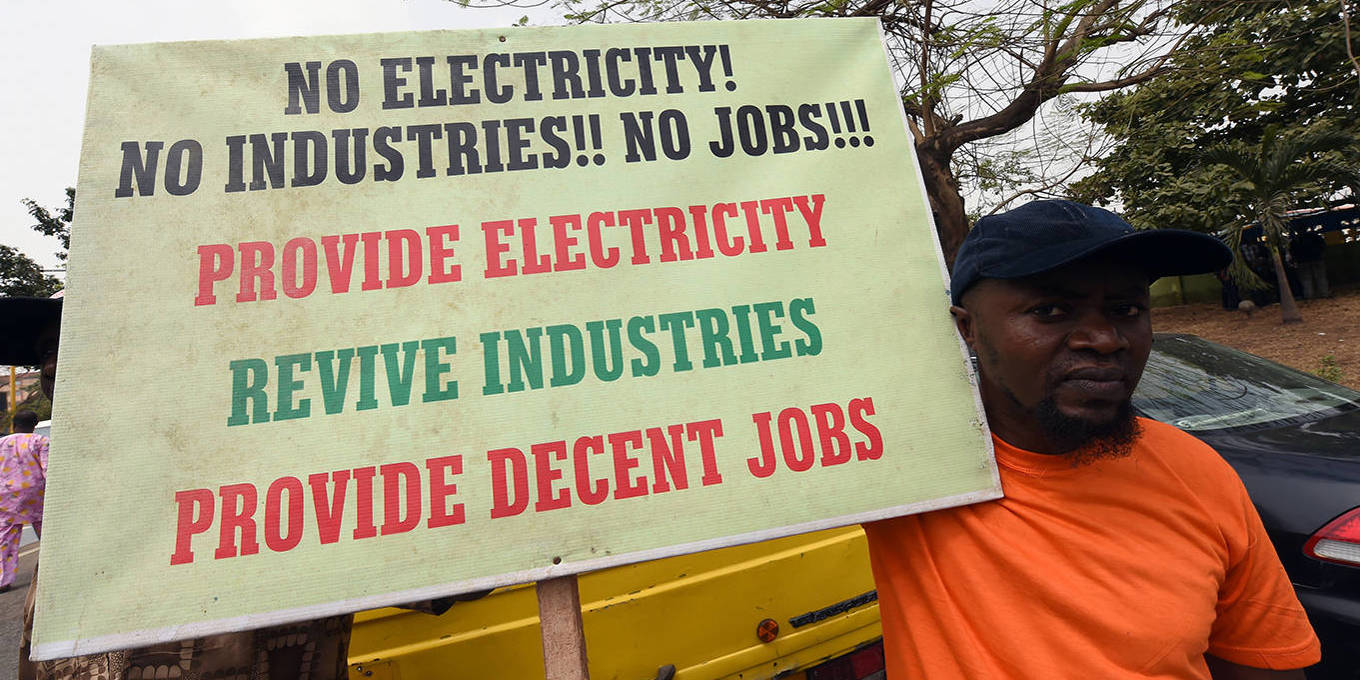
It is no secret why African countries with large fossil-fuel reserves nonetheless have failed to reduce extreme poverty or provide reliable electricity to all households. Those in power have made a conscious choice to privilege hard-currency export revenues, some of which then finance elite consumption rather than public investment.
LIBREVILLE/LOS ANGELES—Africa is facing one of the world’s great energy windfalls. The continent holds roughly 125 billion barrels of confirmed oil reserves and more than 620 trillion cubic feet of natural gas, implying vast additional deposits still waiting to be discovered. At the same time, some 600 million Africans have no electricity at home, and this figure has not fallen since the COVID-19 pandemic. On current trends, it will still exceed a half-billion in 2030.
The problem is not geological, but political. Every barrel of oil shipped from an African port to a European or Chinese terminal is a barrel not converted into kilowatts for an African household. Every long-term liquefied natural gas (LNG) contract signed with a foreign utility commits gas that could be powering an African hospital, school, or factory. The choice between exporting hydrocarbons and using them to electrify the continent is highly consequential yet almost never debated openly. That needs to change.
The case for energy exports is clear enough. The continent depends heavily on imported food, medicines, capital equipment, and manufactured goods that it does not yet produce at scale. For many producer countries, oil and gas exports are the only reliable source of foreign exchange, without which they cannot pay for those imports, service sovereign debt, or maintain enough fiscal space to function.
But the case for domestic use is equally compelling. Nigeria holds enough natural gas to achieve 100% electrification within its borders, and gas-to-power projects across the continent have long demonstrated technical viability. The International Energy Agency estimates that achieving universal electricity access in Africa would require annual investments of $15 billion for ten years, and though only $2.5 billion is currently being committed each year, domestically deployed hydrocarbons could help bridge the gap.
In theory, these two options are economically equivalent. A government could export oil, invest the proceeds well, and use the returns to finance power infrastructure. A barrel exported at world prices and a barrel converted into electricity should produce the same national wealth if governance is sound and pricing is free.
In reality, neither condition has been met. One major distortion is corruption. Rather than being invested in electrification, hydrocarbon revenues in most African producer states are regularly captured. Nigeria has generated more than $600 billion in oil revenues since the 1960s while also recording one of the world’s highest rates of extreme poverty. During oil-boom years, Equatorial Guinea has achieved the continent’s highest per capita GDP even as over half of its population lives below the poverty line.
All told, research tracking offshore bank accounts has found that around 15% of windfall gains flowing to petroleum-producing countries with weak institutional safeguards ends up in the pockets of those in power. This easy money then becomes easy spending—but on elite luxury consumption, not public investment.
Domestic energy subsidies are a second distortion. In many African producer states, consumers pay far less for fuel and electricity than the actual cost. Angola has the world’s fourth-cheapest retail gasoline. Nigeria’s domestic gas prices have historically been held so low that building a gas-fired power plant is commercially pointless.
These subsidies are not accidents. They are core instruments of the petrostate political economy: a diffuse benefit handed to populations who otherwise see little of the wealth nominally being extracted on their behalf. But subsidies also send a false signal to investors and governments, making energy exports appear economically superior to domestic use, even when the welfare arithmetic says otherwise.
Recent geopolitical shocks are a third factor. Russia’s full-scale invasion of Ukraine severed some 80 billion cubic meters of annual gas supplies to Europe, and this year’s Middle East war tightened LNG markets further. Suddenly, European governments were in Algiers, Dakar, and Maputo pleading for more supply. Algeria became the European Union’s second-largest pipeline gas supplier in 2023, providing 20% of pipeline imports, behind Norway at 54% and ahead of Russia at 17%. Angola has directed LNG cargoes westward. And a new project off Mauritania and Senegal shipped its first cargo to Atlantic markets in 2025.
For African producers, the windfall has come in the form of both revenues and political cover. Governments now have internationally legitimized reasons to deepen their export orientation. Committing gas to Europe for 20 years can be framed as an act of solidarity and diplomacy, rather than as a choice made at the expense of domestic electrification.
There is a bitter irony here. Not only did European governments spend more than $640 billion shielding their citizens from the price consequences of the Ukraine crisis, but part of that expenditure boosted revenues for African producer governments, where funds flow upward to elites rather than outward to households without power.
A reckoning is coming, though. Africa’s total population will reach 2.5 billion by 2050, and domestic energy demand is rising fast enough that Africa is projected to shift from a net energy exporter to a net importer by the early 2030s. It is not politically sustainable to have a young, urban, electricity-dependent population confronting persistent blackouts in countries that are visibly resource-rich. Moreover, the global energy transition is narrowing the window through which oil and gas can be exported at high prices to willing international buyers.
Something will have to give. The question is whether it happens through deliberate reform—institutions that constrain rent-capture, energy prices that reflect domestic opportunity costs, and revenues channeled toward electrification—or through the kind of mismanagement and instability that has historically plagued the continent’s natural-resource sector.
Africans are not being asked whether they would prefer the foreign currency or the electricity, nor are they being told what choices are being made in their name, by whom, and for whose benefit. This silence is a political choice, and ending it is where any serious reform must begin.
