


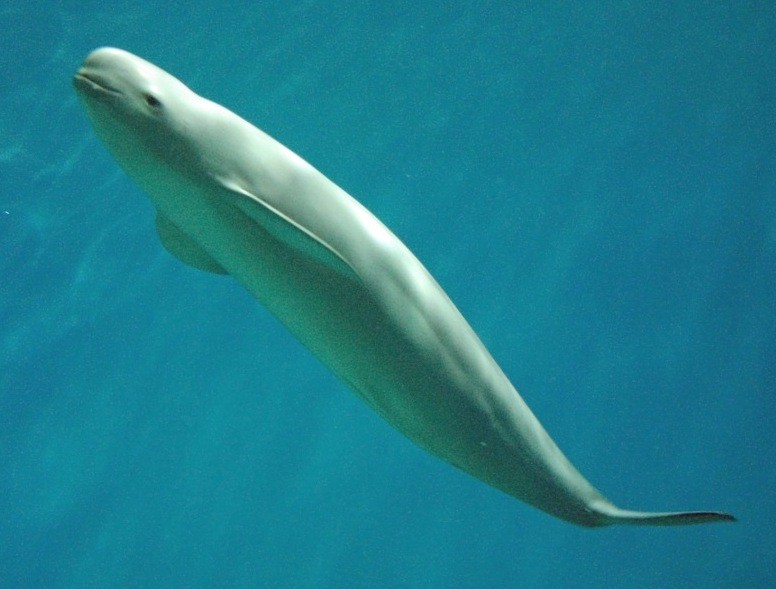
The Indo-Pacific finless porpoise is one of India’s smallest cetaceans, inhabits turbid coastal waters, and lacks a dorsal fin — all of which make it a difficult species for researchers to spot.
Recent research suggests these animals are far more prevalent in Indian waters than visual sightings suggest, yet they may be disappearing before they can be accurately counted, reports contributor Mansab Sayyad for Mongabay India.
A fully grown Indo-Pacific finless porpoise (Neophocaena phocaenoides) measures 1.5-1.9 meters (4.9-6.2 feet) in length and weighs about 30-45 kilograms (77-88 pounds). It’s highly inconspicuous: it has a blunt, rounded head, no dorsal fin, and occupies shallow, muddy waters, surfacing only briefly.
But the finless porpoise can be “heard”. It navigates turbid waters by echolocation, emitting high-frequency pulses that are unique to the species and far above the range of human hearing — but detectable by specialized sound-recording devices.
In 2025, a study counted finless porpoises using both visual and acoustic surveys off the Sindhudurg coast, north of Goa state. The acoustic surveys detected finless porpoises four times more often than visual surveys.
Lead author Isha Bopardikar, from the Indian Institutes of Science Education and Research (IISER) Tirupati and Cornell University’s K. Lisa Yang Center for Conservation Bioacoustics, said relying on visual estimates in Indian waters is a significant drawback due to limited visibility and the animal’s brief surfacing. This means that population assessments that only use conventional visual sightings from boats may be capturing only part of the picture.
Understanding the population trends of the finless porpoise in India is essential since the shallow coastal zones these porpoises inhabit are increasingly becoming a hazardous zone of boat traffic. The porpoises frequently get entangled in fishing nets as bycatch and suffocate. In Goa alone, an estimated 26 porpoises die annually along a 100-kilometer (62-mile) stretch of coastline.
Their biology makes entanglement particularly lethal. Unlike dolphins, whose conical teeth sometimes allow them to tear through nets, porpoises have spade-shaped teeth that snag easily. “Dolphins can sometimes tear out of nets, but porpoises cannot,” said marine mammal researcher Dipani Sutaria. “They get stressed easily and fishers say they cry like human children when entangled.”
The high-frequency clicks that finless porpoises use for communication are inaudible to the Indian Ocean humpback dolphin (Sousa plumbea) and orcas (Orcinus orca), which is a great defense mechanism against these larger cetaceans, Sutaria said. However, the porpoise’s private acoustic world is being shattered by industrial noise, commercial engines, and high-speed vessel traffic, which impairs their ability to distinguish between food and danger.
The 2025 study concluded that acoustics is a more efficient tool for tracking this species in this region. According to Sutaria, shifting toward acoustic monitoring can help generate the long-term population data needed for conservation.
Read the full story by Mansab Sayyad here.
Banner image: An Indo-Pacific finless porpoise at Shimonoseki Marine Science Museum, Japan. Image by Cipher01 via Wikimedia Commons (CC BY-SA 3.0).
